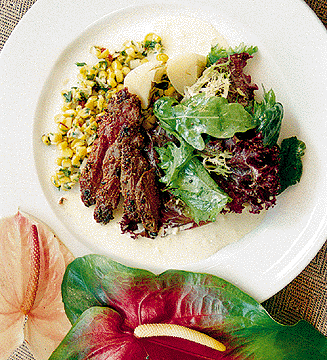
The curious and those just plain craving ostrich meat
will pay the price for the exotic dish. A sampler menu at Alan Wong's
Restaurant costs $45. Above, togarashi seared ostrich salad.
Star-Bulletin photo composite
The curious and those just plain craving ostrich meat
will pay the price for the exotic dish. A sampler menu at Alan Wong's
Restaurant costs $45. Above, togarashi seared ostrich salad.
Star-Bulletin photo composite

Feasting on it may cost you an arm and a leg, but you won't need a year's membership at Gold's Gym to work it off.
It is ostrich meat and its popularity is soaring on the mainland.
But the cows and swine in Hawaii won't be getting any reprieve from this flightless feathered friend anytime soon.
That's because it may be some time before people feel comfortable sticking their necks out for an ostrich burger. Few eateries and virtually no supermarkets here are showcasing the largest bird known to man, at least not yet.
You still can sample a three course ostrich-done-a-variety-of-ways meal at the trendy Alan Wong's restaurant. The tab: $45.
"When we do it as an entree, it sells like hot cakes," said sous chef Barbara Stange Wong. "A lot of people are curious ... We'll experiment with it and make a combo and make it enjoyable for our guests. When we do it, we do 10 or 12 portions for one evening and when she's out, she's out."
"It's the same thing as eating an alligator, right?," said Wendell Koga, executive director of Hawaii Farm Bureau Federation. "How much of a market will it be? It's going to be a real small market. But you never know. I'd imagine if there's demand that it'd be brought in."
Ostrich meat is expensive, for many prohibitive. In recent months, prices on the mainland have tumbled: About $6 a pound for ground meat and $10 for a fillet.
Opinions vary on how the bird, racing its way to the top of mainland restaurant menus and supermarket shelves, would fare in the islands.
"It'd take a distributor to bring it in (to Hawaii) or it'll take a retailer to instigate the action," said Richard Botti, president of the Hawaii Food Industry Association. "I wouldn't predict it would take off."
Botti has had a taste.
"Just knowing it's ostrich affected me," he said. "It was bloody, red meat. It was a mental block."
People like Leon Piatkowski and Richard Field hope to change that.
Piatkowski, a mainland transplant on Maui, dreams of becoming the first ostrich rancher in the state. Field, owner of R. Field Wine Company, has been selling ostrich meat as a special order to customers for about a year.
Piatkowski has attended ostrich conventions and already has spent $20,000 on fencing and other ranch necessities. He's been nursing the idea of an ostrich farm for years and was granted permission to build a facility on Maui by the Department of Agriculture last year.
Piatkowski will be issued a permit to import birds after an inspection of the completed facility.
"This is like my baby and my future," he said. "Can you imagine, the first one in Hawaii?"
When we do [ostrich meat]
Barbara Stange Wong,
as an entree, it sells like hotcakes ...
A lot of people are curious.
Sous chef
"I think (Hawaii) is an awesome market," Piatkowski contends. In hotel lined Honolulu, "The demand for the meat will be really nice."
Field also believes ostrich meat has a future in Hawaii.
"It's going to be a process of education and impressions made by the mainstream press," Field said. "We've seen so many products follow the same path. I think it'll be four or five years when it's not going to be seen as such an exotic food anymore."
From the signals coming from California, it may be a lot sooner than that.
"It's going gangbusters," said Laura Frends , sales manager for Escondido, Calif.-based Brandywine Meats, the largest supplier of ostrich meat on the West Coast. "The industry is just booming ... We hope to get prices down. I definitely think that it's here to stay."
Demand for the company's product for retail sales has catapulted nearly 500 percent in three months, from about two thousand pounds to 10,000 pounds a month, she said. In Southern California, from trendy restaurants to smaller burger joints, ostrich is quickly becoming the hottest ticket in town. Supermarkets have contacted Brandywine after customers got a sampling and demanded more of the chunky red meat that doesn't shrivel upon cooking.
"As a healthy alternative, there's no comparison," Frends said.
U.S. Department of Agriculture evaluations show a 3-ounce portion of ostrich meat weighing in at about 97 calories, compared with 135 for turkey, 140 for chicken and 240 for beef.
But beef lover's needn't worry. In the meat market, cows rule.
A nice, juicy steak still remains the number one choice of meat eaters in the state and the nation. People in Hawaii prefer beef over any other meat two to one, said state agriculture statistician Donald Martin. Beef claims 55 percent of the meat market, poultry 25 percent and pork 20 percent, he said.
Can Martin imagine a category for ostrich meat?
"It's really hard to say. Seems like people here are willing to try new things," he said. "Our diversified agriculture sector wouldn't mind. I don't know if everyone would like it. The beef industry might not appreciate it."
Industry officials say ostrich meat has benefited from the fears associated with Mad Cow Disease in England.
What: Ostrich tasting
When: 2:30-3:30 p.m. Saturday, Sept. 7
Where: R. Field Wine Company, 1200 Ala Moana Blvd. (Ward Centre)
Cost: Free