
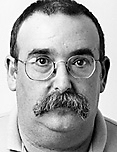
Then the other day Star-Bulletin contributing editor Bud Smyser was talking about aging and death.
"When I turned 40," he said, "I suddenly realized there were more years in my past than my future. It's unlikely you're going to live another 40 years. I didn't find it frightening. I actually found it liberating."
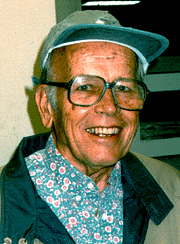 A.A. "Bud" Smyser
Bud is no Dr. Kevorkian, but death is a comfortable subject for him. He's written and spoken extensively about assisted suicide and the right of the terminally ill to die with dignity.
At one time I was put off by this. When I once saw a poster announcing he was giving a speech on suicide called something like, "Welcoming the Great Beyond," my first thought was, "Gee, Bud, I hope it wasn't something I said."
But I came to greatly respect his thoughts on death when I understood how he sees a dignified death as the natural end to a rich life. He simply sees no point in unnaturally prolonging a life that has lost its quality.
You also have to respect Bud on the subject of living. He turned 75 this year and celebrated his 50th year with the Star-Bulletin. He's well on his way to beating his fortyish speculation about how much longer he had left to live.
The most impressive thing about Bud is how his inner compass has kept him on course over the years.
He has been steadfast in his core values and his vision for a better Hawaii. He writes about his beliefs with as much clarity and passion as ever.
Lately, Bud has taken to wearing a baseball cap that makes him look like George Burns when he played God. It gives him an even more all-knowing aura.
So when Bud was talking about aging and death, I was a little embarrassed that he had so conscientiously calculated his remaining life expectancy at 40, and I had yet to do the same at 48.
I asked someone I've known for a long time what she thought of Bud's theory about the bulk of your life being behind you by time you hit your 40s.
"Do the arithmetic, genius," she said.
I asked her, "When I was a wise guy in high school, my teachers used to tell me I'd change my tune when I got older and had to deal with punks like myself. I don't think I've changed that much. Have I stuck to my principles?"
"Well," she said, "Your values have stayed the same, but you're less idealistic about them. You're still committed to working for peace and harmony among all the world's people, for instance, but you don't still think it's as easy as everybody holding hands and singing, 'All we are saying is give peace a chance.'"
MY new grandson Corwin helps me to put some of these things in perspective.
People at work say he looks like me. He's a chubby little guy and the Filipino side of his heritage has yet to show itself. I guess all fat haoles look alike to some people. I think Corwin looks like his father, Dan, who doesn't look anything like me.
But it's flattering when people say he looks like me. Holding him in my arms and looking at a 15-pound, 2-month-old image of myself, I get excited about how his life is all ahead of him. I'm not jealous that most of mine may be behind me. It seems right somehow. Liberating even.