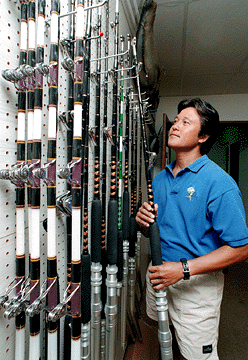
"Japanese don't mind paying the money
for a quality product. Made in America helps,
so does made in Hawaii."
Joe Kimura
Owner of Kimura of Hawaii,
manufacturer of custom-made fishing rods
Photo by Dean Sensui, Star-Bulletin
"Japanese don't mind paying the money
for a quality product. Made in America helps,
so does made in Hawaii."
Joe Kimura
Owner of Kimura of Hawaii,
manufacturer of custom-made fishing rods
Photo by Dean Sensui, Star-Bulletin
A "Kimura of Hawaii - USA" label tags all his products.
"We covered both angles," said Kimura, owner of Kimura of Hawaii, which started as a hobby in his home eight years ago before he opened his Queen Street business in 1990.
Kimura ships rods to Guam, where Japanese retailers snap them up to resell in Japan at a high markup.
"Japanese don't mind paying the money for a quality product," said Kimura, who's looking for his own Japanese distributor. "Made in America helps, so does made in Hawaii."
Yet business advisers and owners say that many Hawaii companies, who know well the power of the Japanese pocketbook here in the isles, may be missing lucrative opportunities to cash in on that aloha connection in Japan.
Cost, production limitations, and a hard-to-crack distribution network have intimidated some local companies from expanding into Japan. But booming catalog sales, electronic marketing, trade shows and government assistance are providing businesses cheaper and easier access to 125 million consumers - about half the population of the United States - who have lots of disposable income and a craving for American products.
Add to that the love Hawaii holds for millions of Japanese tourists - an attraction that goes far beyond the macadamia nuts and Hawaiian candies sold in Japan for years - and the potential for profits multiply.
Most Hawaiian exports are processed foods, but business specialists say vitamins and health products, sporting goods, music and casual clothing also have "Made in Hawaii" potential.
"It's a good image to sell in Japan as well as in Hawaii," said Tokyo-based George Kanazawa, hired last October by the Department of Business, Economic Development & Tourism (DBEDT) to promote the state in Japan. "There's real potential for Hawaiian goods and services."
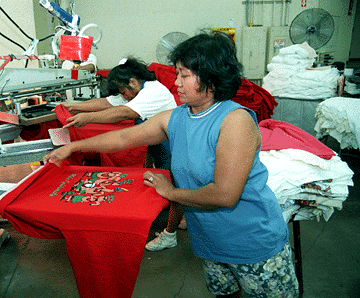
Virgie Mateo, front, and Magdalena Duldoloa operate screen printers at Crazy Shirts' Halawa plant.
Photo by Craig T. Kojima, Star-Bulletin
But he said he believes some Hawaii businesses are not making the short-term investments needed for long-term payoffs. Nor are they taking advantage of free or less expensive opportunities to get their products inside the land of the rising sun.
"That sort of orientation - looking two or three years down the road - is lacking in Hawaiian firms," he said.
Tate Robinson, vice president of Hawaiian Natural Water Company Inc., agreed.
His company, which started exporting bottled water to Japan in June 1995, has used state assistance to help pay for two trade-show trips there.
"Hawaii companies, because of the unknown, have not gone out there and gotten it on," he said. The last state-supported trade expo he attended in 1995 only attracted six or seven companies. "The sad part is that the state had big hopes for a lot of smaller companies and tried to support them but the companies didn't take it up.
"We're missing the boat by not banging our drums like we should."
David Nada, chief of DBEDT's Product Promotion Branch, acknowledged that exporting to Japan is tough for companies whose top priority is survival.
Even though Kimura has had great success selling his fishing rods to the Japanese via Guam, he had to decline an invitation to an April trade show in Japan. "I think it would have paid off, I just didn't have the money," Kimura said.
But Nada urges persistence. "For those who take the step and actually go to Japan and follow up leads, most succeed if they have the right product," he said.
Recent state belt-tightening has cut the help offered local businesses looking to export. But, Kanazawa noted, "The pipeline between Hawaii and Japan is so broad. There are so many channels for Hawaii firms to get access." They include:
 Japan's frequent trade shows, many with free booths. For example, Osaka is offering free booths Oct. 21-23 for companies selling outdoor and emergency survival goods.
Electronic mail-order. The American State Offices Association and a Yokohama, Japan, institute offered free home-page advertising space on the Internet for high-tech manufacturers. Kanazawa got 12 inquiries but only four applications from Hawaii. He's also looking at advertising Hawaiian products on web sites.
Pacific TraderNet Hawaii, an electronic mail-order service that opened here in March, said it can help small businesses by handling problems such as language barriers. The company has signed at least 30 Hawaii retailers.
"Companies are slowly getting the idea they've got to market for the Japanese population," said the company's director, Daniel Iki.
Catalog sales. Some local companies, including Crazy Shirts Inc., have had success with catalogs. Kanazawa hopes to develop a mail-order association of Hawaii companies that will tackle logistical problems in Japan.
Whether companies ride into Japan on the information highway or take a more traditional route, it's still one of the toughest markets in the world. Direct marketing usually requires a Japanese distributor, and production limitations can be a problem in supplying a country with so many eager consumers.
Hawaiian Natural Water's Robinson said the two years it's taken the company to break the Japanese market "have been a struggle, and it's still a struggle."
Distribution in Japan was a key factor, Robinson said. The company attended two trade fairs, picking up 75 to 100 contacts at each. Constant follow-up with potential distributors was necessary.
Officials estimated it costs from $7,500 to $15,000 for a company to take its show on the road. But with state support and creative cost-cutting, Robinson estimated that can be cut to $4,000 to $6,000.
"To be successful in the long term, you have to have somebody manage your products over there," Robinson added.
DBEDT's Nada cautions that the main reason Hawaii businesses fail in Japan is by marketing the wrong products. The Japanese demand high quality, he said.
"People will buy things for gifts in Hawaii but it doesn't mean they will buy it back home," Nada said.
Although not a sure test market, Japanese tourists can at least be a good indicator of a product's potential in Japan.
Randy Yeager, senior vice president and general manager of Crazy Shirts, said strong sales of quality Hawaiian products to tourists is the first step into Japan, then catalog mail-order or Internet marketing, and finally direct sales.
Crazy Shirts followed that formula. Twelve years ago it started mail orders to Japan, which now makes up 13 percent of all its catalog sales.
Last year Crazy Shirts began wholesaling its clothing to nine Japanese stores called American Marketplace - replicas of Crazy Shirts shops.
Still, no venture into Japan will come easily, even for big, well-known businesses.
Liberty House first tried mail-orders in Japan in 1989 but gave it up, according to Barbara Tunno, marketing vice president for the department store chain.
The company started again last year and is seeing success this time with its Japanese-language catalogs sent through mailing lists.
"This time we're much more targeted to the mail-order buyer as opposed to just visitors at our stores here," Tunno said.
"Their buying patterns have changed and we've refined our merchandise mix."
State and business officials encourage Hawaii companies to seek help if they would like to export their products to Japan: