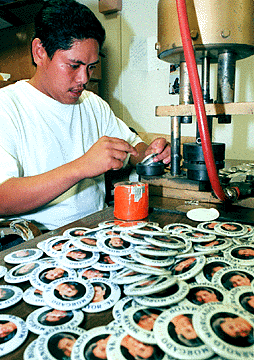
Velo Meleisea assembles buttons for Arnold Morgado's
mayoral campaign at Aikane Button & Ribbon Co.
Photo by Kathryn Bender, Star-Bulletin
Velo Meleisea assembles buttons for Arnold Morgado's
mayoral campaign at Aikane Button & Ribbon Co.
Photo by Kathryn Bender, Star-Bulletin
It's election year, which means a continuous round of political hoopla and hype for the next three months.But for some businesses, the half-hour TV tear-jerker on the candidate, the ubiquitous queue of sign-holders at major intersections and the $25-and-up fund-raisers with sushi and Bud mean more dollars to ring up on the cash register.
Think about it. All those buttons, bumper stickers, signs and T-shirts were made somewhere. Caterers and banquet halls had to be lined up for fund-raisers. Pollsters, direct-mailers, advertising agencies and printers had to be hired to plan an attack and get the word out. Realtors had to be contacted to rent campaign headquarters. Ads and commercials have to be placed on TV, radio and in newspapers.
For many companies, campaign business is good business, whatever the political persuasion.
However, veteran political campaigner Jim Loomis, once an aide to former Mayor Frank Fasi, dismisses election year buttons, signs and stickers as "just props. I'm not convinced of the overall value of a lot of that stuff. I know that traditionally, more money is wasted on printing vast quantities of bumper stickers."
Leroy Seefeld, Tom Mahar, and Paul and Gwen Miles would argue otherwise. They're in the business of supplying all those "props."
Seefeld, owner of the 13-year-old Aikane Button & Ribbon Co., said politicians look to buttons "to get a message out to people in a hurry or at a glance."
Election years mean about 15 percent more business, he said, with typical orders of 200 3-inch-diameter buttons for 76 cents a pop.
"They usually give us the message and leave it up to us to emphasize certain parts," Seefeld said.
Signs Inc. advertises in the Yellow Pages under "political campaign service" and goes after political orders "because it's good business," owner Mahar said. Volume typically goes up 5 percent to 10 percent in an election year, he said.
But political signs are just one of the company's specialties: "We do anything you can put your name on."
So far this year, the company has made a 20-foot banner for Democratic Party headquarters, refrigerator magnets for Congresswoman Patsy Mink, sign-waving placards for candidates and a whole lot of bumper stickers (about 50 cents each for 1,000).
What happens when there's no electioneering going on? "We're quite busy in real estate signage," Mahar said. "That's good for us because that's stable."
Paul Miles got started in the advertising specialties industry 56 years ago in his native Indiana. Thirty years ago, the Miles' started the Foot Print Co. in Hawaii.
Every few years, the couple sends mailers to candidates, touting every conceivable kind of item you can slap a name on. It pays off. Political business adds 10 percent to 15 percent to their volume, Gwen Miles said.
Bumper stickers remain the all-time best seller, but ad-specialty items have gotten a lot more sophisticated over the years, she said. A "Post-Cal," for example, is a postcard with a peelable sticker on the front (10,000 at 13 cents each).
Then there's a card-like sign to hang on doorknobs, with a flexible magnet on the bottom to be torn off, allowing a candidate's name to be displayed on refrigerators.
Still, for some businesses, profits are not as bountiful as they may seem, according to several of those interviewed, including Loomis.
He's been involved in the media end of 21 major campaigns. His ad agency, Loomis & Pollock, this year is working on the campaigns of Mayor Jeremy Harris and Congressman Neil Abercrombie.
Political work "really doesn't do that much for us, strange as it might seem," because "it soaks up an agency's resources," he said.
"The upside is that a fairly substantial amount of money comes in in a relatively short time."
Back to the downside: "The days of the campaigns with limitless funding are over," Loomis said. He pointed to Fasi's failed 1992 gubernatorial bid, when "money was no object. If a $1,200 TV spot opened, we didn't ask anybody, we bought the thing. Those days are over."
KHON-TV general manager Kent Baker echoes Loomis, saying money in them thar (campaign) bills is not as much as viewers might think, although "we don't lose money."
It depends on the contests. With no major races, such as a gubernatorial or U.S. Senate campaign, "the amount of additional money (expected this year) is really not that much," he said.
"That's because we (TV stations) have to sell the spots at the lowest possible rate to politicians (by federal law)." That can mean turning down higher priced ads, he said.
Printers have also been feeling the squeeze.
Job orders may go up 5 percent this year because of political campaigning, said Roy Yamashiroya, president of 32-year-old Service Printers. But in the past, especially with big races, politics could increase business by as much as 15 percent to 20 percent, he said.
"I personally think the mass media advertising (TV and newspapers) has taken dollars away from printers," he said.
On top of that, "even the candidates, I feel, are pinched. They'll find other types of media or face-to-face contact rather than mailing."
While potholders, magnets and sponges "are very good as an attention-getter, nobody votes for you because of gadgets," observed state Rep. Barbara Marumoto. "If you've got the money, fine, otherwise, you use shoe leather and sign-holding. Any extra money goes for printing and postage."
For a while, with personal computers, many candidates chose to do some of their own mailings, she said. But with the U.S. Postal Service's move to automation, mail-outs are more complicated, spurring a switch back to experts.
Automation means presorting and bar codes, something that the 49-year-old Cardinal Mailing Services is well-equipped to handle, said president Scott May.
Cardinal's direct-mail business will go up 25 percent in the months preceding a general election day.
It's an intense 2-1/2 months, because "we don't hire more people and our fixed costs are the same. We just have to get out more in a short time. That tends to make us very profitable, but it's a lot of work and strain."
Any difference between non-political and political clients? May chuckled. For candidates, "It's c.o.d. That's the normal practice in the industry."
TV also demands advance payment, said Jack Kellner, director of communications at KHON-TV.
"Stations protect themselves by requiring cash upfront because there have been times in the past where a campaign might run out of money before paying its bills," Kellner said. Campaigns are "self-liquidating, they can dissolve after campaign and where do you (as a creditor) go?"