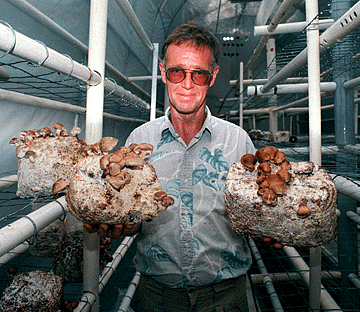
Michael Harburg shows off some of the shiitake mushrooms he's growing in a refrigerated laboratory on the hot Kona seacoast.
Photo by Rod Thompson, Star-Bulletin
Michael Harburg shows off some of the shiitake mushrooms he's growing in a refrigerated laboratory on the hot Kona seacoast.
Photo by Rod Thompson, Star-Bulletin
After experimenting with shiitake mushrooms for 21/2 years, operating on a shoestring budget with scrounged equipment, Harburg hopes he can expand his production tenfold soon.
If he succeeds, he'll be going against nature, growing mushrooms in a semi-desert. "Keahole is one of the hottest, sunniest places in coastal America," he said. Shiitakes originated in wet, often cold Japan.
But Harburg can create his own microclimate inside the refrigeration container because his Ono Take company is located at the Natural Energy Laboratory of Hawaii, which pumps cold water from deep in the ocean.
Cold water is cheaper than electricity for cooling. "It's really economical to do this," he said.
The rewards could be big. Harburg expects to sell his mushrooms for $8 a pound and notes that the U.S. market for "gourmet edibles" has been growing 20 percent a year since 1992.
Cary Ho, who owns Magic Sands Cafe, is his main customer now. "We provide a very fresh type of food," she said. "We have strong feelings about food as medicine."
Harburg and Ho caution that they can't make any medicinal claims about mushrooms. But some say shiitake and other mushrooms boost the human immune system and provide benefits for cancer and AIDS patients.
Harburg would like to grow maitake mushrooms, said to show "significant activity" against the AIDS virus in the lab. They sell for $800 to $1,800 per dried pound.
But he faces stiff competition, not from other companies but from nature. "When you're growing mushrooms, the biggest competition is microscopic," he said.
No one knows that better than Ray Lauchis, who spent 10 years and $200,000 trying to grow shiitakes in wetter, colder Waimea.
The worst problem is the spider-like dust mite, so small it goes through filters, he said. Other fungi also contaminate the sawdust.
"We had good periods. Then all of a sudden we'd throw out 90 days of work," he said.
Lauchis' former associate, Malcolm Clark, owns Gourmet Mushrooms Inc. of Sebastopol, Calif., with branches in Canada, Britain, and Holland. "Technical sensitivity" is critical in growing shiitakes, Clark said. "You have to have scientific training."
There are 1,300 strains of shiitakes, he said. Choosing the right one for Keahole could be critical.
Traditional Japanese farmers grow shiitakes on oak and other hardwood logs, but the process takes up to 18 months. In sawdust, they can be grown in 90 days.
"Koa is about the best thing you've got on the islands," Clark said, but additives are needed. Harburg adds coffee wood.
A commercial operation would need $500,000 to get going, and $5 a pound, not $8, is a more reasonable expectation, Clark said.
Harburg knows at least some of the pitfalls, having worked at a mushroom farm in New Mexico.
"This is not a very easy business," he said.
"Nobody teaches you this. You have to teach yourself."