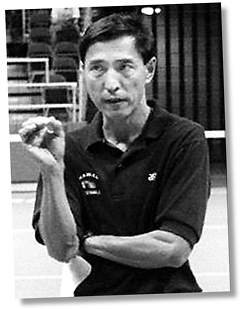
Dave Shoji enters his 22nd year as Wahine
volleyball coach with a record of 590-121.
Star-Bulletin
Dave Shoji enters his 22nd year as Wahine
volleyball coach with a record of 590-121.
Star-Bulletin
It's long enough for one career, maybe two. It's longer than Dave Shoji ever expected to be in this job.
The University of Hawaii women's volleyball coach has been with the Wahine since 1975, their second intercollegiate season. Back then, Shoji thought of the part-time UH job as a stepping stone to something better. Something more permanent, something with more prestige.
Something like, for example, the athletic director's job at Kalani High School, where he had begun coaching the girls' varsity volleyball team in 1972. It wasn't to be.
Shoji has become a permanent fixture in the women's collegiate game, compiling a 590-121 record with four national titles. This season, as the Wahine move from the Big West to the Western Athletic Conference, he should become only the seventh Division I women's volleyball coach to reach 600 career wins.
And, if today's preseason coaches' poll - which has Hawaii No. 1 - holds true, Shoji will have a fifth national title come Dec. 21. Only perennial rival UCLA has more, with six.
Shoji will also turn 50 this season, just 17 days before what could be Hawaii's ninth title match appearance. He hasn't forgotten what being at the top feels like, not when he's had teams that won three championships in a span of five years (1979-83).
"I'm surprised I'm still here," said Shoji, whose Wahine opened practice yesterday. "At the time I started, it was definitely a temporary stop en route to a 'real job' in high school coaching. Twenty years ago, coaching women's volleyball was a volunteer job. Now, it's a bona fide profession.
"Volleyball has become such a major sport for women. It's all gone hand-in-hand. The better the coaches got, the better the game got."
The former All-American setter at UC Santa Barbara feels he's become a better coach, particularly from the technical aspect. Being a lifelong student of the game does that.
"We're getting similar athletes as we've had in the past," he said. "But since I'm more aware of the technical aspects, I think I'm able to have our players realizing more of their potential.
"Recruiting is definitely harder than ever. There are more schools now that have attractive programs than ever before. The talent is really spread out. It's good for the game, but it makes recruiting harder than it ever has been."
Shoji estimates the top players have 30 options to attend a top volleyball school as opposed to 10 schools even 10 years ago. He's emphatic when listing Hawaii as a definite Top 10 program.
The numbers don't lie. With the exception of the injury-plagued 1992 year, the Wahine have advanced to postseason play every year since their inception in 1974.
For the past two years, Hawaii has smashed national attendance records, last year setting attendance marks for fans - 145,006 overall, an average of 6,042.
There have been 24 All-Americans.
"Having the arena has taken what we've always had and blown it out of proportion," he said of the 10,225-seat Special Events Arena that opened in late 1994. "We've always been close to the top nationally in attendance. The interest here has always been high.
"All the coaches (nationally) are hoping for more exposure. They're all hoping that what has happened with our program can happen with theirs."
It's a program that Shoji finds difficult to walk away from. There are thoughts of coaching the U.S. women's national team - he's again been nominated for the job - but with two young children, he doesn't feel he can pursue that dream for at least another four years.
For now, pursuing the NCAA title - elusive for the last eight years - is the goal. Last season was one of his most bittersweet: 31 victories to open it and then a 3-2 loss to Michigan State in the regional final that kept the Wahine from their first final four spot since 1988.
"Looking back, it was probably one of the most enjoyable seasons, until the end," he said. "It was a team that definitely over-achieved. It wasn't a team that I would have thought would be
31-0. I had so many doubts. We had two unproven outside hitters, an unproven middle blocker.
"The team was upset at me because I told them we were ranked too high (at No. 5) in the beginning. My assessment at the start of the year, obviously, was way off."
Shoji hasn't looked at the tapes of the loss to the Spartans. He never looks at the final match of a season if it ends in defeat.
He has replayed that December night over and over in the VCR of his mind, however. He still
doesn't know what he would have done to change the outcome.
"Basically, it came down to not playing up to our potential," Shoji said. "Anything I say now sounds like sour grapes, but there were a lot of factors working against us. We were as good as they were, maybe better. Basically, Michigan State wore us down.
"How would we have done at the final four? I can't answer that. There were four great teams there. (Nebraska, Stanford, Texas, Michigan State). Who knows how we would have done. Could we have won? Obviously we would have loved to try."
Like he does when playing Waialae Country Club, there's nothing to do but hole out and go on to the next tee. In 10 days, when Hawaii opens at the NACWAA Volleyball Classic in Normal, Ill., Shoji will begin to find out just how close he is to the pin with this swing.
It could be an ace.