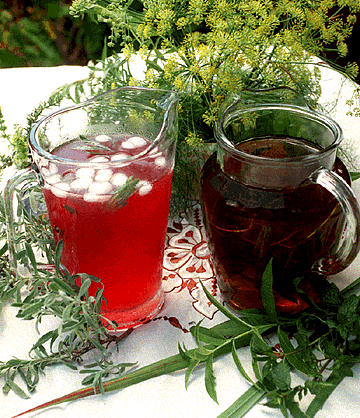
Pink lavender lemonade and a simple sun tea with added herbs are great for summer sipping. Flo Stanley knows; she grows her own herbs for tea (see below).
Pink lavender lemonade and a simple sun tea with added herbs are great for summer sipping. Flo Stanley knows; she grows her own herbs for tea (see below).
We're talking herbal teas, please.
Flo Stanley, dubbed the "herb lady" for the classes she's taught at the Lyon Arboretum, is sold on sowing herbs for teas. Her 7,500-square-foot Mililani house lot is bursting with 90 herb varieties.
"My philosophy is to use everything fresh," she said. "Herb tea is easy and useful to grow in Hawaii."
Stanley suggested half a dozen herbals for green-horn growers - lemon verbena, any mint, lemon grass and culinary herbs such as basil, rosemary and fennel. She said growing secrets are to buy good, healthy seedlings, let them become established for one month, then harvest leaves with restraint.
"Fennel started blooming a week or two ago and it makes a wonderful tea," she said. "It tastes like anise. I just made two big bouquets of fennel flowers and sent them home with people."
She said that fennel tea is great for settling upset or gaseous stomachs and calming collicky babies.
Waimanalo herb grower Dean Okimoto of Nalo Farms said he'll be selling a myriad herbal tea plants at this month's Lyon Aboretum plant sale, set for 10 a.m. to 3 p.m. Aug. 24 at Blaisdell Exhibition Hall. His offerings will include lemon balm, lemon grass, lemon verbena, French lavender, peppermint, spearmint, apple mint, pineapple mint, Vietnamese mint and anise hyssop.
Okimoto said his medicinal tea herbs and their supposed cures include fever few for migraine headaches; valerian root for insomnia; wormwood, or artemesia, for digestive problems; and echinacea. The latter is said to purge the body, boost the immune system and, applied topically, disinfect boils and wounds, according to "The Nutrition Bible" by Jean Anderson and Barbara Deskins (William Morrow, 1995, $30).
 "We are slowly expanding the tea line," Okimoto said. "I am trying to get mamaki and some of the Hawaiian tea herbs. As yet they're hard to find."
He proffered suggestions for neophytes to grow: "Lemon verbena - which makes a wonderful tea - and lemon balm are fairly easy if you put them in the ground. The mints are relatively easy."
He added that echinacea is hard to grow, anise hyssop is an annual needing regular replanting, and wormwood is a bit difficult to cultivate.
Away from farm and field, herbals are still a blooming business at Hawaiian Tea Co., Kini Po-Po Foods, and Down to Earth Natural Foods store.
The Hawaiian Tea Co. of Maui just introduced Hawaiian Tea 2000, which company president Dori Ingalls calls "the ultimate herbal blend."
Developed in collaboration with Sara Shannon, author of "Good Health in a Toxic World," the tea contains dandelion root, echinacea purpurea, hibiscus, lemon grass, orange peel, rose hips, citric acid crystals, kelp, chickory, dulse and oats.
"It's really delicious and very calming," Ingalls said.
The blend joins the 15-year-old company's other three herbals - Mamaki & Wapine, Makawao Mint, and Upcountry Maui Blend - available at Daiei, Longs, Woolworth, coffee stores and gift shops.
Kini Po-Po Foods of the Big Island produces three indigenous herbals - hibiscus, ko'oko'olau and mamaki. These herbs serve as purgatives, according to "Native Hawaiian Medicine" (translated by Malcolm Naea Chun, First People's Productions, 1994). The manual says ko'oko'olau combats lung trouble and restores the appetite, while mamaki is good for pregnant women and children.
Shizu Ha, Oahu manager for Kini Po-Po, said, "Those old Hawaiian herbs have been real good sellers in the local market. People find out about them from friends; then people call from the mainland and place orders. We have a hard time keeping up" with the demand for the teas.
Kini Po-Po teabags in mamaki-ko'oko'olau with mint, and hibiscus flavors are sold at ABC Discount Stores, Food Pantry Stores, Longs, and Woolworth Ala Moana and Waikiki. Loose mamaki and ko'oko'olau teas are available at Longs Ala Moana, Shirokiya and Waianae Store.
And, for those into mix and match herbals, Down to Earth Natural Foods store has a self-serve shelf of dried herbals. They include - with approximate prices per pound and supposed effects, according to store assistant manager Wayne Satsuma - chamomile buds ($16), hibiscus flowers ($10), horehound (for bronchial congestion - $15), peppermint ($12), astragalus, or huang qi (cancer treatment - $31), and dong quai (tonify blood and help circulation - $42).
So, sow and sample some of the Herb Lady's following herbals to soothe those tensions away.
1 cup boiling waterAdd hardy herbs to boiling water, cover and simmer at least 5 minutes. Remove from heat, immediately add 1 or more tender herbs, cover and steep 5 minutes to 1 hour.
2 or 3 teaspoons fresh herbs or to taste (use "hardy" herbs, such as English lavender, lemon grass or lemon verbena; and/or "tender" herbs, such as basil, fennel, peppermint or other mint; or 1 teaspoon dried herbs)
Steep overnight if making 1 gallon or more at a time.
1 fresh, pesticide-free hibiscus flower (a blossom that is ready to close or already closed up)Remove the stamens, pistils and green calyx (bottom) from hibiscus; rinse flower. Remove boiling water from heat, immediately add cleaned hibiscus and steep 10 minutes or until cool. Add mint, lemon juice and honey or sugar to taste.
1 cup boiling water
2 cups waterBring water to a boil, add ginger and boil 10 minutes. Dilute with more water or add more ginger, according to one's taste.
1-inch piece fresh ginger, crushed, or to taste
5 cups waterRemove the stamens, pistils and green calyx (bottom) from each hibiscus; rinse flowers.
1 cup sugar or to taste
1 to 2 tablespoons chopped fresh English lavender leaves
6 fresh, pesticide-free red hibiscus flowers (blossoms that are ready to close or already closed up) or 1/4 cup dried hibiscus flowers
Handful of fresh mint
1 cup lemon juice or to taste
Fresh lavender flowers, for garnish
In a saucepan, bring 2-1/2 cups water and the sugar to a boil. Reduce heat, add lavender and simmer 3 to 4 minutes, stirring to dissolve sugar. Remove from heat, add hibiscus and mint; cover and steep 1 to 2 hours.
Strain liquid into a large pitcher or jar, add the remaining water and lemon juice, and stir well. Correct flavor with more sugar, water or lemon. Pour over ice cubes in a chilled glass and garnish with a lavender flower. Makes 6 to 8 servings.
Is herbal tea good, bad or neutral for you?Rike Weiss, a holistic health practitioner with a master's degree in traditional Chinese medicine, said, "Europeans have been drinking herb teas for centuries, for pleasure and health. Herb teas don't have caffeine - that's the inherently good part. They also have healing qualities and those can be from very simple to very complex."
But Aurora Hodgson, chairman of the University of Hawaii department of food science and human nutrition, warned that herb tea devotees shouldn't go overboard. "There is a perception among consumers that natural is safer, natural is better, natural is more healthful," she said, "and that is not necessarily true."
She said there are some herbs that will give adverse reactions. "Some of these herbal teas are trendy and some are said to have been used for a long time in other countries. But sometimes we can't have experience with them and, unfortunately, it is sometimes through very tragic situations that we learn what some of these results are. That's why I stress: We have to know what we are putting in our mouth."
She said there is no such thing as absolute safety with foods, and the bottom line is "do everything in moderation."
Mililani "Herb Lady" Flo Stanley agreed, recommending that people drink no more than three cups of herbal tea daily.
"The Nutrition Bible" by Jean Anderson and Barbara Deskins lists some reservations about herbal teas:
Alfalfa leaves and tops are possibly unsafe for some.