Another wants to talk about a week-old parking citation.
"I tried to feed the meter and it was broken. Must I still appear in court?"
Such nonemergency calls are clogging Honolulu's 911 emergency system, an independent report says.
The report, authored by Keoni Tonaki, a member of the Mayor's Downtown/Chinatown Task Force, says two-thirds of the 2,500 calls processed daily by Honolulu's 911 system are not emergencies.
By comparison, San Bernardino, Calif., a much larger county, averages 300 emergency calls a day, Tonaki said.
The abuse of Honolulu's system results in unnecessary delays and duplication of reaction, he added.
Robert Prasser:
"Instead of wondering where
to call for police service,
we feel it's better that
people call 911 for
all police matters."
Harris and Yoshimura say the study was done without their knowledge.
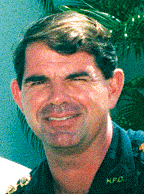
"This is becoming the most official, nonofficial report around," said Maj. Robert Prasser, commander of the Communications Division. "It wasn't commissioned by anybody and it suffers from a narrow view of the system, poor scholarship and poor research.
"It's a report with no methodology."
Tonaki, a broadcast television director/editor, is currently on the mainland working on a film project. The report, he said, was compiled through research and interviews with Police Department personnel familiar with the system.
In a written statement to the Star-Bulletin, Tonaki proposed changes to resolve some of the system's shortcomings.
"Drastically reducing nonemergency calls, setting up a 24-hour nonessential line, punishing fraudulent 911 callers with a fine on their telephone bill, adding more trunk lines to accommodate a growing population and educating the public on the proper way to cancel a 911 call so that our police officers aren't dispatched to false alarms (would be) a good start," he said.
Honolulu's 911 system is not set up only for emergency calls but also for police services, Prasser says.
"Something that may not seem like an emergency at first, such as a neighbor reporting a domestic argument, could lead to serious injury or death if it is left up to the caller to determine what is a nonemergency or emergency," Prasser added.
"Instead of wondering where to call for police service, we feel it's better that people call 911 for all police matters."
Prasser noted that there's no bottleneck in the system.
"Our statistics show that calls are picked up in under five seconds. We average 75,000 to 80,000 calls a month and I receive approximately six complaints a month from people upset with the service."
A committee made up of police, fire, ambulance, GTE Hawaiian Tel and city Building Department and Data Services personnel meets monthly to review the 911 system, Prasser noted.
"I think we're always looking for ways to improve the system," he added. "If everything in the report were true, we'd be looking at a horror story because a lot of people would be dying."