
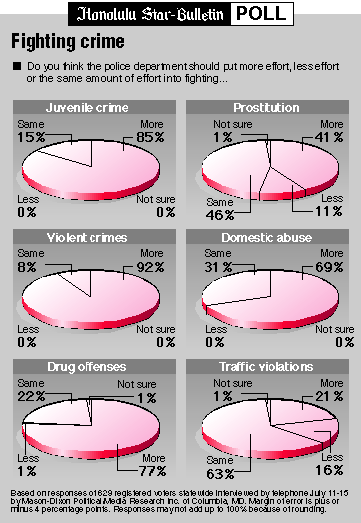
An overwhelming majority of Oahu voters responding to the Honolulu Star-Bulletin Poll said police should devote more efforts to fighting such crimes. At the same time, most respondents said they think the Honolulu Police Department is doing a good job overall.
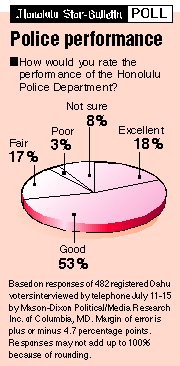 The poll asked 482 registered voters to rate the Police Department's performance. Fifty-three percent said they think the department is doing a good job, and 18 percent gave it an excellent rating.
Only 3 percent rated the department's performance as poor, 17 percent called it fair and 8 percent said they were not sure. The poll has a margin of error of 4.7 percentage points.
Police Chief Michael Nakamura credited community outreach for the strong approval rating.
"We stress in our officers the fact that we are part of this community and we have to recognize that law enforcement cannot survive in any community without the support of the people they serve," he said.
Nakamura said the public understands that police are only a part - albeit a major one - of crime fighting and therefore can't bear all the blame for increased criminal activity.
That was the case with Sue Paulo, a Kaneohe resident and health care manager.
Paulo was among the 85 percent of respondents who said police should do more to fight juvenile crime and 69 percent who said police should put more effort into fighting domestic abuse. But she doesn't blame officers.
"I don't believe that our criminal justice system is doing what they can in terms of the need to take a harder stance on some crime, and the kind of revolving door that we have with regard to criminals," she said.
"I don't see it as a police department problem. I see it as a criminal justice problem. Simply because we don't have enough jail space is not (reason) to let the criminals go."
She was also among the 63 percent who said sentences given by judges have been too lenient. None said sentences have been too severe, while 28 percent said they have been appropriate.
Of the respondents, 92 percent said police should do more to fight violent crime and 77 percent wanted more efforts devoted to fighting drug offenses.
The three candidates for city prosecutor were asked to respond to poll questions. Peter Carlisle and David Arakawa did not respond. Randal Yoshida answered only the question dealing with the performance of the Police Department, which he rated as excellent.
Nakamura said the public has come to share police frustration with the lack of adequate jail space, which forces early release of many nonviolent offenders.
"Right now there's no consequence to many of the crimes committed in this state," he said. "It's not a good way to do business. You may even encourage some young people to get into crime because they realize there's no consequence to getting caught."
But the public is as concerned about prevention as it is about keeping criminals behind bars, Nakamura said.
The poll results confirm what the campaigns of President Clinton and Bob Dole have already established: Crime in general and juvenile crime in particular are hot issues with voters this year.
Crime ranked above the economy and second only to candidates' integrity when the Star-Bulletin poll asked voters to rank issues that are important to them in this year's mayoral race between incumbent Jeremy Harris, Arnold Morgado and Frank Fasi.
But University of Hawaii criminologist Meda Chesney-Lind said such pronounced concern about crime belies statistics that show a decrease in many forms of criminal activity.
While total juvenile arrests have increased in Hawaii over the past 10 years, the number of arrests for what the FBI calls index offenses - murder, rape, robbery, aggravated assault, burglary, larceny-theft and automobile theft - has declined slightly, she said.
A huge increase in arrests for curfew violations, truancy and running away from home account for the overall rise in juvenile arrests, Chesney-Lind said.
"I think the attitudes (about juvenile crime) are driven more by media coverage of crime rather than trends," she said. "Fear of crime is always big on people's minds whether or not there's a crime problem."
Chesney-Lind said it was heartening to see that 69 percent want more efforts devoted to fighting domestic violence, but she said it troubles her that the figure is far lower than the 92 percent who said more should be done to combat violent crime.
"Domestic violence, we suddenly discover, isn't really violence to the same degree," she said.
Check our back issues pages
for previous days' poll results