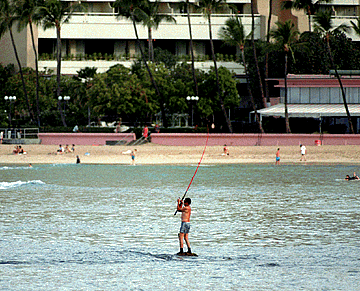
A fisherman tries his luck on a reef off Waikiki Beach.
Photos by Ken Ige, Star-Bulletin
A fisherman tries his luck on a reef off Waikiki Beach.
Photos by Ken Ige, Star-Bulletin
The Bishop Museum fish expert has been around the world numerous times cataloging the planet's fish species and has seen a worldwide decline in fisheries. His solution is kapu areas, used by ancient Hawaiians to allow fish to breed unmolested.
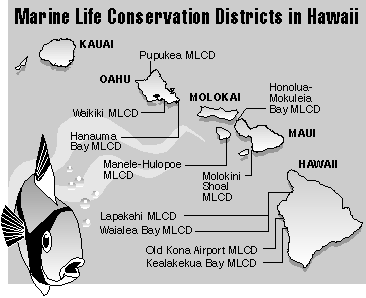
State resource officials and many fishermen share Randall's philosophy that marine sanctuaries can help save Hawaii's threatened fish species but they don't agree on what form they should take or how they should be enforced.
Fishermen opposed the last two conservation districts that the state proposed, in Waikiki and along the Ewa coastline. Fireman Henry Pelekai, who also has spent decades at the helm of an akule fishing boat, was dead set against the proposal for Ewa.
"A sanctuary is very good, it rejuvenates the area. But they were trying to use conservation to implement a business." Pelekai and other fishermen were convinced that the state was trying to keep out divers and recreational fishermen and open up underwater submarine tours and snorkeling concessions.
"A sanctuary should be a sanctuary, where no one comes and visits the fish. That stresses them out," Pekekai said. "A true sanctuary is peaceful."
At public hearings filled with angry fishermen, Randall was usually the lone voice speaking in favor of sanctuaries.
"The argument you get is: 'My father fished here, my grandfather fished here, you're not going to let us fish here. It's my right.' I guess they forgot about the kapu system the ancient Hawaiians used to protect threatened stocks of fish."
Everyone agrees that Hawaii's stocks of reef and deepwater fish are depleted, Randall said. "Permanently closed areas are the absolute key to protecting the stocks. When the fish can reproduce in peace, their eggs and young scad will fill the surrounding areas."
The trick, he added, is to select the protected areas with care so that traditional fishing sites aren't disrupted.
Limiting the size of fish that people are allowed to keep won't save the species from overfishing, Randall said. They must be protected for their full life cycle.
Parrotfish, wrasses and groupers start off as females, and become males later in life. If they are caught when they are females, there will be no males to reproduce.
The situation frustrates Pelekai as well. "The biggest problem here is there is no limit for recreational fishing. Sometimes recreational guys take juveniles by the bucketful. One bucket, if left to mature, would be five or six hundred pounds of fish.
"If each guy is grabbing a bucket of young, they are catching more than I do in one day of catching adults," Pelekai said. "I like to see people fishing on the beaches and harbors, it's a good family recreation. But they should set limits."
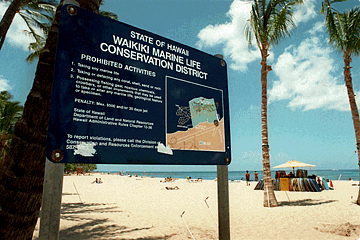
As head of the Department of Land and Natural Resources, Mike Wilson views marine life conservation districts as important tools to protect and sustain ocean resources for future generations.
But he is reluctant to create new fish sanctuaries because "there is no real management program if all we have are rules and regulations on the books, with no enforcement. And at this point enforcement is a disaster."
There are only 18 marine patrol officers statewide to enforce regulations, and Gov. Cayetano's plan to double that force was abandoned by the Legislature late this session.
"It's amazing to think that the state with best marine resources in the nation has an enforcement organization that resembles that of a Third World nation," Wilson said.
"The future of our resources really depends on the vision of our fishermen. They are the users of the resource, and we can't protect the resource unless they agree with what we are doing."
The fishermen sometimes view the state's actions with suspicion. "Us fishermen look at it down the line," said Pelekai, and they could foresee the state pushing them out of the waters from Kahe Power Plant to Barbers Deep Draft Harbor for a sanctuary, then increasing its boundaries all the way past Barbers Point to the planned Ewa Marina.
Randall doesn't think the state has to worry about keeping fishermen out of conservation districts. "When they realize the value of an area, the people will protect the preserve," whether they be hotel staff, dive groups or area residents.
Once while collecting specimens in an Israeli marine sanctuary along an isolated stretch of coastline, Randall was startled by a game warden who demanded to see his permit when he emerged from the water. "Six people had called within 40 minutes to report that someone was spearfishing in the preserve."
Randall and Wilson feel that the best approach is to propose smaller sanctuaries and convince the public that the preserves are essential to Hawaii's future, so they will help guard the resource.
Pelekai has a different solution. "The natural way won't work, there are too many people fishing. The state hasn't put enough research into replenishing the stock that is here, to use hatcheries for the keiki and put them into the ocean, like the moi and tilapia. They have to get it back into the system."
Fishermen are painfully aware that time is running out.
"Every time when I catch a fish," said Pelekai, "I turn around and thank the ocean, because some day it's going to stop."