Honolulu Star-Bulletin Local News
SOLAR
ECLIPSED
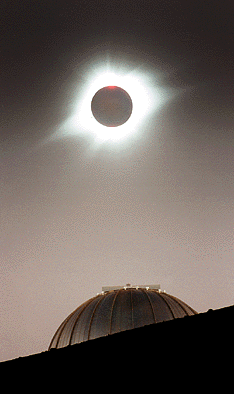
This full solar eclipse of July 11, 1991, is seen from atop Mauna Kea, which one solar astronomer says has gotten the bulk of the Institute for Astronomy's attention. The United Kingdom Infrared Telescope (UKIRT) sits in the foreground.
Photo by Dean Sensui, Star-Bulletin
Astronomer
Richard Canfield says
the UH Institute for Astronomy
is neglecting the field that was
once its foundation
By Helen Altonn
Star-Bulletin
Solar astronomy has nearly disappeared in Hawaii - one of the world's premium spots to study the sun.
Most solar astronomers have left the University of Hawaii, including an internationally recognized scientist who blames UH Institute for Astronomy directors for the program's decline.
Richard Canfield, who left May 31 for Montana State University, charges Institute Director Don Hall and associate director Len Cowie with "malfeasance" for failing to nurture Haleakala's potential as they do Mauna Kea's.
Canfield came here in 1986 to lead the solar group and take charge of the Mees Solar Observatory on Haleakala.
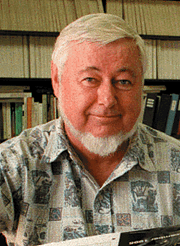
Don Hall:
The director of the Institute for Astronomy is accused of failing to nurture the solar program.
Photo by Ken Sakamoto, Star-Bulletin
He quit those positions in 1990 because of differences with Hall and Cowie, but stayed on as a researcher.
"The only reason I put up with the institute as long as I did was the (10-year) tenure vesting rule," Canfield said.
He said Hall and Cowie have "abrogated their responsibility" to the UH, the state and the Mees Observatory - an internationally recognized solar facility before any telescope went up on Mauna Kea.
Canfield said the director's office shifted from supportive to antagonistic after Cowie's arrival, six months after Canfield's. An extragalactic researcher, Cowie runs the institute when Hall is dealing with Mauna Kea observatories and telescope development.
But Hall accepts responsibility for all decisions: "While I'm gone a lot, there are no decisions taken that I don't sign off on or review. So the buck stops here."
Hall said he was "taken aback" by Canfield's criticism. "I don't honestly believe solar was singled out in any way. Certainly not by Len (Cowie) and I behind closed doors."
Solar astronomers founded the Institute for Astronomy, Canfield noted. Yet, he said, the director's office recently has done nothing for Mees while spending millions of state dollars on instruments and hiring state-funded tenure-track scientists for Mauna Kea.
"This institute is an excellent example of abuse of (state) monies for what is essentially a personal fiefdom," Canfield said.
With budget cuts in recent years, Hall said, the institute had to lay people off, freeze positions and set priorities. The faculty was unanimous that new positions be used to develop a theory group and instruments for Mauna Kea telescopes accessible to UH scientists, Hall said. "Building up solar was never identified as a priority."
Joseph Blanco, UH Board of Regents chairman, said an audit is being done on the institute, "so we have to wait to see the results."
He said astronomy is a priority "area of excellence" for the UH, and Hall "has taken a small program and really built that into a world-class program."
But with a need to balance environmental concerns on Mauna Kea, Blanco said, "Don has to make some decisions as to what's best for this program. One of the things the board talked to the (UH) president about is the need to maximize all our assets."
Despite lack of institute support, Canfield said, he developed a vibrant group of about 20 scientists, post-doctoral fellows and graduates pulling in about $2 million annually in grants. They were doing leading research for Japan's Yohkoh satellite program and produced "awesome science," he said.
In 10 years, he said, he generated more than $10 million in economic benefits from about $1 million in state money spent annually for his salary and equipment.
The solar group two years ago accounted for 25 percent of all scientific research published at the institute although the team represented less than 10 percent of the faculty, Canfield said.
Now, the program is down to three faculty members, three graduate students and one post-doctoral fellow.
Grants have dwindled to a few hundred thousand dollars a year, he said.
With Canfield's departure, Barry LaBonte is the only state-funded solar member on the faculty. Others are funded through grants.
Cowie pointed out that his background is in interstellar astronomy and Hall is a solar astronomer. "But you have to respond to . . . conditions around you," he said.
Those conditions on Haleakala have shifted from solar astronomy, Hall said, to the Air Force's proposed $19 million optical telescope atop the 10,000-foot summit.
Hall sees Haleakala's future "in attracting other night-time telescopes that don't require the extreme altitude of Mauna Kea."
Meanwhile, "I've taken no decision to close out solar astronomy," said Hall, now recruiting candidates to head the Haleakala Observatory. "If we can attract a really good (solar) person to build the program back up, I'll do it. On the other hand, it may be better to get someone involved with the Air Force and other night-time telescopes."
Canfield said he wrote memos the past year to UH administrators, NASA and others describing the institute's loss of eminent solar scientists and millions of dollars in federal grants. He said his warnings about institute policies stifling the program were ignored.
He said that Mees - one of only three university solar observatories in the country - "is really an outstanding facility" with "gorgeous instrumentation." But where there were three observers, now there is one.
"Literally millions of dollars of instruments are sitting there underutilized," Canfield said.
Cowie said it's been "a very bad situation" since Canfield resigned as head of the Haleakala operation "because there's been nobody to take charge scientifically of Haleakala. Dick said he wasn't going to do it. On the other hand, he was still there and he wouldn't let go."
As acting assistant director pending a replacement, Wayne Lu has scrounged money to retain six staffers at Haleakala.
"This should not have come to this," said Lu, a 32-year veteran of astronomy development at Haleakala. Praising Canfield and LaBonte's "very successful solar program," he said, "It was unfair, inequitable and unnecessary to curtail the funding, as well as the program, in this manner."
See today's Honolulu Star-Bulletin for related stories.