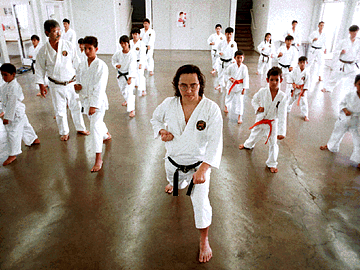
Charles C. Goodin, center, associate/online editor of Furyu,
helps lead a class at the Aiea Matsubayashi Ryu Karate Dojo.
Photo by Dennis Oda, Star-Bulletin
Charles C. Goodin, center, associate/online editor of Furyu,
helps lead a class at the Aiea Matsubayashi Ryu Karate Dojo.
Photo by Dennis Oda, Star-Bulletin
An art of traditionFuryu, published by two isle residents, is about martial arts. But in Bushido fashion its editors have shunned the big lights and sensational topics to focus instead on the philosophy and the history in ...
But "two local guys without deep pockets" are trying to show the unenlightened there is another path to take when pursuing judo, karate, aikido, kendo, iaido (involving swords) and other martial arts.
It's the traditional path, one without the bells and whistles, to be followed in Furyu, the Budo Journal of Classical Japanese Martial Arts and Culture, published quarterly from an apartment in Moiliili and a house in Foster Village.
There is no office, merely the separate homes of the publisher and his associate; no staff; no payroll. Eighty-page issues are printed at Hawaii Hochi Ltd.
Furyu also is online on the Internet. In a major plug, the current issue of the Internet magazine, Yahoo!, rated Furyu one of the three best web sites devoted to the martial arts.
The Internet "version of the print quarterly covers Japanese martial arts and culture with a rare mix of humor, sensitivity and wit," Yahoo! writes. "Compared to other martial arts magazines, Furyu offers an unusually generous number of informative articles."
After two years and six issues, the journal is breaking even and reaching an international audience, with 90 percent of each issue sold on the mainland, and in Japan, Taiwan and Europe.
"We're expanding, but not exploding," said publisher/editor Wayne Muromoto, adding that 3,500 copies of the last issue were printed.
But, money will never be the primary motivation in what is really "a labor of love," say Muromoto and associate/online editor Charles C. Goodin.
Both men have full-time jobs that, in effect, subsidize the publication. Muromoto, 42, is head of the arts department at Mid-Pacific Institute and, until burnout started setting in, was also a lecturer in ethnic studies at the University of Hawaii and newsletter editor for the community colleges. Goodin, 38, is an attorney specializing in real estate documentation.
Both are also devotees and teachers of the martial arts, with Muromoto trained in iaido and ju-jutsu (also spelled ju-jitsu), and Goodin a teacher of karate and practitioner of judo, iaido and kendo.
For these two, it obviously is a matter of Bushido (the warrior's code of honor) that makes them spurn the glitz and big-sell of martial arts as theater in favor of thought-provoking stories on their traditions, philosophies and history.
"The mainstream and even martial arts media have tended to look at the more sensational aspects" of martial arts - the no-holds-barred fights and the violence, Muromoto said.
The reason is obvious, Goodin added. Violence sells. "We're appealing to a different constituency. It's the idea of the silent majority. While there are a few stars who are always on the cover (of magazines), there are hundreds of little dojo (schools)" down the street, he said.
The sensei (teachers) and students there practice martial arts for far more reasons than self-defense, among them "spiritual, cultural, health and tradition - understanding a tradition," Muromoto said.
And it's at them that Furyu is directed.
"We do not feature people with 10,000 students, but maybe someone who has only 10 students and who has been teaching for 30 years," Goodin said. "It's not that they're great, but we look at the example they set."
Muromoto, who grew up in Waialua, studied Japanese language and literature at Cornell and got his master's degree in art at the UH. He's been a writer, photographer and artist.
In 1984, he got a fellowship to study tea ceremony in Kyoto. He joined a martial arts school as a foil to "sitting and moving things around" eight hours a day, six days a week.
"Two years ago, I turned 40 and went into a mid-life crisis," Muromoto recalled.
He had gotten married, changed jobs, dealt with health worries and had his "Great American Novel" rejected.
When he complained, again, about the sorry state of martial arts journals in the United States, someone challenged him to do something about it.
"I had desk-top publishing skills; I knew it could be done," he said. "As long as I didn't lose my pants, I wanted to offer a different vision."
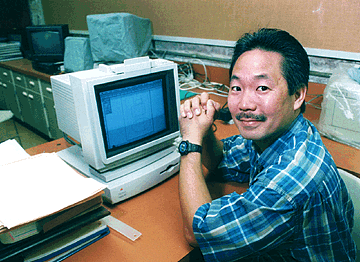
Wayne Muromoto, publisher and editor of Furyu, the Budo Journal, sits
in his office at the Mid-Pacific Institute. Muromoto, who publishes
the magazine from his home, calls the publication "a labor of love."
Photo by Craig T. Kojima, Star-Bulletin
He named his company, Tengu Press, after "a mythical Japanese birdlike creature" who supposedly taught humans the first martial arts.
The name "furyu" is much harder to define. His martial arts sensei in Kyoto gave him the word as his first Zen koan (puzzle). "Furyu" translates literally into wind and flowing water, Muromoto said, but is vastly more complicated.
His sensei told him "furyu" was them "sitting here, drinking beer, looking at the city lights (over Kyoto) and you don't have to say anything," Muromoto said.
When it came time for him to name his journal, he opted for Furyu, "even though people can't pronounce it and don't know what it is."
Goodin, meanwhile, has long been involved in martial arts, learning karate as an 8-year-old growing up in Japan. He moved to Hawaii in the seventh grade and continued his training. He attended the UH and Northwestern, where he got degrees in both management and law. His three sons are also into karate, judo and kendo.
Goodin first met Muromoto when the latter came to interview his karate sensei. He was impressed that Muromoto tracked down their little dojo in Aiea and he's been with Furyu since the second issue, setting up the Internet site.
"I haven't planned any issue from day one," Muromoto said. "Things happen and stories change. It's so crazy."
But computer technology has made publishing relatively easy. A writer in Canada, for example, can just e-mail in his copy and color graphics.
"We use very modern techniques to preserve very cultural traditions," Muromoto said.
The journal "is an anchor," he said. "We could make a decision to go for money rather than quality; go for glitz rather than truth.
"But we opt for traditional culture and integrity. That makes us feel good."
COST: $6/copy; $36 for six issues
ADDRESS: Tengu Press, P.O. Box 61637, Honolulu 96839
HOME PAGE: http://emporium.turnpike.net/G/goodin/furyu/
MORE INFORMATION: A special presentation about Furyu will be given from noon to 2 p.m. on July 27, at Borders Books in Waikele. Demonstrations by several martial arts sensei and dojo will be presented from noon to 1 p.m., and customers will be able to meet the editors from 1 to 2 p.m.