
At the University of Hawaii's Institute for Astronomy, we have learned much from this scrutiny, and it has led us to redouble our efforts to be worthy stewards. However, we wish to clear up some of the misconceptions that may have arisen about astronomy's presence on the mountain and our future plans.
Mauna Kea is now generally accepted as the prime observing site in the world and, over the last decade, the development of telescopes there has tracked the most optimistic projections of the master plan adopted in 1983. The four new telescopes on the mountain will surely usher in a golden age of ground-based astronomy. In coming years many of humankind's discoveries about the physical universe will undoubtedly be made from Mauna Kea.
Astronomy on Mauna Kea is more than a scientific pursuit. It is also a thriving economic enterprise. By the end of the decade, telescope operations will bring nearly $50 million annually into the Big Island economy from out of state, employing 300 to 400 local residents and anchoring the Hilo University Park.
Astronomy on Mauna Kea began as a local initiative. Noting the development of telescopes on Haleakala in the early 1950s, several Hilo residents astutely concluded that Mauna Kea was almost certainly an even better site. They wrote to observatory directors throughout the mainland and around the Pacific Rim, inviting them to assess Mauna Kea as a telescope site. In 1964, Gerard Kuiper, director of the University of Arizona's Lunar and Planetary Laboratory, accepted the offer and, within the year, testing of the astronomical quality of Mauna Kea was under way. In 1964, Mauna Kea was declared "the best site in the world . . . from which to study the moon, the planets and the stars."
The UH became involved in the development of telescopes on Mauna Kea only in the late 1960s, when it became apparent that otherwise the stewardship of this effort would fall to mainland astronomers from Arizona or Massachusetts. After the commissioning of its own three telescopes in the early 1970s, UH was able to attract three more major telescopes - the Canada-France-Hawaii telescope, the United Kingdom infrared telescope and the NASA Infrared Telescope Facility - which all went into operation in 1979.
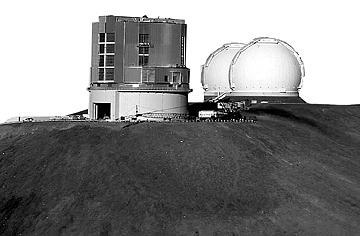 The Subaru Telescope facility atop Mauna Kea.
 One of these is the Smithsonian Submillimeter Array Telescope. Through advances in technology, it replaces a planned 25-meter (80-foot) diameter dish with eight far smaller dishes totaling about the same collecting area, but able to discern much greater detail on the sky. As these will always observe an object simultaneously and their signals be combined, the UH proposed, and the Land Board concurred, that they should be considered a single telescope under the master plan. This concept was emphasized throughout the permitting process and, until very recently, no one had questioned this.
Some have expressed concerns regarding UH's current management of its leased area on Mauna Kea. UH welcomes community input on how to improve its performance. It has doubled staffing of the Onizuka Center for International Astronomy's Visitor Information Station, located at Hale Pohaku. This has allowed double coverage on weekends and expanded hours on Mondays, Thursday and Fridays.
Contractors have greatly improved the retrieval of wind-blown construction material. In the coming months, material on the north and east shields (blown there by 100-mph winds that can occur on the summit) which is difficult to retrieve on foot, will be collected and flown out by helicopter.
In a recent archeological survey, carried out as part of a new historic preservation management plan, it was determined that none of the 50-plus archeological sites within UH's management have been in any way disturbed. Although the adze quarries are located outside UH's management area, personnel report all apparent infractions there.
Concerns also have been expressed about Mauna Kea's endangered palila bird and wekiu bug. More than 30,000 acres of mamane-naio forest on the slopes of Mauna Kea have been designated critical habitat for the palila. The preliminary 1996 Palila population count of 4,200 compares favorably with their population from 1980 to 1995 of slightly below 3,400.
Telescope construction has necessarily destroyed some of the coarse cinder slopes which the wekiu bug inhabits. The UH is committed to leaving undisturbed prime wekiu habitat around Pu'u Wekiu and minimizing the affect on other areas. The UH will also commission a new project both to repeat measurements made in the early 1980s and to survey populations in similar habitats in the science reserve where no development is being considered.
In many ways, astronomy is the most benign major high-tech enterprise in Hawaii. Astronomers collect only starlight and export only knowledge. All of us involved recognize that being able to site telescopes on Mauna Kea is a privilege. We fully realize that the University of Hawaii's stewardship extends beyond the science reserve, as a site for astronomy, to the cultural and ecological aspects of the mountain.