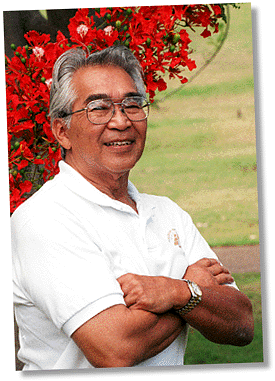
He said he was surprised two weeks ago to get a letter from Dr. Tamas Ajan, a Hungarian who is general secretary of the International Weightlifting Federation, asking him if he would abandon being a referee to become a member of the weightlifting jury.
 "I accepted right away," said the 66-year-old Kono, who also has been chosen one of the 100 Golden Olympians.
Kono, who missed one-third of his grammar school classes due to asthma, won Olympic weightlifting gold medals in 1952 (Helsinki) and 1956 (Melbourne) and a silver in 1960 (Rome).
For eight straight years, (1952-59), he was an Olympic and world champion.
After having participated at almost every level of his sport and having won every honor, it takes a lot to impress Kono. But being asked to oversee the performance of referees officiating the Olym-pics was a role he could not pass up.
To be offered the position meant Kono was being accorded his sport's utmost respect. It meant that weightlifting's top officials believe he not only has the experience and knowledge, but also the unimpeachable integrity to judge the people who are judging the competition.
"It was great to be a referee, but, hey, now I get the best seat in the house," said Kono.
"I have oversight on the fairness of the referees, and make sure the competition is run right, from the staging to where the barbells are positioned."
Kono will be overseeing three referees who each have two options: push the button on a red light (no good) or on a white light (good).
"If a guy keeps making his decision late, that means we have to replace him," Kono said.
One of the four-man jury's key powers is to grant a lifter a reprieve - another lift.
"If a lift is turned down by two of the three officials, we can't overrule, but we can give him another chance," said Kono. "If you call it the way you see it, your conscience should not bother you at all."
It will be Kono's first Olympics on a jury, but he was on world championship juries in China last year and in Istanbul in 1994.
Though he is now at the top of the weightlifting pyramid, Kono said his career came close to be being derailed 44 years ago by Uncle Sam.
In 1952, during the Korean War, he was serving as a cook at Ft. Ord, Calif., when orders came down that he was to be shipped to the war zone. "Cooks were at a premium," he said.
Kono said he was one step away from being shipped out when the Army yanked him back and stationed him in San Francisco.
"They knew I was an Olympic trials contender, and I guess they figured this guy was more valuable to the United States in the Olympics than in Korea as a cook," he said.
So Kono got to go to Helsinki that year, and he won his first gold as a lightweight lifter. But while in Finland, Kono received a telegram telling him he would have to go right from the Olympics to Germany to serve his overseas term for nine months.
Kono said he enjoyed his tour in Germany, where weightlifting is a much appreciated sport. In fact, Kono recalled that German people who recognized him kept wondering why an Olympic gold medal lifter was a private first class and not an officer.
Kono, who set 26 world records, said weightlifting rules were once cumbersome, but they now have been streamlined.
He said lifters used to be weighed one hour before the contest. Despite this, Kono said that until 1976 any lifter who broke a record was required to stay on the platform to be weighed again. A screen was set up around him so he could strip.
Nowadays, lifters are weighed two hours before a contest, and if they break a record they can simply leave the stage without worrying about being weighed again.
Kono doesn't think what it takes to be an Olympic lifter has changed so much that it would write him or his fellow Golden Olympian from Honolulu, dentist Peter George, out of the equation.
"Nothing has changed except the weights they lift," said Kono. "I asked Peter what he thought would happen if we were still lifting, and he said we'd still be champions. That's because it's still up here," tapping his head.
"Whatever the mind can't conceive and believe, you can't achieve. Attitude is so important, and we still have that.
"Old weightlifters don't die," added Kono. "They just become officials."
Age: 66
Hometown: Sacramento, Calif.
Residence: Honolulu.
Education: Sacramento High, Sacramento Junior College, Sacramento State College.
Olympics: Gold medal, 1952, Helsinki; gold medal, 1956, Melbourne; silver medal, 1960, Rome.
International: Set 26 world records, seven Olympic records, eight Pan American Games records, held 11 weightlifting titles, four physique titles. Was world and Olympic champion for eight consecutive years (1952-59) in 148-, 165- and 181-pound classes. Held world and Olympic records in three different body weight classes (148, 165, 181). Set World records in four different body weight classes (148, 165, 181, 198).