
Ron Sorrell, who frequently hikes Diamond Head, checks out one of
the many homeless campsites along the ledge that overlooks
Diamond Head Road. Photo by Dennis Oda, Star-Bulletin
Ron Sorrell, who frequently hikes Diamond Head, checks out one of
the many homeless campsites along the ledge that overlooks
Diamond Head Road. Photo by Dennis Oda, Star-Bulletin
"I walked maybe 50 yards, and I thought, something's wrong with this picture," recalled Sorrell, a Honolulu financial manager and inveterate hiker. He and a buddy backtracked, scaled the incline where the man had emerged, and found something neither expected: a warren of campsites, some fairly elaborate, apparently occupied by transients and homeless people.
"There's a whole world going on up there," said Sorrell, 64, who has returned perhaps a dozen times since then. "It's kind of freaky."
It's a world largely unknown to residents and to the thousands of tourists who drive each day along the oceanside portion of the road, heading from their air-conditioned Waikiki hotel rooms to Hanauma Bay and other scenic Oahu attractions.
But the illegal campsites have existed in some form "for years," according to the state Land and Natural Resources Department, which has jurisdiction over the area. Deputy Director Gilbert Agaran said enforcement officers periodically issue eviction warnings - the last sweep was a few weeks ago - only to see people eventually return.
"It might be the same people who have gone back, or new people," he said. "It's hard to tell. Some of them just like living in that area. Some, of course, would have to be categorized as homeless."
Access to the grounds is about a half-mile past Kapiolani Park, just before the Diamond Head lighthouse. A state sign prohibiting hiking and camping marks the start of a dusty footpath that rises steeply from the road before heading into a relatively level section of the dormant volcano's slopes.
There were a dozen or more campsites seen by the Star-Bulletin last week, interconnected by a network of paths that wind through an arid landscape of dried grass, low-lying cacti and gnarly kiawe trees. Most of the campsites are inland, but a couple skirt a cliff, giving them commanding views of the ocean and the tiled rooftops of the seven-figure homes below.
Stained mattresses and tatami mats mark territory. Beer cans and alcohol bottles are strewn about, adding to a general impression of trash, and rolled matchbox covers give evidence of marijuana smoking.

A shoe, swim trunks and books left behind by campers.
Photo by Dennis Oda, Star-Bulletin
"Last night while I was street witnessing," read one of the entries, "God renewed my burden for the lost and revealed to me in a very real way what it means to deny oneself."
This is not the only part of Diamond Head that is being illegally occupied, though. High up on the western face, a man identifying himself as Duncan said he has lived sporadically for about six months in a tunnel carved into the mountain.
"I've got a little Coleman stove, a little cot, bring up the water, light candles and read books," he said amiably, his two dogs barking behind large metal doors leading into the tunnel. "And I've got the best view in town."
Duncan, who appeared to be in his early 40s, said he is a native of upstate New York and has been in Hawaii for about a decade. An unemployed musician, he struggles with alcoholism and has tried living in a van and at Kapiolani Park. A friend told him about the tunnel, which he calls "a retreat," although officials sometimes chase him away.
Police and the state Defense Department, which controls some of the land within Diamond Head crater, say they have received no complaints and are taking a laissez-faire view of the situation.
"If it was impacting our operations, I'm sure that we would politely ask them to leave," said Capt. Charles Anthony, a Defense Department spokesman. "But it hasn't had any impact to this point."
But Sorrell - a lifelong Hawaii resident, former Outrigger Canoe Club board president and three-time All-America volleyball player - feels action might be needed. Although he sympathizes with the plight of the homeless and understands that officials may have more pressing priorities, he is concerned about sanitation and the stability of some of the campers. And he sees the possibility of Hawaii's image being tarnished if tabloids learn about the campers and other problems on Diamond Head's slopes.
"Diamond Head is our logo," he said. "If anybody found out about what's going on outside our logo, it would make a real good trashy story."
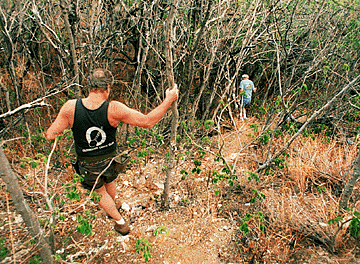
Honolulu businessman Ron Sorrell follows his friend along a Diamond Head trail through heavy kiawe growth. "There's a whole world going on up there," said Sorrell. "It's kind of freaky."
Photo by Dennis Oda, Star-Bulletin