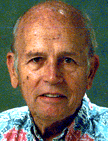
At Palo Alto, Calif., he will turn over the chairmanship to Herbert Hoover III, grandson and namesake of the former president, who created the institution in 1919 after World War I to promote peace. Anderson will stay on Hoover's board of overseers and its executive committee for three more years.
Under Anderson the institution has had three main goals: (1) wider, faster dissemination of its scholars' views, including a forthcoming dip into Central California public TV that could be expanded later on; (2) greater synergy with Stanford University, its host campus, in the form of joint Hoover-Stanford appointments; and (3) a quest to increase its $150 million endowment through a wider contributor base.
Hoover allows some 80 distinguished scholars, four of them Nobel laureates, to think, study and write under an umbrella of financial security on five-year appointments. Many more, including some foreigners and mid-rank U.S. military officers, come to Hoover for limited periods of study, up to a year.
Hoover's 80 scholars tend to conservatism but aren't told what to think or write. At times they disagree publicly. They have done much to develop the flat-tax concept. Their positions sometimes takes liberal turns, as with Milton Friedman, the Nobel economist, and George Shultz, former secretary of state, teaming up to advocate drug legalization.
Anderson said a main concern of the institution is how power should be shared among a free market economy and federal, state and municipal governments. It is accepted that the economy should be as free as possible but must be regulated by government in the public interest. Where these two goals should interface is the concern of much Hoover study.
His 1995 report says, "There is a growing public realization that we either must accede to the gathering momentum of the welfare state or return to more promising ways of freedom."
Hoover research, facts and views are a counterpoint to the 30-second sound bites that now make up much of our public debate. I, for one, admire the challenges to popular wisdom posed periodically by Thomas Sowell on the Star-Bulletin editorial pages.
The views of Hoover scholars initially helped shape market and financial reforms in Russia but encountered political opposition. They seem to be disdained by Boris Yeltsin's new ally, Alexander Lebed, a foe of foreign influence.
HOOVER'S immense research library - 25 miles of shelves - contains major archives on the former U.S.S.R. and the Communist Party.
The views of some Hoover scholars underlie parts of the agenda advanced by the Republicans who took over Congress in 1994. This election year will be a test of how the agenda has been applied. Anderson wouldn't be surprised if voters continue a power split between Democrats and Republicans.
Rush Limbaugh advances many views that reflect writings of Hoover scholars. However, Anderson thinks Limbaugh, tuned to regularly by some 20 million people, "goes way too far in ridiculing government."
Debate is more temperate at the Hoover Institution level. "We don't need color, we need facts," says Anderson. "That's why we need think tanks."