 On Sept. 2 - Liliuokalani's 157th birthday - Hawaii's native people will learn the results of a controversial vote being overseen by the Hawaiian Sovereignty Elections Council.
If a majority of the ballots returned say "'Ae," - yes - native Hawaiians will choose delegates to propose a sovereign native government.
It will be a historic step toward restoring a nation that was last free under Liliuokalani's reign more than 103 years ago.
"I think that native Hawaiians need to get together and vote on this because this is the only valid, open and fair process that can accomplish what needs to be done at this point in time for us to take the next step toward some kind of sovereignty nation."
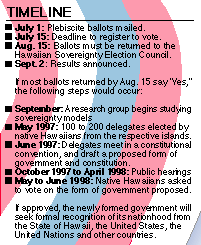 In 1994-95, the state and the Office of Hawaiian Affairs gave the council $1.8 million for the balloting. So far, it has spent $542,220 on the plebiscite campaign. The council dissolves on Dec. 31 of this year.
For the 85,000 Hawaiians receiving mail-in ballots this month, deciding whether to return the yellow "yes" ballot or the salmon-colored "no" ballot depends on what they think of the plebiscite itself.
Leading sovereignty groups such as Ka Lahui Hawaii and Ka Pakaukau are among 30 groups comprising a "Stop the State-Sponsored Plebiscite" coalition. The group has denounced the state, the elections council and OHA for holding the vote and have staged protests, workshops and rallies to stop the effort.
Ka Lahui - which McKenzie called the "engine of the opposition" to the plebiscite - recently stepped up its campaign with cable programs to counter plebiscite ads. One of Ka Luhui's concerns is that the vote will deprive Hawaiians of a plebiscite overseen by the United Nations.
What one expert says
Francis A. Boyle, professor of international law at the University of Illinois at Urbana-Champaign, has warned the coalition that if Hawaiians go forward with the vote, they may have no further right to a plebiscite under international law.
He reasons that President Clinton's 1993 apology to Hawaiians for the 1893 overthrow of the monarchy acknowledges that Hawaiians never relinquished their claim to sovereignty. By participating in the plebiscite, he said, Hawaiians would relinquish that claim.
"That's why this is so dangerous," said Lilikala Kame'eleihiwa, associate professor of Hawaiian Studies at the University of Hawaii.
Kame'eleihiwa said the plebiscite will bar Hawaiians from asking the U.N. to put them back on its list of indigenous peoples colonized by another country because they are working with the U.S. to achieve sovereignty.
If Hawaiians had remained on the list - they were removed in 1959 at statehood - they could have used the U.N. decolonization process to regain control over their land and government, the coalition says.
The bottom line, Kame'eleihiwa said, is the vote will mean Hawaiians have accepted help from the U.S. and do not want the international community to intervene.
"And, of course, in the international arena and in the world's eyes, America has to be seen to deal correctly with the Hawaiian people," she said. "I mean, look at us, we're charming, we sing, we dance, we're friendly, we have Aloha all over the world . . . If America is not treating us right, then America is in the wrong," Kame'eleihiwa said.
The coalition wants voters to void their ballots and mail them to Ka Lahui, where members will present them, along with petitions favoring the U.N. decolonization process, to a U.N. commission this November in Geneva, Switzerland. Meanwhile, the coalition is promoting a series of puwalu, or public gatherings, where decisions are made through consensus as an alternative to the vote. The next puwalu is to be in early September on Oahu.
Group's goals questioned
McKenzie said Ka Lahui and the coalition are trying to confuse people so they will not vote. She said a successful plebiscite would thwart Ka Lahui's goal to be recognized as the sovereign government.
"It's not pulling the wool over our eyes or many other Hawaiians' eyes. Most people understand what's going on as far as that's concerned," McKenzie said.
The council has distributed a handout that disputes arguments that Hawaiians should boycott the vote. For example, McKenzie said, Hawaiians would not forfeit their opportunity to hold an internationally sanctioned plebiscite.
Kanahele backs the vote
And while some Hawaiian groups oppose the plebiscite, others support it, most notably OHA and the Nation of Hawaii, headed by Dennis "Bumpy" Kanahele.
Kanahele was one of the first commissioners chosen by Gov. John Waihee in 1993 to serve on the Sovereignty Advisory Commission - the precursor to the council - before he resigned to form the Nation. Today, the Nation sees opposition to the council as a drain of time and energy, and supports the agency as a way to unify Hawaiians.
"The more the Hawaiian people are pitted against each other and divided over the issues such as this, the longer it will take to restore sovereignty and the narrower our window of opportunity grows," read a statement posted on the Nation's Internet web site.
A'o Pohaku Rodenhurst, a council member and Nation of Ku leader, was out last week promoting the vote with a band of sign-wavers, saying: "We encourage you that if you have one drop of Hawaiian blood, please register to vote."
 Billie Beamer
But some are confused. Billie Beamer, speaking on behalf of herself and not as an OHA trustee, told the Unrepresented Nations and Peoples Organization at public hearings here last week that she's in a Catch-22. If she votes "no," she may be seen as voting against sovereignty instead of against this plebiscite. A "yes" may be construed as a vote for a model of sovereignty that calls for secession from the U.S. instead of the state-within-a-state model favored by OHA.
The only alternative, she says, is to file an injunction to stop this vote until more education can be done. The Unrepresented Nations group is in Hawaii reviewing the status of Hawaiians at Ka Lahui's request. Initially, it found the plebiscite process confusing but will issue a report and recommendations on it this summer.
But McKenzie sees no need for confusion.
"It's a very straightforward question ," she said. "All this question means is, 'Do you as a Hawaiian want to elect Hawaiian representatives from your district to come together at a convention to gather and discuss all the sovereignty options?'"
The information responds to 14 questions about the vote asked by the Stop The State-Sponsored Plebiscite Coalition, Ka Lahui Hawaii and other opponents.
It says, among other things, there is no legal basis to claims the vote violates international law or that the state and U.S. government should have no part in the sovereignty process.
In fact, international law suggests the opposite, the handout says.
"We believe as citizens of this state and as taxpayers we have a right to call upon this state government to assist in this process of self-determination," said Mahealani Kamau'u, a council member and executive director of the Native Hawaiian Legal Corp.
"We understand that it is a fundamental principle of international law that colonizers (such as the United States) assist in such a process. And we have done what we believe is in good faith to move this process forward for our people," Kamau'u said last week at a press conference kicking off the vote.
Moreover, allegations that the state-funded council will remain under state influence are unfounded, the council says. When the Sovereignty Advisory Commission - the forerunner of the 20-member council - was created in 1991, it included members Ka Lahui and Ka Pakaukau.
No organization at that time claimed that the commission was state-controlled, the report said. More importantly, the council's legislative mandate dissolves on Dec. 31, leaving Hawaiians - if they vote yes on this plebiscite - searching for funds if they are to continue this process.
Also, claims that the vote discriminates against non-Hawaiians are incorrect, said Lulani McKenzie, executive director of the Hawaiian Sovereignty Elections Council.
Big Island resident Harold F. Rice in late April filed a federal lawsuit claiming he was denied voting rights in OHA elections because he is Caucasian and not Hawaiian, although he claims his ancestors can be traced in Hawaii before 1893, when the Hawaiian monarchy was overthrown.
U.S. courts, McKenzie said, have found that special programs for indigenous peoples, including programs such as OHA, where only native Hawaiians can vote for Hawaiian trustees to run an office designed to aid Hawaiian people, are constitutional.
It is this special political relationship between the governments and indigenous peoples that makes this native Hawaiian vote appropriate and legal, the council said.
Other claims challenged in "A Call for Hawaiian Unity: Setting the Record Straight" include council expenses, voter education and the registration process.