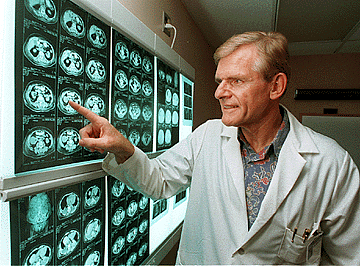
Dr. Brian Issell of the Cancer Research Center of Hawaii looks over CAT scans of an abdomen to monitor treatment.
Photo by Dennis Oda, Star-Bulletin
Dr. Brian Issell of the Cancer Research Center of Hawaii looks over CAT scans of an abdomen to monitor treatment.
Photo by Dennis Oda, Star-Bulletin
By Jim WittyThe cancer center was awarded a $2.3 million grant and affiliation with the National Cancer Institute
"I am really confident that one day we will be able to eliminate cancer," said Issell, head of the Cancer Research Center of Hawaii. "In 20 years we may be there. We don't know. But there's a phenomenal acceleration of information."
Much of the progress is being made in Hawaii, a key battleground in the campaign for a cure, he said.
The effort got a major boost recently with a $2.3 million, three-year support grant and designation as a National Cancer Institute cancer center.
The long-sought affiliation opens the center to an expanded array of research opportunities and gives it access to more experimental drugs for clinical trials, Issell said.
Twenty-five years ago, after President Nixon declared war on cancer, 162 out of 100,000 Americans died from cancer. Today, the rate has gone up to 174 per 100,000.
But Issell believes the Honolulu center is strategically poised to help turn the tide on several fronts, including:
For instance, Japanese people born in Japan face a "very low" risk of colon cancer. But one generation later, after moving to Ha
waii, they jump into the highest risk group, Issell said.
"We know that it is not all genetic," he said. "We focus on dietary factors."
The center has helped establish the National Cancer Institute and American Cancer Society's current dietary guidelines for cancer prevention.
Reasons may include low use of health services and inappropriate treatments for Hawaii's unique population mix, he said.
Issell said that although all cancers are different, a cure will be possible when scientists discover precisely what it is that makes a cancer cell different from a normal cell. He's optimistic that researchers are closing in on that knowledge.
The grant will be used for "core functions" of the center including new cancer research initiatives, he said. The Cancer Research Center operates on a $10 million annual budget, less than $2 million of which comes from the state. The balance comes from grants, Issell said.
To reach the center's Cancer Information Service, call 1-800-4-CANCER.