 They don't have the marketing muscle of the Big Three. No one will confuse them for AT&T, MCI or Sprint.
Yet resellers of long-distance phone services are capturing a small but growing chunk of the $66 billion-plus U.S. market. And in recent months, they've been increasingly setting their sights on Hawaii.
Since the beginning of the year, at least two new players have entered the Hawaii-mainland market: GTE Long Distance and WorldxChange Communications.
Others, including Excel Communications, also have established a presence here, mainly through independent representatives, who sell calling plans in much the same fashion Amway dealers hawk their products.
Some resellers tout their services long distance: sales people on the mainland make their Hawaii pitches over the phone.
Resellers started springing up nationally after the federal government opened the long-distance market - once the exclusive domain of AT&T - to competition in 1984. Hundreds of them now compete, though only a handful have extended their reach to Hawaii.
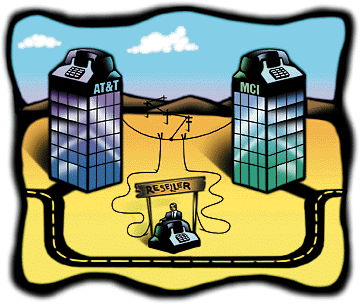
Resellers typically don't own the phone lines. They lease capacity from so-called facilities-based carriers - the AT&Ts and Sprints of the telecom world - at wholesale rates and resell the service to customers, usually touting low prices.
Nationally, most resellers focus on business customers. Residential service is much more difficult to market - especially stacked against the massive advertising campaigns of the Big Three - and the profit margins are smaller, according to Khali Henderson of the Telecommunications Resellers Association, a Washington, D.C.-based trade group.
In Hawaii, though, resellers are trying to lure customers in both markets. But capturing market share from AT&T and Sprint, the two dominant players locally, will be difficult because customers won't easily switch to small, little-known carriers, industry officials say.
It's also difficult comparing the cost of competing calling plans. Some carriers price calls based on distance. Some use time of day. Some use both. Some offer discounts based on the volume of calling.
Further complicating things, many resellers charge a basic monthly fee, which pushes up the per-minute pricing they refer to in their marketing.
When Consumer Action, a San Francisco-based consumer advocacy group, compared the offerings of 15 long-distance companies earlier this year, it found some resellers that consistently underpriced the Big Three.
Ken McEldowney, Consumer Action's executive director, said evaluating a reseller is no different than evaluating any long-distance company.
Ask about rates, restrictions, service capability and other factors, then match that to your calling patterns.
"There's no way of saying what company is best," he said. "It's just a matter of how you use the phone."
If resellers offer only slight savings, McEldowney said he would tend to favor facilities-based carriers. Resellers operate at such slim profit margins that they don't seem to be as flexible in meeting special needs of customers, he said.
Eric Tom, general manager of Long Distance/USA-Sprint in Hawaii, cautioned that customers need to look at more than just cost.
When people have problems with a reseller's service, they have to call customer-service representatives on the mainland, he said. And because the reseller doesn't control the phone network, a satisfactory resolution to the problem may not come as quickly, he said.
"It's not their reputation they're selling," Tom said. "They're selling price."
But reseller proponents dispute that.
In today's high-tech world, they say, resellers can offer quality service no matter where staff members are based.
"As long as they have information on their (computer) screens in front of them, I don't think it makes much difference whether they're down the street or across the country," said Bruce Robin, a Honolulu-based telecom consultant who does work for resellers.
On the rare occasion when a network problem occurs, it typically is handled from the mainland anyway, Robin said.
And the owner of the network is just as interested in resolving the problem quickly because the problem affects the owner's customers, too, resellers say.
By early next year, reselling will be more than just a long-distance issue for Hawaii residents.
When companies like AT&T and Sprint begin offering local phone service, they initially will do so using Hawaiian Tel's network.
Until they develop networks of their own, those companies will have to lease capacity from Hawaiian Tel - or any other carrier that sets up a local system - and resell the service to customers.