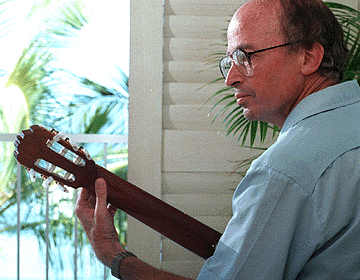
Carlos Barbosa-Lima performs in the intimate setting of
Indigo restaurant on Wednesday.
Carlos Barbosa-Lima performs in the intimate setting of
Indigo restaurant on Wednesday.
By Tim Ryan
Star-Bulletin
Brazilian guitarist Carlos Barbosa-Lima, who performs in two dinner concerts Wednesday at Indigo Restaurant in Chinatown, is all these things. Maybe more.
"The guitar is like a second body, always next to me," Barbosa-Lima, 51, says during an interview at a Diamond Head beachfront apartment.
"I have always loved its intimacy. You hold it close to your body; there's always contact. I can feel it vibrate through my body when I play. I caress it and it responds. Well, usually."
Barbosa-Lima, who is moving to Puerto Rico this month from his New York home of nearly a quarter century, has traveled the world performing his unique style of Brazilian guitar that meanders among classical, Brazilian and jazz.
He performs solo, sometimes with good friend Charlie Byrd, or with symphony orchestras and has more than 30 albums to his credit. His most recent release is "Twilight in Rio."
But mostly, Barbosa-Lima plays the way he lives, solo, solitary. He travels alone, practices alone, lives alone, has never married. He is, Barbosa-Lima jokes, "married to music."
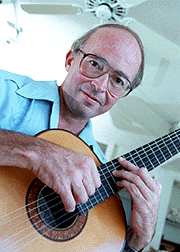 On this picture postcard day in paradise, Barbosa-Lima explains how much he enjoys "communicating with nature playing in such a beautiful place as Hawaii." He points to a lanai chair just a few feet away from swaying palms and the ocean six floors below.
"I very much enjoy sitting there while the sun sets and the moon rises. It is beautiful and inspirational, no?"
The Spanish guitar has conquered a lot more territory than Spanish kings. It's portable, adaptable, dulcet and polyphonic - no wonder it has become the international instrument.
The tunings may change, and a player might use fingers, finger picks or plectrum; a microphone or electronic pickups may amplify the music beyond the reach of natural, hollow body resonance. But the basic principles of strings and frets, plucking and strumming, have affected music cultures everywhere.
Barbosa-Lima suggests that the guitar may be the ultimate post-modern, multicultural instrument. He should know. He has come to the business of musical diversity honestly, almost as a matter of cultural birthright, Brazil having been a critical musical crossroads in this century.
Barbosa-Lima's recitals gracefully support the melting pot theory, from the myriad influences in the music itself to the transforming hand of the guitarist's arrangements. His musical selections often have been praised for their "accessibility" and "diversity."
"Diversity is very important for the audience and the artist," he said. "The common denominator is always the classical foundation. Then you expand your tastes.
"I like to explore all the angles, capture the flavor of other styles and mold it to my guitar which, I believe, is a little orchestra in itself."
He was born in Sao Paulo and began studying the guitar at age seven after a chance encounter in a guitar store with Luiz Bonfa, Brazil's top guitarist at the time. Barbosa-Lima would later study with Isalas Savio, the father figure of the modern Brazilian guitar movement, and in 1968 with the legendary Andre Segovia.
Barbosa-Lima recorded his first album at 12 - earning $500 thanks to his father-turned-agent - and appeared regularly on Brazilian television.
Although the Spanish guitar had both virtuosos and enthusiasts long before Andre Segovia made his public debut in 1909, it was Segovia's evangelical zeal, Barbosa-Lima says, that brought the instrument into the mainstream of concert life.
The guitar at the time was little esteemed outside of flamenco and other folk idioms, and guitar recitals were unknown. In 1924, however, Segovia played in Paris to great acclaim, and his first concerts in the United States in 1928 were hailed by critics. Segovia thoroughly revamped the technique of the guitar and enriched its repertoire with numerous transcriptions of works originally written for other instruments, Barbosa-Lima said.
So it comes as no surprise when Barbosa-Lima says it was Segovia who gave him the best advice.
"He said to be myself, that I had my own style, and that is what I should develop, not copying someone else. 'Listen to all kinds of music and try to search my soul for how it makes me feel.' "
The reporter asks to touch Barbosa-Lima's hands. They are pink and soft. The tips are calloused. The left hand is more muscular than the right.
He has trained himself to do many things with his left hand - especially to open doors and pull zippers - to protect the nails on the right which are used for strumming.
Even after nearly 40 years of strumming, Barbosa-Lima may practice as much as four hours. "Learning, of course, in any endeavor, never ends. Because I am interested in new styles there are so many refinements to master. By avoiding repetition, I avoid tedium."
Observing Barbosa-Lima gently laying his much traveled guitar in its case, you can imagine him as a doting father cradling a child, a husband caressing his wife.
"I think music and women resemble each other very much. Segovia said both are very unpredictable and require so very much attention. This is the one I have chosen."
What: Carlos Barbosa-Lima in a dinner performance
Seatings: 6 and 8:30 p.m. Wednes-day, with shows at 7:30 and 10 p.m.
Where: Indigo, 1211 Nuuanu Ave.
Cost: $50 per person
Information: 956-7221