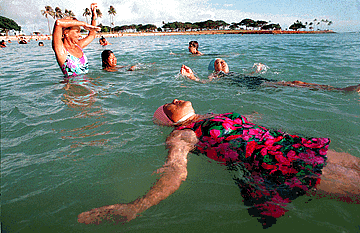
Instructor Peggy Anderson works with beginner swimmers
at Ala Moana Beach Park. By Kathryn Bender, Star-Bulletin
Instructor Peggy Anderson works with beginner swimmers
at Ala Moana Beach Park. By Kathryn Bender, Star-Bulletin
Her defining moment came in water over her head, arms and legs gracefully parting the water, keeping all her 107 pounds afloat. Her movements became fluid, relaxed, and, finally, controlled.
Lee said she realized that if she were on a boat and fell overboard, she'd be safe.
"At least I can go on my back and float," said Lee, now 76. "I accomplished something. When I was growing up, I never did go in the water."
The ocean has become her playground and a source of relaxation.
Lee learned to swim through the American Red Cross program, which offers free swimming lessons for adults and children at Ala Moana Beach Park.
And if it were up to Oahu's No.1 lifeguard, more people would show up there for lessons. "More than half the kids here don't know how to swim," said Ralph Goto, head water safety administrator for Oahu.
He said Oahu lifeguards make on average 800 to 1,000 rescues a year. Too often he sees people depending on boogie boards or scuba gear before they've mastered basic swimming and survival skills. "It's backward."
In a state surrounded by water, there's a false notion that people just naturally know how to swim with "visions of children frolicking with the marine life. Swimming is a skill that needs to be taught."
Hawaii isn't churning out Olympians because it lacks a broad base of elite swimmers, Goto said. "It's not poor coaching," he said. "We don't have enough kids who know how to swim."
The question becomes who's responsible for children learning to swim -- parents or the community? A mandatory learn-to-swim program at public schools may be worthwhile, Goto said, especially because less-affluent areas often produce fewer competent swimmers. Some private schools, including LeJardin and Punahou, already have swimming requirements.
"If we can get to them before they get in trouble (in the water), it's less traumatic for everyone," Goto said.
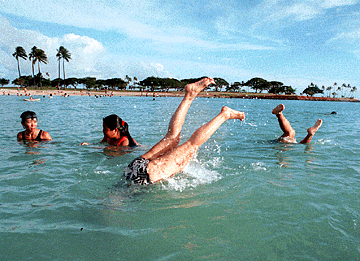
Swimmers practice hand-stands as part of a Red Cross beginning adult swimming class at Ala Moana Beach Park. Despite bing surrounded by water, Hawaii has a disproportionately low number of residents who know how to swim.By Kathryn Bender, Star-Bulletin
For some of the old-timers, the classes have become a social hour with shared giggling and teasing between turns. Many of them meet early in the morning to practice swimming.
"They don't want to graduate," Doyle said. "They don't want to leave their friends."
He points out a few swimmers prodding each other along and said, "You couldn't split those three up with dynamite."
Robyn Thomson is one of the volunteer instructors who has been with the swim program for years. One of her most memorable students was Norma, a woman who lived in Hawaii her entire life and learned to swim in her 70s after her kids were grown and out of the house. In the beginning, she didn't want to put her face in the water and held onto the instructor with a white-knuckled grip. "She was really nervous," Thomson said.
But Norma progressed from paralyzing fear to swimming in deep water by the summer's end. She'd swim the crawl, then flip over on her back. And she fell in love with the water.
"She was so stoked!" Thomson said. "For her to make it all the way was just incredible. She was really mad at herself for spending her whole life in Hawaii and not going in the water."
Then the bomb dropped - Norma had to move to Oregon.
"She was sad," Thomson said. "She'd spent her whole life in fear of what she was living around."
But Thomson encouraged Norma to check out pools in Oregon, telling her, "You can still swim there."
Classes meet at Ala Moana Beach Park. Call the American Red Cross for details at 734-2101. Adults: Session II July 8-30; Session III Aug. 5-22. Kids: July 6-Aug.10.
Drowning is the second leading cause of death from unintentional injuries for those 5 to 24 years old, and the fourth leading cause of death for all ages, according to a 1995 National Safety Council accident report. Here are some water safety tips:
- Always swim with a buddy.
- Know your swimming limits and stay within them. Don't try to keep up with a stronger swimmer or encourage others to keep up with you.
- Alcohol and swimming don't mix.
- Watch out for dangerous "toos" - too tired, too cold, too far from safety, too much sun.
- Always wear a Coast Guard-approved life jacket when boating and fishing.
- Know local weather and surf conditions.