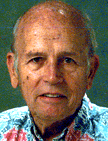
Have we failed? Not entirely, says Brian Issell, director of the Cancer Research Center of Hawaii, a branch of the University of Hawaii.
Cancer is primarily a disease of older people and Americans now are living into their 70s and 80s in large numbers. On an age-adjusted basis, we are beginning to see a downturn in cancer deaths. Cure probability is up from 30 percent to 52 percent.
Cancer comes in over 80 varieties. Considerable success is being achieved with those that affect the young. Breast cancer recoveries are improving, too.
All cancers involve cells that spin out of control and keep reproducing themselves almost to immortality when normal cells heed body signals to stop. Computer studies of the immensely complex structures of all cells are helping us to understand this better.
Hawaii studies have contributed much to the now-common knowledge that fish, fruits, vegetables, grains and high fiber diets contribute to keeping cells under control whereas high fat diets and smoking help them break free from normal restraint.
Hawaii is a living laboratory where researchers can study the important roles played in cancer by different ethnicities, genes, cultures, diets and lifestyles.
We see Japanese in Japan having the world's lowest rate of colon cancer while Japanese in Hawaii have the highest. Why? Diet is suspected, but there are many variables. In some cultures differences may turn on resistance to early detection.
So good is the UH Center that it gets $7 million in federal grants to supplement less than $2 million from UH. It is a recently designated National Cancer Institute Cancer Center, one of 56.
It also is so good that the enormous M.B. Anderson Cancer Center at the University of Texas with more than $100 million in grants is considering joint clinical research with the center and Hawaii's hospitals. This might mean creation of our first cancer ward, with nine to 20 dedicated beds.
I explored with Issell my personal concern about the vastly underused option to refuse treatment and opt for comfort care only. He tells UH medical students this can be reasonable in many cases but runs up against an ingrained "do something, doctor" syndrome. "Do nothing" people may even live on in reasonable comfort for several years.
Issell would like to see more of the "do something" patients in dire straits opt to accept experimental treatments. They could thus help science.
Key treatments still are radiation, chemotherapy and surgery, all of them hard on the patient. They are justified if they can bring a cure, as they often do. Sometimes, however, they only run up bills and stretch out the dying period with prolonged discomfort.
I see this among too many of my friends. I would like to see it reduced by better understanding that death is the natural, inevitable end of the process that starts with birth. It often can be a friend, not an enemy. One new, less intrusive treatment is hormone therapy. It doesn't cure but can lengthen useful life.
THE Cancer Research Center of Hawaii is 25 years old. Since 1981 it has occupied a free-standing building especially built for it on Lauhala Street adjacent to Queen's Medical Center.
Its 170 staffers are organized into sections focused on diet, what makes cells "go wild," the development of new therapies based on natural products, prevention and control through clinical trials and a cancer information service. The center also maintains the Hawaii Tumor Registry.
All new cases are reported to it and follow-up data fed in. It has shown, for example, that different ethnic groups respond differently to different drugs. It is the foundation of the center's research and key to Hawaii's contribution to overall better national understanding and care of cancer.