
Old-fashioned superstition and mysticism
have more than likely had an influence
on even the most modern of homes
Story by Burl Burlingame
Illustrations by Kip Aoki
Star-Bulletin
 THE yard is mowed. The hurricane clips are screwed on tight. The circuits are grounded. The attic is cooled by The Waianae Solution. The lightning rod is poised. The dog is snoring but still vigilant. All seems secure and happy in your little corner of the homeowners' market.
But wait - is your home safe in the dragon's navel?
We'll explain that later. In the meantime, even though you're a thoroughly modern person, there's a good chance pure, old-fashioned superstition played a part in your home.
The concept of home and hearth and hoodoo goes back as far as anything CAN go back. Prehistoric cavemen probably had traditional superstitions about pitching the bearskin tent north-south instead of east-west. It was better that way at keeping the cold winds out, but if you wanted your descendants to remember the custom, you told them it was because the Big Bad Bear Ghost insisted on it. Or else.
In pre-literate cultures, this kind of palliative acted as a kind of memory mnemonic, suggests Bill Chapman of the University of Hawaii Historic Preservation Department. "In ancient times, you needed prodigious feats of memory to keep everything straight. In medieval times, artisans memorized the facts needed for building something by imagining a kind of giant structure where specialized knowledge was grouped in rooms. It was a trick to organize the memory."
In this way, useful knowledge morphed into superstition, common sense devolved into ritual, and Chinese farming tips became the mystical art of feng shui (fung shway), without which no self-respecting Hong Kong business tycoon dares act.
One of the major changes facing Hong Kong when it swaps governments next year will be how officials handle mysticism. Hong Kong planning maps have a layer for geomancy, the magic of topography, charting out the ebbs and surges of mystical powers. It actually affects city planning. Officially, the Communist Chinese do not subscribe to mystic principals other than those in The Little Red Book. So one of the power struggles will take place on the cosmic plane. Cool.
Superstitions encountered in Hawaii often grow out of Western and Eastern cultures. Take the blessing of buildings by priests. In ye olde Europe, holy men sanctified the grounds of churches and cathedrals and usually the castles of the king, because he was next to God. Japanese immigrant populations had high percentages of Shinto believers, and Shinto priests made it a practice to consecrate everything that isn't tied down. So did Hawaiian kahunas.
The various ethnic practices merged and became popular culture. As a result, Hawaii has more blessed buildings than anywhere else on earth. You can't turn a spadeful of dirt or even redecorate without calling in a holy person to give it a spiritual thumbs-up. Mainland priests who move to Hawaii are often stunned by the sheer number of building-blessings, says Hawaiian legend raconteur Glen Grant.
"And then, you always hear about the terrible accidents that happen when a building or construction site isn't blessed," Grant said. "It's a kind of modern urban legend."
Rev. Abraham Akaka, who has probably blessed more buildings than anyone else on this earthly plane, says that the act is a way of connecting "with a higher power in control of creation," which puts your own little creation - even if it's a skyscraper - properly in the scheme of things.
"In every religious ceremony, no matter how different, there's a basic meaning: they want to be blessed," Akaka said. "It's like many different canoes in the water voyaging toward dreams and hopes beyond the horizon. The guiding star is high and above them, but very real too."
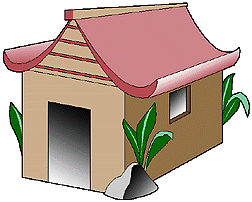 Here are a few architectural superstitions that can be seen locally:
- Curving the corners of a roof line upward. This supposedly makes bad spirits slide up and off a roof. This design is so common in Asia that it is a kind of vernacular architecture, and you can still see it on many older bungalows in Honolulu. Carpentry-wise, it's a pain. It's not known if this design is more or less stable in hurricane-force winds, however.
- Not keeping the front and back doors aligned. Some Filipinos believe spirits of the dead find it easier to cruise a house if there's a straight shot through it; some Chinese see the alignment as a way of letting fortune slip too easily through the house. Some modern architects see the alignment as a way of creating your very own wind tunnel.
- Conspicuous ti plants in the yard. In ancient times, ti was used to mark the boundaries of kapu territory. That tradition has carried over to planting ti at the boundaries of a new property. Some say red ti in the front yard is bad luck. The old European tradition of nailing an oak sprig to the ridgeline of a newly constructed house can be seen in bouquets of ti tied to new ridgelines.
Some superstitions are so ingrained they have invisibly colored even everyday functions. We called architect Glenn Mason to talk about this subject, and he believed most local architectural superstitions came from Asia. But his own name reveals a complex and long-standing Western belief system of imposing order on chaos.
Western designers - back into prehistory - believed that order and harmonic symmetry can be reduced to a mathematical formula. These formulas became bound up in the arcane art of numerology, and became trade secrets known only to a select few. By the Age of Reason - ho ho! - elaborate rituals with religious overtones codified these beliefs.
Yep, we're talking about the Masons, who refer to God as "The Great Architect of the Universe." By the late 1700s, guys like Mozart, George Washington, Benjamin Franklin, Voltaire, King Frederick II and others were routinely participating in secret ceremonies, dressed in elaborate costumes, and venerating humble building tools as if they were pieces of the True Cross.
By the 1830s, average people got fed up with the elite, secretive nature of the Freemasons and an anti-Masonic movement swept the land. But the Masons reinvented themselves in the late 1800s as a fraternal organization, and today is one of the largest such in the world. Masons still have secret ceremonies and elaborate rituals, but the goal is more likely to be community service rather than imposing a blueprint on the universe.
Their influence was pervasive. Look at the dollar bill, with the pyramid and the floating eye: Masonic icons. Look at the practice of laying cornerstones: Masonic ritual.
It was the superstitious medieval practice of numerology, however, that has had the greatest and most invisible effect on architecture. The Masons simply tapped into that numeric tradition and ritualized it.
"There are numbers that were thought to be 'perfect' on a mystical level," Chapman said. "They included 3 and 4 and 8. The fallout is that our whole way of measuring architecture is based on mystic numbers. The foot is 3 times 4 inches, or vice-versa. Studs are nailed 18 inches on center. The 'average' room is 12 by 12 feet. Boards and sheet-rock are 4 by 8 feet. Three bricks together make 24 inches. That sort of thing."
The combinations of these numbers made up a European "mystical ideal of perfect proportions," Chapman said. "So that a properly designed building was actually an exercise in mathematical harmonies." It also explains why, even through the metric system originated in Europe, it has been slowest to take root in England and America. The meter may be more precise, but the yard is a toehold on the golden proportions of the universe.
Is it strictly European? Before the Japanese went metric, their units of measurement were the shaku - almost exactly the English "foot" - and the tatami, which is 3 by 6 feet.
In "The Old Way of Seeing," author Jonathon Hale explains it as "The Golden Section" (also known as the "Divine Proportion"), a mathematical formula of ideal dimensions: A is to B as B is to C, and A plus B equals C. There are complicated ways of figuring it, but it boils down roughly to 1.618, or 3 by 5. Anything containing these proportions are ideal. Examples include the chicken egg, the chambered nautilus, the average tree, the Great Pyramid of Cheops, the Parthenon, Chartres Cathedral and Audrey Hepburn's face. Think of that when you add on to your house.
Which brings us full circle to the dragon's navel.
 he hottest topic in architectural superstition these days is feng shui, which literally means "wind and water," the balance between the causal and the unfathomed. Essentially, it is a quest to create a harmonious built environment between the natural balance of earth and heaven.
It began, near as anyone can tell, way in the B.C. in China, and like most apocrypha, began as a shared perception of the environment that led to certain dogmas. Later, different schools of thought redefined the various "rules," and today it's tough to get a precise fix on proper feng shui. Today, according to Asian astrology scholar William L. Cassidy, feng shui "has become corrupted to contain absurd notions of interior decoration, the use of charms and talismans, the runaway concept of site 'improvement' ... all for a hefty fee."
Even so, some people today won't make a move without consulting a feng shui geomancer. Take your pick. The bookstores are also full of feng shui handbooks.
Some of the notions are common-sensical. For example, siting your home halfway up a rise - a "dragon" or a "tiger" - uses the strength of the topographic formation to protect the home. Too high, and the wind gets it; too low, and it could flood. Safe in the dragon's navel, then, is the place to be.
Tell it to Marvin and Mika Lee of Kaimuki. Their 65-year-old house has an indentation where the kitchen is. Since the kitchen is one of the three "power spots" of the home, along with the bathroom and entranceway, they are rebuilding it to make the house more square. "The problem is that the kitchen is on the northeast, which is a kind of power corridor," Mika says. "Making the kitchen side more square will channel that energy to our benefit."
Wish them luck.