
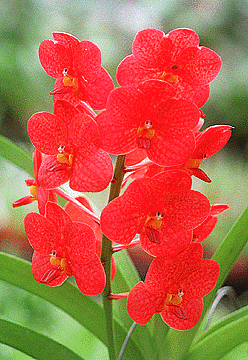
Vandas come in magnificent colors, including the medium red of Ascda Duang Tarn "Robert."
The word "vanda" is derived from ancient Sanscrit, and refers to the sacred mistletoe found on Vandaca oak trees.It's a stretch, because Vandas have nothing to do with mistletoe and don't grow on oak trees, but the botanist Robert Brown - who established the genus in 1820 - liked the name. Since then, people have been cultivating Vandas for a variety of reasons. They most often list the magnificent colors, the number of blossoms and the ease of growing as strong points. But not Douglas Schafer.
Schafer, a retired submariner, has been growing Vandas for 15 years, and he started with Vandas so he wouldn't have to wash pots. "My wife had taken a series of classes at Lyon Arboretum from Dr. (Yoneo) Sagawa and Ben Kodama and became an enthusiastic grower of Dendrobiums and Cattleyas. When I came back from sea duty, I'd help her by building benches and scrubbing pots.
"I got pretty interested in orchids, but I wanted to grow something that wouldn't need a lot of repotting."
Schafer grows his mature Vandas in slatted teak baskets that he imports from Thailand. "I tie the seedling in the basket with no planting medium, and water it every morning," he said.
He first learned about Vandas at a visit to the Maui County Fair in 1981, where Roy Fukumura was exhibiting his hybrids. Schafer went home to Pearl City and started growing Vandas and is now an accredited judge with the American Orchid Society. His first piece of advice is to read a book about Vandas if you plan to seriously delve into cultivation.
He recommends "Orchid Growing in the Tropics" published by the Orchid Society of Southeast Asia and "Vandas and Ascocendas" by David L. Grove. Both are in the public library.
"Vandas are easy to grow in Hawaii, but you have to understand them. I see friends buy an orchid and it dies, so they buy another one. The last thing they need is another orchid, what they need is a book," Schafer said.
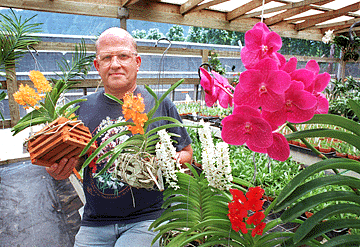
Douglas Schafer began raising Vandas 15 years ago.
"Don't group the plants close together because they need air movement. If you're using pots, don't let the roots from one pot twine into another pot."
Buying a blooming plant is a cop-out among the serious growers. Real men start with seedlings in 2-inch plastic pots. Schafer's anti-pot program breaks down here, because he immediately repots the plants in small clay pots.
"The plant breathes better in clay, the pot is heavier and less likely to fall over," he explained. He uses a mix of 1 part charcoal and 1 part coarse perlite to 3 parts bark. "I don't use hapu'u because it eventually breaks down, and when it does it kills the roots," Schafer said.
When the roots have developed, he then transfers the plant to a teak hanging basket. "I picked up the idea in Florida. The Vanda can take a lot more rain in a basket than a pot."
If the way to grow succulents is to duplicate the climate of Phoenix, Ariz., the way to grow Vandas is to come as close as you can to the weather in Chiang Mai, Thailand.
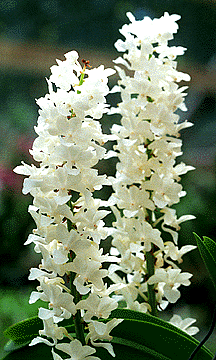
Rhynchostylis Coel-estis alba produces tiny white flowers.
Vandas require strong light, and full morning sun is recommended. Plants that receive too little light will grow leaves that are dark green and noticeably longer and wider than those on properly treated plants. Watch the development of mature leaves, and if they seem too large, move the plant into more light.
"Water is a critical factor," Schafer said. "If you are using a fine planting medium you shouldn't water as often as if the plant is in a basket. Vandas do better in baskets hanging from the eaves or trees than on the ground, partly because of the drainage. Keep water out of the crown of the plant, where the leaves meet at the top."
Schafer added that the last thing that an ailing Vanda needs is fertilizer. "Don't try to correct things by fertilizing. If your Vanda isn't growing well, clean it up, repot it, cut off the dead roots and put it into a shadier location." Fertilizer will cause a salt build-up that a healthy plant can absorb but a sick one can't. "A bad sign is to see the leaves closing up," he said. Schaefer uses a good quality, balanced, water-soluble fertilizer, usually a 20-20-20 or 15-15-15. He fertilizes every other week.
Every third feeding, or every six weeks, he uses a fertilizer with higher phosphorus content (with a higher middle number to increase flowering); he flushes plants out with clear water monthly.
Schafer will present a hands-on workshop on Vanda orchid culture at the Farm Fair July 6 from 8 to 9 p.m. The fair opens today at Aloha Stadium.