
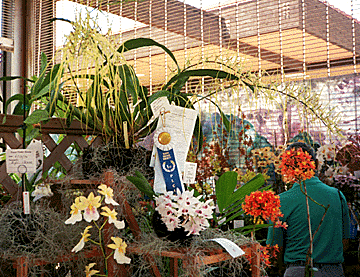
Brassia Rex was tops in the Kauai Orchid Society summer show. Photo by Joan Conrow, Star-Bulletin
The award for Best in Show and a citation from the American Orchid Society went to the Brassia Rex grown by Alan Yamada. The plant produces sprays of yellow flowers with very long, spiky sepals and petals that open in rapid succession. This particular plant was chosen, a judge explained, because of the vigor of the flowers and their symmetrical arrangement along the stem.
This is not a difficult orchid to grow, and it is usually cultivated in pots or baskets, using a light, rather fine planting medium with good drainage. Like most orchids, Brassia Rex should be watered only two or three times a week. Brassia will grow best in partial shade, never in full sun.
Many growers recommend using a reduced-strength fertilizer as often as once a week, rather than at full strength once a month. Look for a fertilizer high in nitrogen (the first number in a fertilizer formula) when the orchid is not in flower, and a high phosphorus fertilizer (the middle number) during blooming season.
At the show, hardcore orchid growers walked slowly among the entries, discussing carriage (the manner in which flowers growon the plant), and crosses (the parent plants from which hybrids are produced). The more dilettante viewers recognized the Cattleyas they wore at the Senior Prom.
Jean Inouye, president of the Honolulu Orchid Society, was one of the show's five judges, all accredited by the American Orchid Society. It takes years of apprenticeship and exams before being named a judge, and Inouye was most interested in the species orchids of Makai Farms' Robert Wolaver and Michelle Carroll.
Just as hemlines go up and down and vans replace station wagons, there are fashion forward orchids. The newest thing is the oldest orchid, the species.
The majority of orchids in garden shops today are hybrids, or crosses, between two different orchids, a process developed 140 years ago by an English gardener. Today there are about 80,000 different hyrids, but all of them come from the original or species orchids first found growing in the wild. It is these early orchids that growers are returning to.
The species craze began early this century when millionaire enthusiasts collected tens of thousands of specimens of individual species to exhaust the source and corner the market. Wills were written instructing heirs to destroy orchid collections so no one else could enjoy or profit from it.
One of these species orchids, Vanilla imperialis, is the only one in the huge family of orchids with any commercial value beyond its beauty. The drudge among the charmers, the vanilla orchid is grown for its beans, which are cured, dried and distilled into the economically important flavoring.
Vanilla orchid plants resemble vines and can grow as long as 75 feet. But they can't support themselves, and have to grow on something. To accommodate the vines, Wolaver planted a small forest of gliricidia, a fast-growing tropical tree first cultivated by the Aztecs to shade their cocoa plants.
While vanilla orchids are easy to grow, their sex life is a head-
ache. In Hawaii, lacking the plants' natural pollinators, they are pollinated by hand. This may be more fun for the orchid than for the person performing the long and tedious task. When done right, the pods will begin to appear. After 7 to 9 months, the green pods will turn yellow at the bottom and are harvested.
But there's more. The pods must be cured because if they are dried out too quickly, they shrivel and turn black. "What we do," Carroll said, "is to plunge the green pods into boiling water for 20 seconds, and then put them in the sun to dry. Every night they are wrapped in wool blankets to retain some of the heat."
When you put this all together - from planting the tree that holds up the vine that won't grow pods unless somebody intervenes, to picking and bathing the pods and putting them to bed each night in a blanket - it's a whole lot easier to buy your vanilla at the supermarket. That's what Wo-laver and Carroll are counting on.
Families and children are welcome to participate in a pot luck dinner that starts at 6 p.m. with the walk taking place after dark in the American section of the Koko Crater Botanical Garden.
Walkers should bring a flashlight.
For more information, contact society vice president Nathan Wong at Foster Garden, 522-7063.
"The Nature of Hawaii," a series of oil paintings and pastel sketches of native Hawaiian plants, animals and landscapes, will be on view 9 a.m. to 4 p.m. daily from July 4 through 31st.
Opening festivities will be held 5:30 to 8 p.m. July 6, during which Brong will discuss her work. Another meet-the-artist session will be held 11 a.m. to 4 p.m. July 7.
Ho'omaluhia is at 45-680 Luluku Road in Kaneohe.