Sports Watch
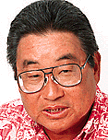
Becker was one of just five sportswriters who covered Jackie Robinson in 1947 when he became the first black player in modern major league history.
Brooklyn's Ebbets Field, which sat around 30,000 fans, wasn't sold out for the historic game against the Boston Braves. But to hear all the people who claimed to have been there, you would have thought the seating capacity was 100,000. It's akin to all those people who said their relatives came over on the Mayflower.
"I didn't," admitted Becker. "I came on the next boat."
Well, he's old enough to qualify. But Becker was there on the scene, observing first hand the emancipation of baseball.
"It was the most important day in the history of sports. Believe me, I was there," Becker told the Honolulu Quarterback Club at its noon luncheon yesterday.
"We didn't want to make a spectacle of the thing," Becker said, explaining why the coverage of Robinson's debut was so low-key.
THE five reporters didn't all huddle at Robinson's locker. They spread themselves around in the clubhouse, chatting as well with the other Dodgers - Pee Wee Reese, Dixie Walker, Kirby Higbe, Eddie Stanky and Hugh Casey. All were from the South, by the way.
Today, instead of five, there would be 5,000 media types all crowding around Robinson, trying to get him to say something in order to blow it out of proportion, according to Becker.
Robinson played first base in the game and went hitless in four at-bats, grounding into a double play.
He was asked after the game, "Was it a case of being nervous?"
"Hell, no," Robinson replied. "It was because Johnny Sain was pitching."
Robinson went on to become the National League Rookie of the Year and the Dodgers won the league title and joined the New York Yankees in one of the most thrilling World Series ever played.
TODAY, blacks in baseball, in all sports for that matter, are taken for granted. But trying to comprehend the racial discrimination that existed when Robinson first broke in still boggles my mind.
What Robinson and Branch Rickey, the courageous Dodgers' owner, did 50 years ago deserves to be told and retold.
Knowing that Becker would be talking about that dramatic moment in baseball, I reread one of the best books ever written about Robinson and Rickey - "Baseball's Great Experiment - Jackie Robinson and His Legacy," by Jules Tygiel.
Rickey knew all along what he was doing and found the right person in Robinson, a gifted four-sport athlete from UCLA.
Rickey and Robinson knew what the burden of being a racial pioneer was going to be like. Robinson's decorum would have to be beyond reproach and he was not to retaliate at the race-baiting that would occur.
That Robinson would get an earful of the N-word was nothing compared to some of the abuse he encountered, especially the ordeal of spring training in Florida. He and his wife sat at the back of the bus en route to his first camp. Even in his early years with the Dodgers, he couldn't eat with his teammates in hotels in St. Louis and Cincinnati.
When Robinson retired from baseball after the 1956 season, three teams were still all white - the Philadelphia Phillies, Detroit Tigers and Boston Red Sox - the latter having the dubious distinction of being the last to be desegregated in 1959.
Baseball has come a long way in terms of race relations, and it owes a great debt to Jackie Robinson.
Unfortunately, after 50 years, the thought that one of the benefactors of his legacy is a surly and unappreciative Albert Belle shows that it is still far from being a perfect world.