By Alan Matsuoka
Star-Bulletin
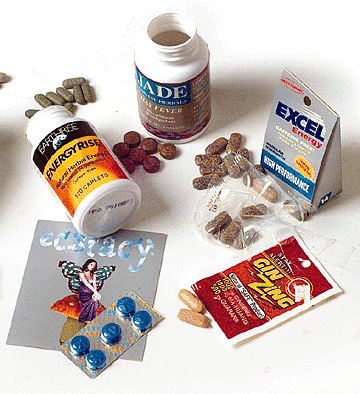
Easily available stimulants containing
ephedrine have been blamed for heart attacks
and other ailments when abused.
But should they be banned?
Easily available stimulants containing
ephedrine have been blamed for heart attacks
and other ailments when abused.
But should they be banned?
They can be found in health-food stores and around the corner at the mini-mart.
But the Food and Drug Administration is waving the yellow flag, and if a state agency has its way, they would be among over-the-counter products taken off the shelves. The attention is over herbal dietary supplements that contain ephedrine.
Long used to treat asthma and upper respiratory ailments, the chemical's synthetic form is found in decongestants and bronchodilators.
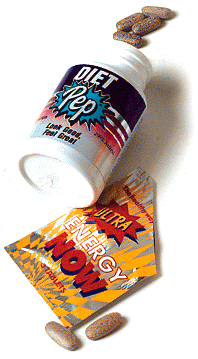
Now, though, the naturally occurring stimulant is being repackaged under such hard-sell names as Ultra Energy Now and Diet Pep, and some officials in Hawaii are worried about the consequences of abuse.
"It's dangerous," said Keith Kamita, head of the state Narcotics Enforcement Division. "People with practically nothing wrong with them are having heart attacks taking too much ephedrine."
The debate heightened earlier this year when a 20-year-old college student on a Florida spring break died after taking twice the suggested amount of Ultimate Xphoria - one of the formulations that touts itself as an alternative to illegal street drugs. Like the other supplements, it uses the ephedra plant to provide ephedrine, an ingredient also commonly listed as ma huang. Following the death, the FDA in April warned people to stay away from the mimic drugs, and said it is investigating their production and marketing.
"The FDA takes seriously the health risks inherent in these products," the agency said, calling ephedrine "an amphetaminelike stimulant that can have potentially dangerous effects."
New York and Florida subsequently banned the sale of products containing ephedrine.
Are Hawaii residents rushing to get an ephedrine rush?
It's difficult to gauge, but there are signs of a passing fad with, perhaps, low damage. While national news reports linked the herbal products to 400 adverse reactions and some 15 deaths, local FDA representative John Cook said he has received only one unconfirmed health complaint here.
 A Honolulu merchant said sales of Herbal Ecstacy -- the best-known of the so-called legal highs -- was "way, way off" after initially being strong last year. Young people don't seem to be particularly impressed, even by implied claims of enhanced sexual sensations. Former Mililani High student Lauren Dunnock, 15, said she had difficulty finding students who tried such products while researching an article for her school paper, the Trojan Times.
For the most part, she said, those that did felt gypped (a pack of five Herbal Ecstacy pills can cost $15, with three to five pills the recommended dose).
"I think a lot of people just wanted to try it, you know, oooooo, a legal drug," said Dunnock, who moved to Maryland this week. "And then they're like, 'Oh, this sucks,' and they don't really take it anymore."
A 32-year-old Windward surfer and outdoors enthusiast, who asked to remain anonymous, said he took energy-boosting pills daily for more than six months, downing them with coffee and Cokes.
An increased heart rate and chest pains persuaded him to stop. He said most of his friends, after heavy use, have also called it quits, even though the effects were not all negative.
"If you're active, it's a good feeling," he said. "You take one and that thing would get you going. It'd be like drinking 10 cups of coffee. If you weren't active, you'd feel real wired, almost to the point of fidgety."
There is some feeling that the supplements have found a firmer foothold in the physical-fitness crowd: athletes hoping for a competitive race-day advantage, body-builders looking to press those extra pounds.
Kathy Russell, head trainer at the Marina Athletic Club in Hawaii Kai, said the search for a magic formula includes "paddlers who need endurance and still want to drink too much beer."
"I see people using bronchial dilators that can give them a heart attack because they think it can help their performance, when maybe they just need to work on their technique a little more," she said.
Ephedrine sparks the release of central nervous system neurotransmitters, increasing their concentration, while stimulating neurons themselves, according to George Read, a pharmacology professor at the University of Hawaii's medical school. He said the effect could be serious for the elderly or those with faulty hearts, leading to blown blood vessels and arrythmias. Other, more effective drugs have mostly replaced ephedrine.
While officials express concern about the health risks, the narcotics division has its eye on a larger problem: crystal methamphetamine. Ephedrine is a precursor chemical for ice, and the fear is it can be extracted from bulk amounts of over-the-counter medications and used to make the drug. An attempt in conference committee during the past legislative session to make ephedrine available only by prescription failed. Kamita said he is looking at next session.
Regulations require buyers and sellers of large amounts of ephedrine to report their transactions, but some foreign countries don't fully cooperate, said Stanley Hayakawa, in charge of the U.S. Drug Enforcement Administration here. He said even though there appears to be no manufacturing of ice in Hawaii - Mexico and California are prime sources - making ephedrine available only by prescription would help in "a problem worldwide for DEA."
Congress has a proposal to require sales reports for pseudoephedrine, a chemically similar substance that's an ingredient in more than 100 cold, diet and allergy pills, and that also can be used to make crystal meth.
But it seems unlikely ice's flow would stop. Edgar Kiefer, chairman of the UH-Manoa chemistry department, said any good organic chemist with some graduate-level training can synthesize the drug using more basic materials readily available in quantity.
"It's a very simple compound, and that's the problem," he said.
Kamita said he would like to see all forms of ephedrine restricted, including ma huang used by Chinese herbalists to brew traditional infusion remedies.
Rodney Chun, a Honolulu naturopathic physician, said he can see reasons for some regulation, but worried that tincture of ephedra, one of his best decongestants, might become out of his reach.
Any broad controls on ephedrine herbal supplements apparently will have to come from the state. The FDA said amendments to the federal Food, Drug and Cosmetic Act put the legal burden on the agency to prove on a product-by-
product basis that an item is unsafe, rather than having companies prove their product is safe.
"It would be very resource intensive," said Cindy Wolodkin, a spokeswoman with the FDA's district office in San Francisco.
State Rep. Lennard Pepper, chairman of the House Health Committee, said he would be willing to give serious consideration to proposed controls.
The industry argues that the health problems they are accused of causing often arise from misuse of their products.
Even Russell, who is certified by the American College of Sports Medicine, an organization that discourages dietary supplements, sees a place for herbal remedies as an alternative to higher-priced medications.
But maybe the best way to "look good, feel great" - as one of the supplements claims on its bottle - is to follow the basic advice she gives to clients: Eat well, get enough rest and work out. "Your body," Russell said, "is a very good food factory if you do it right."
The Food and Drug Administration said possible adverse effects from ephedrine range from serious problems - such as heart attacks, strokes, psychosis and death - to less significant impacts such as dizziness, headaches and heart palpitations.Ingredient labels may list ma huang, Chinese ephedra, ma huang extract, ephedra, Ephedra sinica, ephedra herb powder, epitonin or ephedrine.
Consumers who have been injured or suffered an adverse reaction after taking a dietary supplement or any product with ephedrine can call 1-800-FDA-4010.
Health professionals who have treated affected patients can make a report by calling 1-800-FDA-1088.