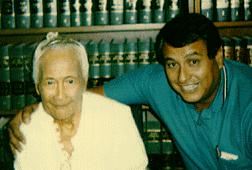
"My aunt was vulnerable because she was isolated," said Kenneth Kamakana, shown here with her in 1993. Cecilia Kamakana "wanted her story told," he said. "She didn't want others to make the same mistake she did."
By Rod OhiraA hidden crime is increasing
in Hawaii, a crime that
preys upon the elderly
"Trust me, I'll take care of everything," Louis Blissard would say to her, Cecilia Kamakana recalled to her relatives.
Kamakana had no reason to doubt her close friend, financial adviser and attorney - a man she had known for 25 years.
She named him as beneficiary for most of her assets, valued at more than a million dollars. But in 1992, the retired nurse would end up suing Blissard for breaching his fiduciary duties.
Many of the transactions Kamakana signed in the last few years of her life were procured through "undue influence," the suit alleged. Hawaii courts presume that undue influence is used when an attorney drafts documents or arranges transactions with his client from which he receives a benefit from the transaction, it noted.
The suit was settled out of court 15 months after Kamakana's death in August 1994 at age 90, one day before the start of trial. Her estate received property and cash worth over $500,000.
Blissard, a former U.S. Attorney for Hawaii, declined to be interviewed for this story.
But in an October 1995 filing by his attorneys, he denied wrongdoing. "Any loan or gifts received from the Plaintiff or made voluntarily by the Plaintiff were with her full knowledge and agreement," the document states.
Attorney Francis Yano, who represented Kamakana and her estate, said this case was unusual because there was restitution.
"Ms. Kamakana got back what was rightfully hers because she realized, at age 88, that something was wrong and she asked for help before it was too late," he said.
"My aunt was vulnerable because she was isolated," said Kenneth Kamakana, shown here with her in 1993. Cecilia Kamakana "wanted her story told," he said. "She didn't want others to make the same mistake she did."
Kamakana's family refused a confidentiality provision as part of the settlement.
"My aunt wanted her story told," said Kenneth Kamakana, special administrator for the estate. "She didn't want others to make the same mistake she did."
Cecilia Kamakana never married. She was an independent and frugal woman who kept meticulous financial records until age and poor health made her dependent on a small circle of people.
Except for a few relatives, his aunt chose to isolate herself from family, partly because of a land dispute involving her father years earlier, said Kamakana, a Honolulu police detective. When she met Blissard in late 1960s, Kamakana was "land rich, money poor," her nephew said.
Cecilia Kamakana's holdings included Molokai properties at Kanoa Fishpond in Kawela, which she purchased for $200 in the mid-1930s, and two houses on Ihe Street in Liliha. Blissard, a retired U.S. Marine Corps brigadier general who earned a commendation for combat duty at Iwo Jima, successfully represented Kamakana in a "quiet title" case against the state over the fishpond.
Blissard's attorneys noted in court papers that he rarely charged Kamakana a fee for services and was largely responsible for her becoming a wealthy woman.
During the 1980s, most of Kamakana's Kanoa fishpond property was sold to R.K. Development Inc., which developed and resold the lots through a "sweet deal" arranged by Blissard, her attorneys claimed. "Discovery has shown that rather than an outright purchase of Ms. Kamakana's land, she had been made a partner or joint venturer with R.K. Development Inc.," court documents state.
"Instead of simply buying the land, she was promised payment of $535,000 during the next decade, and 20 percent of the profit. The profit actually paid to her was about $35,000." Cecilia Kamakana signed the documents without understanding what was going on, her nephew says. "My aunt thought she still had property," Kamakana said, "because she didn't believe in selling her land."
Four wills and a trust, prepared between 1981 and 1992, named Blissard as primary beneficiary.
Blissard prepared the 1981 will, which left him the bulk of Kamakana's estate. His personal attorney handled the 1982 and 1989 wills, which accomplished the same.
The 1992 will and trust was drafted by another attorney, who testified in deposition that he never met or gave Kamakana advice because he was led to believe that Blissard was still an active attorney practicing law at the time. Blissard gave up his license to practice in January 1992.
The family became involved when Kenneth Kamakana, a police detective, was asked by his aunt to check on her properties in 1991. He reported to her that Bureau of Conveyances records indicated she had transferred ownership of some of her Molokai properties to others.
She soon ordered him to stop investigating, but Kenneth Kamakana believes "someone was telling her what to say" on the telephone. At his father's urging, Kamakana began looking into his aunt's affairs again a year later. By then, she had hired Yano as her new attorney.
Kamakana was shocked by his aunt's physical condition in 1992. She was under doctor-ordered home care.
"She smelled bad, like she hadn't taken a bath in a while," he recalled. "I was really afraid for her safety. She wanted to talk to (Yano) but said she hadn't seen him."
His aunt was being isolated from visitors, who were being screened by Blissard and his associates, Kamakana said.
Blissard, however, claims it was Cecilia Kamakana's relatives who isolated him and other close friends from her, his attorneys noted in court documents.
The situation was resolved after Cecilia Kamakana expressed her wishes to an Adult Protective Services investigator."My aunt was vulnerable because she was isolated," Kamakana said. "I think what happened to her is very prevalent. It's a hidden crime in today's busy society because we tend to forget about old people."