Photos by Dean Sensui and Craig Kojima
Star-Bulletin
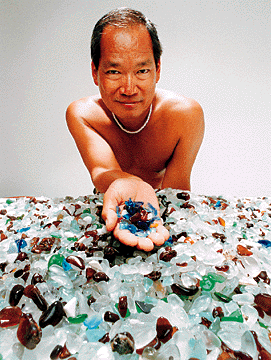
If it shines and glitters, he gleans. Allen Nakano is well on his way to his goal of picking up and collecting one million pieces - or one ton, whichever comes first - of glass from Oahu's beaches.
One man's Glass
is another's Treasure
Allen Nakano was minding his own business, working on the perfect tan, when his obsession with little glass gems began.The rest, as they say, is history
Story by
Greg Ambrose
AS you walk along the shore at Sand Island Beach Park, it's easy to wonder which will hurt your feet the most, the coral chunks that pass for sand, or the numerous pieces of broken glass.
But when the sun strikes the glass after the waves have splashed them with a coat a water, the beach is transformed into a king's ransom of rubies, sapphires, diamonds and emeralds.
The glass pieces glisten, beckoning you to examine them. And no matter how innocently and casually you reach down to pick up the gleaming offerings of the sea, it's the first step down the spiral of total obsession.
Soon you forget everything else in your desire to grab more of these jewels. And you can never get enough.
Only with a massive effort can you break free of the spell, and stand bewildered, blinking in the sunlight as trees, people and waves come slowly back into focus.
Allen Nakano is totally hooked on the little glass gems. He started out working on the perfect tan years ago at his favorite beach on Sand Island. Then he started picking up beach shells until he had a large collection.
After a while, he began to look past the shells and notice the glass, polished by waves and sand to opaque perfection.
"You start picking up those rare blue ones and go, 'Wow!' You get caught up in it, picking up a hundred, a thousand, you can't stop."
Unlike many people who collect beach glass, Nakano is a man on a mission. He won't be satisfied until he has earned a place in the record books by picking up a million beach baubles, or a ton, whichever comes first.
He has 100,000 now, harvested and counted one at a time. "The hardest thing is to count them. Most people wouldn't have the patience of picking up that many." On a good day, he'll collect 1,500 in half an hour, though he averages that many in an hour.
Nakano is the swap meet man, which leaves him all the time in the world to haunt the shoreline at Sand Island. For the past 27 years you could find Nakano every Wednesday, Saturday or Sunday at the swap meets, even at Waialae before the drive-in was shut down. He hawked shells, bottles, beach glass, coins and knicknacks.
 His biggest sellers are McDonald's and other fast-food toys, which apparently are irresistible to Japanese tourists.
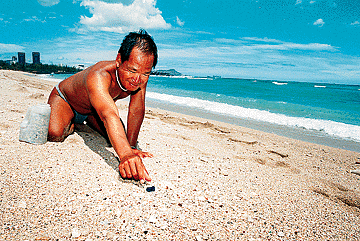
The other four days of the week he leaves his Waipahu home and heads down to Sand Island with a cloth bag, towel and four plastic cat food containers. Each holds 1,500 pieces of glass and weighs 45 pounds when full.
He leaves his gear at one end of the beach and begins foraging, returning to exchange a full container for an empty one. The day's hunt isn't over until all four containers are filled.
Along the way he works on his tan. "I use oil, which burns me. I like that dark tan look, even though I know it's bad for the skin."
But the tan is just a fringe benefit of his main task, which is to snag every bit of glass. "It's great hunting out at Sand Island. Some days I think, 'There is my million right there.' "
When the waves haven't lined the shore with glass, Nakano goes into the water to hunt his glass gems. If he doesn't move quickly, the waves snatch them out of his hand.
Sand Island was a landfill for years, and the ocean is continually uncovering a gratifying amount of glass not to be found at other beaches.
Most common is the clear white glass, frosted by abrasion from washing in the shore break waves. The solid white pieces are more rare, the remnants of chinaware or old toilet bowl porcelain.
The pervasiveness of dark brown and green glass testifies to the popularity of beer among island residents. Although lovely to look at once the ocean has sculpted the pieces, some people might argue that they looked better when they were filled with brew.
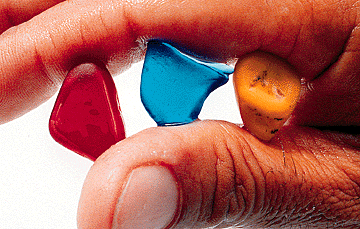
The light blue-green pieces really get Nakano's heart beating quickly. They are rare and beautiful remnants of old Coca-Cola bottles. But his real prizes are the cobalt blue pieces from Vicks and Milk of Magnesia bottles, or the equally rare red shards that Nakano guesses are pieces of car reflectors and traffic stoplights.
"It's like finding treasure on the beach," he says, although people have told Nakano that he is doing them a favor by clearing the beach of glass.
 While he slowly works toward his place in the record books, Nakano uses the glass to create art. He has made hundreds of flowerlike pins that he sells or gives away to friends, but his crowning creation is a top hat that fits on his head. He glued it one piece at a time.
Unfortunately, he didn't mix the resin properly, so the hat sort of sags when heated by the sun.
His new project is a Japanese good luck cat. He's starting out small to perfect the technique so he can build a really big one.
But that takes time from his collecting, and as his frenzy mounts, he is beginning to resent anything that keeps him from his goal. He grumbles at the loss of collecting time when friends ask for a hand, where before he cheerfully helped.
He usually responds pleasantly when people accost him at the beach, but during the conversations he glances anxiously at the waiting glass.
"I try not to look at the people because they always want to talk, and ask 'What are you picking up?' When I don't want to talk I tell them, 'What do you think I'm picking up, a turtle egg?'
"That gets rid of them. Now that I'm going for my goal, I need to spend more time at the beach."