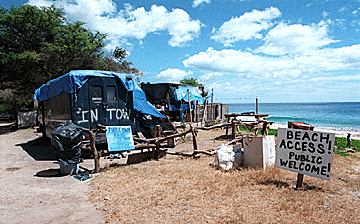
A makeshift home welcomes visitors to the beach. Photo by Craig Kojima, Star-Bulletin
A makeshift home welcomes visitors to the beach. Photo by Craig Kojima, Star-Bulletin
By Kim MurakawaCampers and the state are silent as to what actions they will take
Silvery waves lap gently along the shore. Dark heads bob in the water as fishermen check their nets for any overnight catch.
It has been this way at Makua for as long as anyone can remember. The shifting white sands where the valley meets the ocean have always been home to a fishing village.
But this is not old Hawaii.
As the first rays of sunlight reach out over the mountain, a bone-jarring explosion rattles the entire U-shaped valley down to the shore.
"You listen to that," says Makua resident Cory Cidade, standing at the Kaena end of the bay. "That's such a beautiful valley. She's crying out to us, 'Help me!'".
Army troops have occupied the valley for more than 50 years, using it for war training exercises. Farrington Highway separates the area the Army uses from the beach area, serving as an unofficial boundary line.
"If you really look at the situation really close, that is the crime," Cidade says of the bombings. "When no one's around, you can hear them raping her at night. It's a shattering experience.".
Tents and more-permanent shelters illegally line the sandy road parallel to the coastline. A rag-tag group, not all Hawaiians, has assembled here over the years - some to regain their lost culture, some to live rent-free.
Those who remain at the beach - as a state eviction looms at 6:30 a.m. June 15 - consider themselves villagers, not squatters.
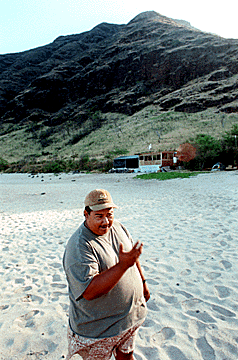
Makua resident Cory Cidade says the war training exercises carried out by the U.S. Army in the valley for more than 50 years are a crime. The valley, he says, is "crying out to us, 'Help me!'"
Photo by Ken Ige, Star-Bulletin
The land Leandra Wai lives on at Makua was owned by the Kamaka family before the military took it over. Wai says she may be able to trace her roots back to the Kamakas, but that is not why she came.
Two years ago, Wai says, she was depressed and a psychiatrist wanted to put her on prescription drugs. She decided instead to work her problems out at Makua. Emotional scars, broken relationships and physical disabilities have been healed, claim those who have come to Makua.
Those who live here have only recently found a name to describe what they say has happened at Makua over the years. It is a pu'uhonua - a sanctuary - where many have come after falling through the cracks in society.
In ancient times, every ahupua'a, or land district, had a place of refuge, says Wai's husband Sparky Rodrigues.
This pu'uhonua is a little different, but happened naturally - it's a healing place derived from their culture that they want to continue, he says.
"You can make it into a sovereignty issue," says state Rep. Merwyn Jones. "I look at it as a housing issue. A lot of them are there because of the high cost of housing in Hawaii.".
Jones' constituents in Waianae and Makaha, many native Hawaiian, have felt unwelcome and harassed at the beach. The beach residents, though, say the troublemakers come from other parts of the coast. Constituents also complain the beach dwellers just want to live for free and lay around all day.
"They feel the beach belongs to everybody -- why are we letting them stay?" Jones says.
It is an issue that has split the tight-knit coastal community, where generations of extended families live near each other. That closeness has kept some people from criticizing publicly, Jones says.
Complaints to the state Land Department and pleas to the governor over trash problems and an atmosphere of intimidation at Makua sparked the latest eviction effort.
Members of the Makua Council, however, say the Army and foreign investment are the real reasons. Both Kathleen Racuya-Markrich, the governor's spokeswoman, and DLNR spokeswoman Aulani Wilhelm deny any pressure from the Army.
State officials say they want to improve the area for public use. During the last legislative session, lawmakers appropriated $500,000 for improvements, including restrooms, showers and other park facilities.
The promise of a state park was part of the 1983 eviction - but it never materialized. Eventually, a new group of people moved back to occupy Makua.
The state hopes this time will be different, Racuya-Markrich says.
She says the state has tried to help each resident ease back into society to avoid a recurring situation.
"It's not history repeating itself. There are adequate facilities to help practically all of the families make some transition into the community by June 15," Racuya-Markrich said.
But Cidade predicts the residents will be back on the beach in a few months, unable to make a go of it from the state's options.
"In two months they're trying to solve a problem they haven't been able to in years," he says.
The first rumors of eviction swept through the camp last September. Back then, Wai says, she was not involved in the decades-long struggle for sovereignty.
"The state has forced us to become educated," she says. "Only then did we wake up and understand what we needed. We're all waking up now, and our government needs to understand. We need to talk now."
Pushed into the political arena, they are learning to play the game. The residents learned to lobby lawmakers, held a cleanup that gained publicity, and are featured in a documentary "Makua: to heal a nation," showing weekly this month on cable television. The video was made earlier this year by Na Maka O Ka Aina, a private video production company on the Big Island.
They want Makua to be an educational culture center, as well as a place for Hawaiians to come for peace.
"This would be the only live pu'uhonua in the islands," Wai says, smiling.
It would be a place for Hawaiians to feel free to live and perpetuate their culture in the open. Wai predicts growing poverty among native Hawaiians if they are not allowed to work through their struggles in a way that is in line with their culture.
"That's good if you have a lot of land, but on Oahu we've got so limited beaches and everybody wants it," says Rep. Jones.
As eviction day draws closer, the camp is in chaos. Anger and stress over the possibility of their homes being destroyed have the people on edge.
Gov. Ben Cayetano is firm on next week's eviction, Racuya-Markrich says. The state is deliberately vague about how - even if - it will actively enforce the evictions that day. It wants to avoid a confrontation and ensure the safety of its workers.
Wai and Rodrigues say the residents know. They have been warned that their homes will be razed that day.
Wai says anything could happen. Residents have planned it as a day of fasting and praying, requesting support from others around the world. Instead of eviction day, it will be the day Hawaii as a nation is reborn, they say.
The only thing left is the blessing of kupuna.
"Come June 15, they will know what they have to do," Wai says of her compatriots. "Whatever happens, it's going to start putting right the wrongs."