
Scott Hamilton doesn't always know what city he's in,
but he knows Hawaii. The sight of the beach and
Diamond Head are unmistakable.
Photo by Craig T. Kojima, Star-Bulletin
Scott Hamilton doesn't always know what city he's in,
but he knows Hawaii. The sight of the beach and
Diamond Head are unmistakable.
Photo by Craig T. Kojima, Star-Bulletin
"How many performances do I do a year? How many days there are in a year and add a couple more," he says, laughing.
Hamilton's skating as much as ever. This year his performances number 68; competitions, 9; TV specials, 5; and independent exhibitions, 10. And he's loving it.
Not bad for a kid who at two contracted a mysterious illness that caused him to stop growing. It wasn't until years later when he was given six months to live that his adoptive parents took him to Boston's Children Hospital where his ailment began to correct itself through a diet and exercise.
That's one big reason why the 5-foot-3, 115-pound skater - who in the '80s had a string of unprecedented skating victories including eight consecutive national and world titles - has developed a make-no-excuses attitude.
Is skating still fun?
"Gosh, some nights are brutal and difficult," said Hamilton, 37. "But it's like any other career. As much as you may love your job, how many days in a row can you go to the opera?
"But when I get in front of the crowd and the lights come up and you see the faces of the people and you realize how much trouble they went through to get there, it all kicks in."
Hamilton continues to compete professionally. In 1994 he won at the Gold Championship, the Canadian Professional Skating Championship, and the Fox Television Network's Rack-and-Roll Skating Championship. He performs in his own "Scott Hamilton's America Tour" and national tours like "Stars on Ice," which he also co-produces.
Hamilton works hard to improve the sport from within the United States Figure Skating Association and from the outside as a role model, and does not sugar coat his comments about "revelations" chronicled in the book "Inside Edge" by Washington Post reporter Christine Brennan.
The book focuses on the 1994-95 season when skating became a TV staple instead of a special event. The book also discusses judging, AIDs among skaters, and homosexuality in the sport, all of which led the USFSA to deny Brennan press access for events.
Hamilton, who has not read the book, called the ban "foolish."
"Isn't freedom of the press guaranteed? The decision ... won't accomplish anything. Christine will still be there. And it's just a matter of time until they rescind it."
Why did the USFSA make the move, rescinded yesterday?
"There have been massive changes and growth all at the same time. Naturally, feathers are being ruffled," Hamilton said.
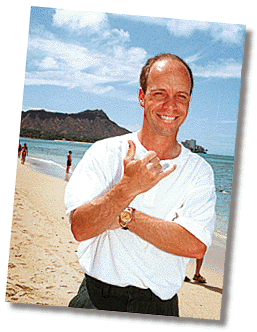
Hamilton goes Hawaiian
-- shaka, brah!
The biggest reason for the media attention is not just because of the Tonya Harding-Nancy Kerrigan baseball bat attack incident, Hamilton said, but because CBS lost their football contract to broadcast NFC games. That left a lot of Sunday afternoons to fill.
"I'm sitting around in the summer of 1995 ... and my telephone starts ringing off the hook. When you're 11 years out (of the Olympics) and that happens, you know something is changing big time."
But what the Tonya-Nancy melodrama did do was change the rules of journalism, he said. "There was a feeding frenzy to pay big bucks for exclusive interviews. And when I looked up in the stands and saw the National Enquirer, Washington Post, New York Times and Current Affair elbow-to-elbow ... it frightened me."
He said Brennan's assertion that figure skating has a higher percentage of AIDs-related illnesses and deaths than other sports is false. "What makes it so much more visible in the entertainment and figure-skating arenas is that the people involved have a passion to help and are quite vocal about it."
As for the stereotype that male figure skaters are predominantly gay, he says that's another "false image." "Some guys may have developed effeminate characteristics because the women outnumber men maybe 5-to-1 and they've spent so much time around women."
But part of that image are skaters' responsibilities when they perform in "bejeweled, sparkling costumes and wear lots of makeup," he said. "A lot of guys - especially from Europe - do it because they feel it makes them look better to the judges," he said.
At the 1984 Olympics Hamilton chose a one-piece, speed-skating-style suit as a reaction to his competitors' "costumes."
"I wanted to be perceived as an athlete and I think lots of judges welcomed it because competitions were turning into a contest of who could be more elaborate. Some skating to Mozart dressed as Mozart. Pretty soon we were going to have to wear push up dresses and bustles."
Hamilton's strategy in appealing to judges has always been adapting to their culture.
"If you go to the Olympic Games and you skate to hip hop ... the chances are that the German judge will give it to somebody who performs to something more his culture."
It comes with the territory, he said. "If you're willing to win under a system you have to be willing to lose under the same system with no sour grapes ... The bottom line is that you're part of the process. That's how you got there in the first place."
What: Ice Spectacular with Kristi Yamaguchi, Scott Hamilton, and more
When: 8 p.m. tomorrow and Saturday; 4 p.m. Sunday
Where: Blaisdell Arena
Tickets: $22.50 and $29, with a $2 discount for senior citizens and children ages 12 and under
Call: 545-4000 to charge tickets by phone