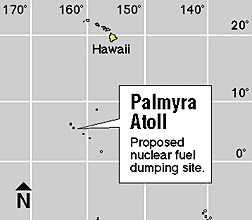
 The bill would direct the Nuclear Regulatory Commission to issue a license to the owners of Palmyra to operate a storage facility for 200,000 tons of spent nuclear fuel for at least 20 years.
By Rod Ohira'This is bad legislation that would result in a nuclear nightmare,' he says
"This is bad legislation that would result in a nuclear nightmare for the Pacific," Hawaii Sen. Daniel Akaka said. "I will aggressively fight its introduction, consideration and passage."
Akaka's staff came across the proposed bill, "The Private Storage Facility Authorization Act of 1996," in a Department of Interior Office of Insular Affairs periodical.
The bill would direct the Nuclear Regulatory Commission to issue a license to the owners of Palmyra to operate a storage facility for 200,000 tons of spent nuclear fuel for at least 20 years.
The legislation would circumvent commission licensing standards and waive environmental, engineering and safety requirements that normally apply.
"I call on the new owners of Palmyra to abandon this foolish plan and spare the people of the Pacific the anxiety that this proposal would generate," Akaka said. "The people of the Pacific will not sacrifice their health and environment in order to fix environmental problems created elsewhere."
KVR Inc., a New York investment partnership headed by William Venezia, purchased the atoll from the Fullard-Leo family in February. The sale price was reportedly in excess of $36 million.
The legislation also asks that the Palmyra facility be exempt from the Clean Water Act and National Environmental Policy Act.
The latter is a federal law that requires environmental impact statements to determine suitability of the waste storage proposal.
Interest in Palmyra as a spent nuclear fuel storage site is not new.
In 1979, there was strong protest in Hawaii and the South Pacific region when Japan and the United States considered placing a storage facility on the atoll.
The late Sen. Spark Matsunaga pushed for legislation requiring congressional approval for the establishment of any nuclear waste storage waste facility in the Pacific. The bill was signed into law by President Carter in 1980.
Storage of spent nuclear fuel is an alternative to the reprocessing of plutonium, which can produce material usable in nuclear weapons.
Mike Jones, a University of Hawaii physics professor, calls the proposal by the new Palmyra owners, "a prescription for disaster."
The type of containers in which the spent nuclear fuel will be stored and how it's transported to the atoll are as much a concern as security, Jones said.
Because Palmyra atoll is prone to erosion and extreme weather conditions, it does not offer any long-term solutions, Akaka noted.
"Any nuclear material stored at Palmyra would eventually have to be relocated," Akaka said.
"The National Academy of Sciences and the NRC have determined that above-ground storage of nuclear materials can only be an interim solution.
"If this proposal succeeds," he added, "ships carrying spent nuclear fuel from all corners of the globe will transect the Pacific to deposit nuclear material at Palmyra, only to transport this fuel once again to a permanent storage site at another location."
High-level nuclear waste will be a radioactive hazard for 10,000 to 100,000 years, he noted.