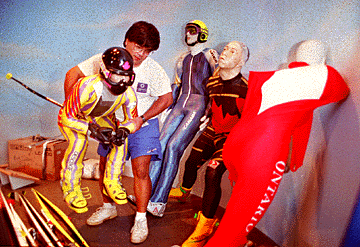
Wayne Kokazu moves in skier mannequins.
Winter sports are prominent in the Canada-based exhibit.
Photo By Dennis Oda, Star-Bulletin
Wayne Kokazu moves in skier mannequins.
Winter sports are prominent in the Canada-based exhibit.
Photo By Dennis Oda, Star-Bulletin
SPORT Illustrated
A huge, and very cool, exhibit at
Bishop Museum explains
the science behind
athleticsBy Burl Burlingame
Star-Bulletin
We're not kidding about size. SPORT comes in nine full-sized shipping containers, more square-footage and weight than that needed for the previous dinosaur and whale exhibits. (But the truth can now be told: those weren't real whales and dinosaurs, but light-weight imitations. Don't spoil it for the kids.)
"SPORT," which opens Saturday, is called "the ultimate in high-action science," featuring more than a dozen hands-on - and bodies-on - displays that explain the science behind athletics.
"Thank you, SeaLand!" says BM exhibits director and designated quote-wrangler Ken Miller, when explaining how the exhibit got here. "It's our largest moving job so far. When I first saw it three years ago - in an earlier incarnation on the mainland - we booked it for the Olympic summer. But it's grown! We just have to velcro and screw and bolt it together now."
The Bishop Museum is adding portions as well. Outside the Castle memorial building, the entrance is flanked by "Sportstart," a kind of souped-up playground, and the Hawai'i Sport Pavilion, a permanent tent housing Hawaiian sport displays and demonstrations.
Sportstart is designed by James "Jimi" Jolley, an independent playground consultant with sites in more than 15 countries. Bishop Museum planetarium director Peter Michaud was drafted to help build the area. "It uses recycled materials like wood and old tires," said Michaud. "The skills kids develop through play here carry on to real sport later."
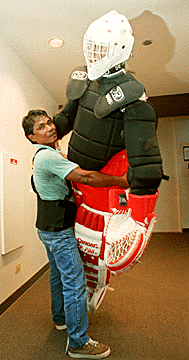 Samuel Domingo moves a hockey mannequin into Bishop Museum. Photo By Dennis Oda, Star-Bulletin
The exhibit proper comes from the Ontario Science Center, and like all official Canadian projects, comes in both French and the Queen's English. At least the English signage doesn't end in "Eh?" and the color scheme isn't in the Canadian national color - plaid.
The exhibit does come with Tom Kasanda, a project manager who travels around the world putting up and packing away Ontario Science Center displays. SPORT is mid-way through a five-year projected lifespan, said Kasanda, and will eventually visit about 20 North American.
"We always send crews to help with the installation," said Kasanda. "It's another science museum exhibit ..."
"Not ANOTHER science museum," said Miller. "The Ontario Science Center is one of maybe the three best in the world!"
"We work at informal science learning," said Kasanda, basking in the corona of Miller's admiration. "SPORT is really good at this kind of teaching. Everyone loves sports, and we don't push the science end of it - or it's not apparent right away - but it is there.
"For example, because of the way a baseball is stitched, if it's coming at you spinning end over end, it subtly is one color, and if it's spinning sideways, it's another color..."
Doppler effect? Like the red/blue bands you see when fanning the white pages of a book? (Miller looked pained at the reporter's science ignorance.)
"Actually, I don't know why. I'm a designer, not a physicist," said Kasanda. "The point is, experienced batters can sense the color change and swing instinctually because they know where the ball is oriented."
"There are a lot of cool spots in this exhibit," said Miller. "You stand there, and see it, and you go, hey, cool!"
The science-exhibition industry buzzword for such a reaction is "Aha!," which is an equivalency-exam version of "Eureka!" In other words, the right combination of physical interactivity and intellectual framing strike a spark in the individual's brain, and the lesson is embedded instead of memorized.
An example is a display of women in sports, with graphs and numbers showing how women are catching up to men in many arenas. The display is surmounted by a mannequin of a female athlete leaping over a high jump bar. The bar is the same distance off the ground as a real recording-breaking leap - "Actually, since the exhibit was constructed, I think the record was broken again," Kasanda said - and the sheer HEIGHT of it is impressive, because you're standing next to it, looking up. WAY up. The sheer impact of such a mighty leap is lost over televised games.
Volunteers will help direct traffic in the exhibit and are trained to verbalize budding questions. (More volunteers are needed. Call 848-4180.)
Because of its Canadian heritage, winter sports are prominent.
Added Bishop Museum portions include an exhibit of Hawaiian bobsledding, called he'e holua, surfing information and a display of Duke Kahanamoku-ana. Will Alexander Cartwright, the locally buried inventor of baseball, be included? Maybe.
Other displays explain safety aspects, such as how controlled deceleration lessens the injury of an impact. How do you illustrate this? By hurling eggs at a blanket.
Interactive exhibits include a pitching cage where you can fling a baseball the regulation distance from a regulation mound and be clocked by a regulation radar gun, a spinning shower curtain of Mylar that creates the optical illusion of motion, a kind of mood ring for your feet to test your arch construction, a platform to leap off of and measure landing weight, and others that explain it all in physiologic and physics terms.
One of the best, and the simplest, is a glass doughnut filled with what looks like spicy Italian salad dressing. Spin the torus, then stop it, and the fluid keeps spinning. Exactly what happens to the inner ear while slam-dancing.
And there are tidbits. Hockey protection bears more than a passing relationship to medieval armor. Yellow and black are aggressive, warning colors in nature, and are therefore natural favorites of rugby teams and bumblebees. The ol' "pigskin" has always been made of cowhide.
And we discover, too late, that synchronized swimmers keep their hair in place with Jello. Sometimes a little knowledge is worse than none at all.
What: SPORT
When: Opens Saturday and runs through Sept. 2
Where: Bishop Museum
Cost: $6.95 kamaaina rate; others 14.95; $11.95 for ages 6-17; free for those under 6 and Bishop Museum members
Call: 847-3511