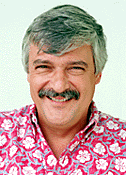
Gov. Ben Cayetano, in his weekend speech to the state's Democrats, assembled in their biennial convention, gave one of the clearest, shortest descriptions of his view of government since taking over two years ago.
Overwrought explanations, or for that matter even repeated short explanations, are not things the governor suffers gladly, so when he decides to publicly spell out his goals, the smart observer will pay attention.
As titular head of the party, Cayetano has a traditional responsibility to head up the Democratic delegation, keep order, boost morale and swell the ranks. In contrast, however, Cayetano told the Democrats not to get too worked up about the local elections.
"We Democrats control the governorship, the mayorship of the two largest counties, three of the four county councils and the state Legislature.
"Our control of the Legislature is overwhelming . . . After the 1996 elections, I suspect there will be even fewer Republicans in both houses.
"I am going to pass on giving 'em hell - somehow it strikes me as being somewhat awkward," he explained.
Cayetano didn't come to preach politics, but to explain the new facts of political life.
Paraphrasing the late Sen. Edmund Muskie, Cayetano asked: "Why can't we raise hell about a government so big, so complex, so expansive and so unresponsive that it's dragging down every good program we've ever worked for?
"Too many Democrats seem to accept waste and inefficiency as a cost of helping people and feel that attacking waste somehow amounts to a repudiation of the New Deal."
These are harsh words, but they were from a politician who has never shrunk from the task of delivering the bad news.
The message last Saturday, however, was one of common sense: Social goals without an efficient and productive government are meaningless.
Few in local Democratic politics have ever consciously linked the words government and productive in the same sentence.
But Cayetano went on, boldly explaining what he wants from his state workers.
"Too many Democrats cannot bring themselves to understand that government's ability to help people is directly dependent on a healthy economy," he said.
Political reason and reality may exist in the voting booth, at the town meeting and even at the State Capitol, but a political convention is a time to be politically correct, not realistic.
BY insisting on a reality-based government, Cayetano was making his own statement, that the good times are over.
For those switching from politically correct to realpolitik, Cayetano's administration offered a quick view of the future, as Earl Anzai, budget director, predicted that up to 100 more state employees would lose their jobs as the state continues to downsize.
Today, after the convention, Cayetano may not be popular enough to lead all Democrats, but his view will survive after others have gone on to other causes.
The challenge for Cayetano is to get his own constituency to accept the message. To do that he will have to give that speech twice a day, not once every two years.