
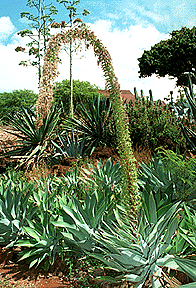
The society is sponsoring an exhibit and sale from 10 a.m. to 5 p.m. tomorrow and 10 a.m. to 3 p.m. Sunday at Ward Warehouse. They want you to know that while cactus is a plant with an attitude, it can be beautiful. "Cactus is also a very forgiving plant," said society vice-president, Nathan Wong. "It's pretty hard to kill one."
That's a real plus. Succulents are unlike other plants that store nutrients by day and use them up at night. Succulents instead accumulate nutrients during the night and absorb them during the day. This is one of the plant's strategies to reduce water loss because evaporation is less at night.
All cacti are succulents, the inclusive category for plants that store water in their swollen stems to survive periods of drought. The inside temperature of a cactus is several degrees above that of the air outside, and the plant can survive in temperatures 15 to 20 degrees above what would kill many other plants.
While small rock gardens are frequently cultivated here, an entire landscaping is unusual. One worth seeing is the garden at Kapiolani Community College on Diamond Head Road. There, volunteer Moriso Teraoka has landscaped a campus hillside with nothing but succulent plants.
Teraoka is even more interesting than the plants he cultivates. On the shady side of 70, he is a full-time Kapiolani Community College student. He has already earned a degree in culinary arts, and is working on one in journalism. He is a star reporter and photographer for the college newspaper, and does almost all of the succulent garden maintenance.
Most of the plants in the garden have been donated by members of the Cactus and Succulent Society, Wong said. "In the beginning, Moriso took whatever he was given, but now he's getting like an art museum. He turns down everything that isn't very special."
Now, the garden offers a remarkable collection of succulents, but it isn't a botanical garden. To achieve that status, every plant must be properly labeled. On May 26, a work party from the society has volunteered to identify and label the collection, making it more educational.
One of the showier cacti in the collection is the Thai variety of Crown of Thorns. It has brilliantly colored flowers, more than an inch in diameter, that remain on the plant for a week or more. "Most cacti flower," Wong said, "but if you are away for the day you might miss it. They bloom briefly, and usually in the spring."
Crown of Thorns is easy to hybridize, and several of these hybrids will be sold this weekend. Many come from the collection of Kikue Akiyama, who will answer questions and give advice on cactus cultivation.
Usually grown as a potted plant, Crown of Thorns also does well in gardens. "It makes a fierce hedge," Wong said. "If you want to keep the neighbors' dogs away, you can't beat it."
It grows quickly, and propagates easily. When you cut a stem off, dry it out for a week and then it can be replanted. The plant is a member of the Euphorbia family and a relative of the Mexican Euphorbia. That's the plant that is cultivated by the makers of M&Ms. A latex extracted from the cactus coats the candy so it "melts in your mouth and not in your hands." This is one of the few commercial uses of cacti.
Most cacti prefer full sun and sandy soil. They like dry air but can deal with average humidity. Cacti need some, but not much, water. Water infrequently, but soak the plant when you do. Overwatering will rot the roots and kill the plant.
About the only pest to attack cactus is the caterpillar, which will take the leaves off. "But the leaves come right back and the caterpillars generally don't," Wong said. "You don't need to spray." He uses a slow release fertilizer like Magamp or Osmacote, following package instructions.
There is no native Hawaiian cactus, although the Mexican native prickly pear is faking it as panini. It was introduced here in about 1800 with the best of intentions as a cattle feed. Mexican cattle love it. Hawaiian cattle got indigestion, and dumb though cows may be, refused to eat it. So now it's a pest and nobody is quite sure of how to get rid of it.
"There's an insect that has destroyed the panini on Maui, and it could be brought here," Wong said. "The question is, what happens when it's eaten all the panini? Then what?"
Good question.