View Point
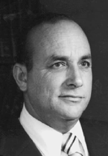
By Whitney Anderson
Friday, May 17, 1996
Special session can help when leadership fails
IT looks as though we are going to have another special session of the Legislature this summer. When this news hit the press, constituents and friends, justifiably upset with the lack of action on important measures, began calling my office with questions that I find difficult to answer.
I have asked these same questions of my colleagues in the past:
- How will the Legislature fully address the issues facing our state during a week-long special session, when it failed to do so during a four-month regular session?
- Why didn't the Legislature just extend the regular session by a few days and get something done then?
- Why can't you guys just do your jobs and stop whining about "tough choices?" We've all got tough choices to make!
These questions, and others that are unfit to print, made me wonder whether it might be better to go back to the way the Legislature used to operate. Before the 1968 Constitutional Convention, Hawaii's Legislature would devote one year to general legislation, and one year to fiscal matters. Issues such as auto insurance reform, high-three pension retirement and same-sex marriage could be dealt with separately from budget and capital improvement concerns. Trying to address all of these issues simultaneously tends to result in achieving little of substance.
I'm not against special sessions in principle - as long as something gets done that could not be addressed during regular session - and if they do not cost taxpayers extra money.
With the staff and resources we have during the interim (each legislator has one full-time staffer, plus the research staff we share), lawmakers could address problems, engage in open debate on the issues, and welcome public hearings without all the extra labor and paperwork.
Special sessions could be a time when legislators meet to discuss specific topics that become too diffused between January and May, such as building markets in Hawaii to revitalize our economy.
Last interim, for example, legislators convened an Economic Committee to discuss economic rebuilding. The sad fact was, however, that nothing concrete resulted from these meetings. The committee did not smooth the way for easier decisions during the regular session (obviously), nor did it come up with specific ideas for resuscitating our sagging economy.
Let's talk transportation
A special session could be convened to discuss master plans for transportation - both between the islands and on each island. According to national analysis, our highways rank 47th out of the 50 states in terms of quality, and we spend too much money on management. Hawaii is an island state, yet we have fewer slips and less mooring space for recreational and business purposes in our harbors than some landlocked states! Over 95 percent of our consumable goods come to Hawaii via shipping, yet we are subject to outdated, protectionist and expensive U.S. shipping laws. And while Oahu's bus system gets good grades, public transportation in some areas and on some other islands is dismal.
During a transportation special session, we could research the viability of buying back our former land rights to the old pineapple railroad service, and building a pilot mass transit system from town all the way to Waianae, not just to Waipahu.
Wouldn't it be great to have a rail system that would be faster than the gridlocked traffic, yet be built to look like a pineapple train of old Hawaii, not some L.A. or mainland city railway?
Sporting life is lucrative
Or how about a special session devoted to building the sports industry, a very lucrative business, in Hawaii? The last administration funded a study that showed how Hawaii would benefit by becoming the sports mecca of the Pacific, and the Legislature voted to proceed in that direction. Certainly there has been some success in this area, with the Billfish Tournament, Ironman Triathalon, Honolulu Marathon, Hawaiian Open, international surf meets, and other smaller-scale efforts.
But what about a concerted plan that truly builds and coordinates sports industries to benefit neighbor islands and Oahu alike? While our state puts more money into the University of Hawaii at West Oahu - a questionable priority given that we already have a public university on Oahu - other opportunities to enrich West Oahu and all of Hawaii are being missed.
The state could provide infrastructure for yacht racing (more slips, as mentioned above); an olympic-size swimming pool to accommodate Olympic athletes training in Hawaii; a world-class, year-round tennis facility to attract professional, televised tennis matches; a canoe house to promote paddling competitions like the popular Molokai Races, and perhaps even promote paddling as an Olympic event.
Better leadership is needed
But what Hawaii needs the most, whether during a regular session or a special session, is leadership. Session after session, the same issues come and go, and legislators are no closer to reaching common ground on some of the most important matters.
You cannot blame "the system" for the lack of action. It's leadership that has been missing. The Senate minority leader and I have both offered coherent plans and ideas to revitalize the state's economy. We have fought for the constitutional rights of Hawaii's people, and for a change in the system.
Now it is up to the people to judge which is more important - another special session, or the leadership to make things happen.
Whitney Anderson, a Republican, represents the 25th District (Kailua-Waimanalo) in the Hawaii state Senate. The opinions in View Point columns are those of the authors and are not necessarily shared by the Star-Bulletin.