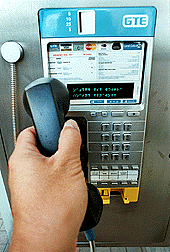
 Hawaii's pay phones are becoming bilingual.
And they're getting "smart."
GTE Hawaiian Tel on Wednesday unveiled the new phones it is installing statewide, another sign of the dramatic changes rippling through Hawaii's telecommunications industry.
The phones give calling instructions in English and Japanese, either over the phone or through text on a small screen.
They also accept so-called smart cards, which are embedded with microchips containing "electronic" money. You insert the card, make a call - long-distance or local - and the charge is automatically deducted from the amount on the chip.
Don Wood, area manager for GTE Public Communications, a sister company to Hawaiian Tel, said the utility already has installed about 400 of the new phones around the state. It plans to eventually replace all 7,500 to 8,000 phones it has here with the smart models, probably over the next 18 months.
Hawaiian Tel, the sole operator of pay phones locally, is making the changes even as the market is on the verge of opening to competition.
At least four companies have applied with the Public Utilities Commission to set up pay phones in Hawaii, and more have expressed an interest in doing so.
Regulators expect the market to open up late this year at the earliest. But just like with local phone service, all would-be competitors must negotiate access agreements with Hawaiian Tel to be able to gain access to its phone network.
The impending competition has prompted Hawaiian Tel to make changes, such as negotiating higher commissions on what it pays businesses for placing pay phones on their premises. Some industry executives believe the move to smart phones also is partly a response to the coming competition.
The new entrants are expected to use similar phones.
As the market moves toward the smart technology, which is much more efficient than using coin-only phones, the potential for profits becomes greater.
"It's one of these little niche businesses that can be fairly lucrative if you have enough phones and provide the right kind of services," said Courtney Brown, president of the fledgling Hawaii Payphones Association, made up of executives vying to get into the market.
Rob Hail, vice president of StarNet Hawaii, one of the companies that has applied to the PUC, said companies are interested in Hawaii because it is underserved and thus presents good opportunities.
But those opportunities may lure too many companies, leading to an industry shakeout in which two or three players likely will survive to compete with Hawaiian Tel, industry executives said.
The competition will lead to more services for isle consumers, such as discounted long-distance rates that will entice people to use pay phones more, Brown said.
Eventually, the executives predict the phones also will be used like quasi-automated teller machines, with people replenishing their electronic cash by phone.
"The consumer should very much come out the winner in all of this," Brown said.