Evergreen

By Lois Taylor
Friday, May 10, 1996
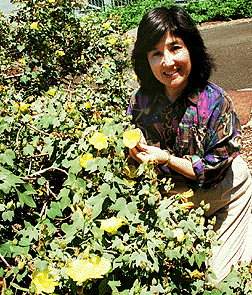
Winnie Singeo shows the ma'o or Hawaiian cotton plant, one of several overlooked native plants. Photo by Terry Luke, Star-Bulletin
Native plants
get legislative mandate
ALMOST everyone is aware of what the Legislature didn't do, but do you know what it did do? It passed a law that will empower the Department of Land and Natural Resources to make certain endangered Hawaiian plants available for sale at nurseries. These are ones - like the state flower, the yellow hibiscus - that are easy to grow in your backyard.
This is a law that local botanists have long favored. If these plants are cultivated at home , they can be dropped from the endangered list, and botanists can spend more time on truly rare plants. There are those where only two or three specimens survive, and that grow nowhere other than where they are now. Through tissue culture, some are being cultivated in laboratories by botanists for possible reintroduction to the wild.
In the meantime, they encourage the public to grow and preserve Hawaiian native plants. One place to see a good selection, and have a picnic under a shady monkeypod, is at Liliuokalani Garden. The garden is located on North Kuakini Street, with the parking lot about opposite the entrance to the Rehabilitation Center of the Pacific at 226 N. Kuakini St. It is one of the five city-run oases that make up the Honolulu Botanical Gardens.
But don't go in the water. Nuuanu Stream, which runs through the center of the garden, carries leptospirosis. This comes from disease-carrying spirochetes that are common to many Hawaiian streams and can create eye, liver and kidney problems.
Liliuokalani Garden has been improved in the last year by volunteers, many of them school children. Weeds and introduced plants have been cleared out - except for the magnificent monkeypods that border the stream.
Winnie Singeo, botanist with the Honolulu Botanical Gardens, suggests that visitors look at the plantings with an eye toward what might work in their own gardens.
Some, like ohai, are on the endangered list and not available now, but those mentioned below can be found at plant sales and nurseries.
- Naio, commonly known as bastard sandalwood, grows in most forests on the main islands. It has a dark yellow hard wood with a waxy luster and spicy odor. The wood is very fragrant when drying, and releases an aroma similar to sandalwood.
Real sandalwood was a major cash crop of the Hawaiian monarchy, who stripped the forests to sell the wood to the Chinese. When the source began to dwindle in about 1840, naio was substituted, but the Chinese caught on immediately and refused to accept it. "Naio makes an excellent garden tree," Singeo said. "It can be kept small by appropriate pruning, and it has pretty little pink or white flowers."
- Pohinahina, or beach vitex, grows well in coastal and inland areas. It is an excellent ground cover, with silvery leaves and blue-violet flowers that grow in clusters at the tips of the branches. It requires well-drained soil and full to partial sun. It will need frequent watering until it is established, but once pohinahina is mature, it requires watering only in times of extended drought.
- Wiliwili is a dryland tree with large pea-shaped blossoms that can be red, salmon, orange, peach, chartreuse or white. The tree can be kept at about 12 feet by pruning, but will otherwise grow to 30 or 40 feet. When the tree is young, it has wicked looking thorns on its trunk and branches, but they tend to disappear as the tree matures.
- Alahee, a member of the coffee family, can be used as a shrub or an elegant hedge. It has dark green, glossy leaves and clusters of fragrant white flowers. It grows best in full or partial sun, and is drought tolerant.
- Akia is a densely branched shrub or ground cover that tolerates a variety of soils and conditions, but only for a while. "It is not a long-lived plant, and it needs to be replaced on a regular basis," Singeo said. "But in small areas it makes an attractive planting."
Akia has small gray-green leaves with very short stems that grow in a spiral. It requires full sun and cinders should be added to heavy soils for drainage. The early Hawaiians used the bark for rope, and it is almost impossible to break small branches off the plant without cutting them.
These and other native plants should not be overwatered, and are often sensitive to fertilizer. The Hawaii Plant Conservation Center recommends slow-release fertilizer or liquid plant food, but suggests that you use only half the recommended dosage.
So think kindly of our legislators who will soon have widened your landscaping options by cultivating some of Hawaii's endangered plants. Think of it as horticultural no-fault.
Send queries along with name and phone number to: Evergreen by Lois Taylor, Honolulu Star-Bulletin, P.O. Box 3080, Honolulu 96802. Or send e-mail to features@starbulletin.com. Please be sure to include a phone number.

Evergreen by Lois Taylor is a regular Friday feature of the
Honolulu Star-Bulletin. © 1996 All rights reserved.

http://starbulletin.com