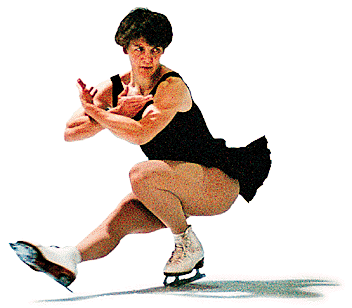
Terry Walters is the U.S. Figure Skating national champion in the 36-45 age group. Photo by Kathryn Bender, Star-Bulletin
Terry Walters is the U.S. Figure Skating national champion in the 36-45 age group. Photo by Kathryn Bender, Star-Bulletin
First in her high school class. First woman to go to West Point. First in the javelin, first in power lifting.
Hawaii's first national figure skating champion.
But Walters is also first to put herself second.
"She's done so many interesting things in her life, but she's so unassuming," Ice Palace manager Therese Hayes says. "She's won nationals and all that; you might think she'd want special treatment. But it's quite the opposite. She's very friendly and helpful and supports skaters of all levels."
Nobody at the Ice Palace has seen anything like this Terry Walters before. And not just because she's a United States Figure Skating Association national champion who successfully defended her 35-45 age group title last month at Lake Placid, N.Y.
"I really love skating. I have a very stressful job (she's a doctor at Tripler), so this is a great release for me," she says. "When that music comes on I just get lost in another world."
Three short years ago, figure skating was on hold. And Walters was definitely in another world. A world of famine and firefights, disease and desolation.
Each day brought unique challenges for Maj. Terry Walters, brigade surgeon for the U.S. Army in Somalia.
There was the time when 90 combat casualties, Americans and Pakistanis, were treated by her small unit. Walters was in charge of triage.
"Basically, I had to determine who would live and who would die," she says. "It was a very intense experience, with a lot of good and bad results."
Her unit worked for 36 consecutive hours.
Most of her deployment was not spent patching soldiers together. The real mission was trying to fix a broken country nearly devoid of hope.
 "Somalia was a very difficult situation and it didn't turn out right. But I feel good about my contributions there," Walters says. "Some of it was very frustrating. You'd get to the point of 'Why should I give this child antibiotics when he's just going to go and drink dirty water?'
"It's a fallacy to believe that everyone was merely starving to death," she says. "A lot of children died of infectious diseases because very basic public health needs weren't being met. We drilled wells and immunized 1,200 kids. We tried to do things that weren't merely bandaid treatments."
Walters says this all with the remnants of a British accent. She was born on Malta, an island in the middle of the Mediterranean Sea. How did she end up in the U.S. Army?
"When I was 10, our family was traveling around the world on a boat when my dad disappeared in the Caribbean Sea," the only child says. "My mother and I were staying ashore at a friend's house. Dad had gone fishing to try to make some money, because we were nearly broke. There was a hurricane and we never saw him again."
They had relatives in New York, so Walters and her mother, Kathleen, ended up there. Kathleen worked two and three jobs to put her through school. Terry excelled in academics and track and field, and was the valedictorian of her high school class.
But there was no money for college.
"That's how we got the idea for West Point," she says. "I got in, and then I realized I had to become an American citizen.
"West Point was a culture shock to say the least," Walters adds. "I didn't even realize it was a military academy until we got off the bus and the guy told us to drop our bags and do push-ups."
To make things even more interesting, she was among the first class of female cadets.
"I had a (male) squad leader who said, 'My duty is to get all of you (women) out of here,'" she says. "He certainly tried."
Walters was among 63 of the 160 women in the first class who graduated four years later with a commission. While at West Point, she set a meet record at the prestigious Penn Relays, throwing the javelin 155 feet.
"Being an interscholastic athlete gets you some respect and gets you out of a lot of hazing," she says. "And that was when I started lifting weights. It was basically for training."
She got serious about power lifting after medical school and her residency. In 1987 and 1988, Walters won national drug-free championships in the 139-pound weight class. She was also a world champ in '88.
The next year, Walters and her husband, Wally (they met at West Point) had their daughter, Vicki.
"It's very hard to powerlift when you're pregnant," she deadpans. "After I had Vicki I got interested in skating."
Walters says her first national championship skating meet, last year, was nerve-racking. But the competition was tougher this time around.
"It was the best from 32 different states at Lake Placid," she says. "People were pretty shocked that someone from Hawaii would win."
Hayes says Walters' victories shouldn't surprise anyone.
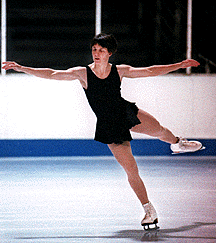
"She's got tremendous power and her jumps are huge," Hayes says. "They're beautiful, big jumps. When you see her skate, it's amazing to see how high she flys."
Hayes adds that if Walters had started skated seriously at a younger age, she may have been of Olympic caliber.
"You can never say for sure, but she certainly has the talent and drive you see in the most successful skaters. With kids, you look for that kind of innate talent and the personality of self-discipline that Terry has," Hayes says. "She's got an incredibly busy schedule, but she's in here five days a week."
Nani Malama, 17, an up-and-coming skater at the Ice Palace, says Walters is "really fun to skate with, she's a motivator."
"She's a role model for everyone at the rink," say Kathy Malama, Nani's mom. "Not just the kids. She's always so excited when other people accomplish things."
Maj. Walters becomes Lt. Col. Walters a week from today.
Are we talking to a future "surgeon general?"
Walters, 38, laughs.
"The way I look at it, if I get a rank, great. If not, so be it," she says. "I just want to be able to contribute to society."
For Terry Walters, that wouldn't be a first.