
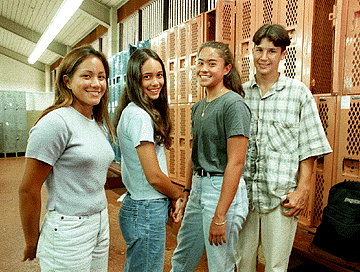
Top finishers in Kamehameha's physical education events, from left, Carly Bolson, Nina Pacarro, Sara Pires and Noa Lincoln. Photo by Dennis Oda, Star-Bulletin
Top finishers in Kamehameha's physical education events, from left, Carly Bolson, Nina Pacarro, Sara Pires and Noa Lincoln. Photo by Dennis Oda, Star-Bulletin
There also are the physical fitness challenges that offer the extra benefit of teaching students good training habits that the faculty hopes will last a lifetime.
All Kamehameha freshmen take a physical education class that culminates for most of them with a 15-kilometer run or a 2.2-mile swim.
And sophomores train for a biathlon that consists of an 800-meter swim followed by a 4-mile run.
These events were completed the past two Fridays at various locations on Oahu. The training and preparation has been year-long.
"This really brings our class together, because everyone has to do it," said Wailele Sallas, who was the first boy to complete this year's biathlon. "We have fun. It becomes a big gathering and a fun thing.
"It's also gotten me into better shape and that gives me a competitive edge in sports," said Sallas, who also competes interscholastically in basketball, football and track.
Kamehameha physical education instructor Gail Murakami coordinated the biathlon and helped get the students ready.
Murakami, a 1978 Kamehameha graduate, remembers when the program started. She was a senior cross country and track runner, and helped put on the events even then, as a student. She said the stringent program was implemented because statistics consistently showed people of Hawaiian ancestry as being below average in physical fitness.
"The health statistics for Native Hawaiians are dismal," Murakami said. "We're at the bottom in almost all areas. Another report just came out for cancer that has us at the bottom.
"Hopefully this program will make a difference when the students have families of their own," she added. "That's the best place to promote healthy lifestyles and to get people to take care of themselves and eat right."
Sophomore Carly Bolson was the first girl to finish the biathlon this year. She said she's learned that there is more to proper training than running and swimming.
"Proper nutrition and rest is really important," she said. "Eating right and getting sleep really matters. You can't cut out a couple hours of sleep even just one night. It will catch up with you."
Of course, not all students look forward to these events.
Freshman swimmer Sara Pires, who qualified for the state meet this year, naturally chose the swim over the run.
"I'm not really looking forward to all that running next year," said Pires about training for the biathlon. "But it shouldn't be too rough, because the training is done at a pace where everyone can keep up."
Pires was the first girl to complete the swim. Alfred Von Gieson was the first boy to finish.
The only students who do not have to run or swim are those who have medical waivers. And there are special individualized programs to help obese students.
"A lot of it is behavior modification," Murakami said. "We bring in dietitians and nutritionists and work with the families. We determine realistic individual goals for these students."
Individual goals also are set for all juniors and seniors. Before students graduate, they are expected to train for and participate in at least one community event, such as a 10-kilometer road race.
Freshman Noa Lincoln, the first boy finisher in the 15-kilometer run, has even bigger aspirations.
"The idea of running long distances seems fun now," he said. "I really want to run a marathon now."
So does Nina Pacarro, the first girl to finish the 15K.
"It's a great feeling when you accomplish something that you thought you could never do," she said. "Someday I want to be like those 50-year-old people running marathons."
Mililani Mauka Elementary is another Oahu school working toward improving fitness in Hawaii's youth. A solution
It has been designated an official model school representing Hawaii in Project Fit America. PFA is a national, nonprofit organization that gets children physically fit and teaches them lifetime cardiovascular health habits.
The $10,000 program is sponsored entirely by Wahiawa General Hospital. The hospital also sponsored a successful two-year pilot program at Haleiwa Elementary in 1993.
U.S. Olympic silver medalist wrestler Andy Rein is here to install the program at Mililani Mauka. Rein is a regional director of PFA.