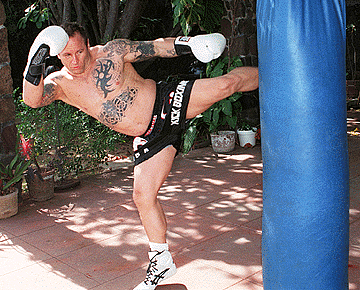
Carl Franks lost an April fight-to-submission bout in Canada
but continues training for future fights.
Photo by Ken Sakamoto, Star-Bulletin
Carl Franks lost an April fight-to-submission bout in Canada
but continues training for future fights.
Photo by Ken Sakamoto, Star-Bulletin
A referee stopped the extreme fighting match April 26 in Kahnawake, Quebec, between Carl Franks, the U.S. United Full-Contact Federation heavyweight champion from Kaimuki, and "Conan" Silviera, a Brazilian from the legendary Gracie jujitsu team.
In the "fight-to-submission" match, Franks didn't submit. But that last punch knocked him to a faraway place for a few seconds, still standing with his light eyes wide open.
Extreme? In boxing, Franks would have been given a standing eight count; the fight possibly stopped. In this match, his glazed look was enough for the ref to raise Silviera's arm in victory.
But Franks will train for his next challenge. And he doesn't think lawmakers have the right to take an opportunity to compete away from him.
"(Legislators) are not looking at it as a sport," said Franks, a solid 5-foot-8, 220 pounds.
His weight trainer agrees.
"It's not for legislators to decide what sports people can play and not play when you have two consenting adults, unless they can say people are getting injured above normal recreation," said Lyn Silbert, a physiology Ph.D. candidate at the University of Hawaii.
"It's a way that people have of expressing themselves."
Full-contact fighting has been a red flag for lawmakers, prompting four states to outlaw the matches. In Hawaii, State House Bill 2688 intended to ban participating in or broadcasting no-rules combat contests here, but died this legislative session.
Rep. Mike White, who plans to reintroduce the House bill next year, said, "(Full-contact fighting) is simply another example of violent and aggressive behavior that, unfortunately, seems to encourage it in other places."
But he's willing to have public hearings to look at what full-contact fighters have done to govern themselves.
"They're more than welcome to present their case," he said.
In Quebec, a court injunction allowed blocking transmission of the event there, but it wasn't enough to keep pay-per-view customers in the United States from watching Battlecade's Extreme Fighting World Championship.
A judge sought the injunction after his federal counterpart refused to stop the event, which was held on a Mohawk reservation near Montreal.
After the event, fighters were caught in the bureaucratic cross-fire and arrested, except for Franks and another fighter, who weren't in their hotel rooms.
Promoters of the sport say it has evolved in the past three years. They say contests are becoming safer with well-rounded fighters disciplined in martial arts and wrestling going for the purses, which range from a couple of thousand dollars to $100,000.
But an image from the early days - bloody barroom brawlers drunk on ego and testosterone - dies slowly. Full-contact fighting is dogged by previous mismatched battles. A few years ago, the Ultimate Fighting Championships matched a 618-pound sumo wrestler with a light-footed karate fighter in a rock-star backdrop of smoke and strobe lights. Within minutes, the karate fighter pounced on the sumo wrestler, hammering the blood out of him. And the crowd roared.
The raw street-fighting image draws some ticket buyers who want spurting blood, snapping bones and obvious pain. A fight to the end. This upsets Franks.
"The thing that's gotten this sport bad press is some promoters making it seem like a bloodthirsty, animalistic bloodbath," he said. "We're a special breed of athletes - boxer, kicker, someone who works on the ground. It's the whole strategy. We're just two guys going at it."
The irony is each "no-rules" event has its own rules. The one in Kahnawake didn't allow eye-gouging or biting. Others won't tolerate throat strikes or groin hits. At any time, a combatant can tap out. And a ringside doctor has the power to stop the fight.
Matt Young, who promoted two events in Honolulu, says those who think contests are gory haven't been to one here, and are comparing them to what they've seen on television.
"Fight-to-submission" is open to interpretation, he added. "It's not a blood sport."
Hawaii has a television market for full-contact events, although small. "It's not a Tyson fight," said Lonnie Shupp, director of program services for Oceanic Cable. Oceanic had questioned whether to air the event and decided on pay-per-view, Shupp said. Advertising was "fairly low-key" because of its sensitive nature, she added.
A bar on Nimitz Highway features freestyle fighting for sellout crowds, and raises eyebrows. Local "experienced" fighters are screened to meet their match at Gussie L'Amour's nightclub for a purse of $1,500, and guys "good at street fighting" are welcome, said promoter T. Jay Thompson.
Two paramedics are on hand, and fighters can tap out or their corner may throw in the towel.
Steven English of Honolulu, a former world arm wrestling champion, goes to see "eight guys go in and one guy walk out the winner." A lot of military combatants and Waianae kickboxers show up. He has witnessed throws, kicks to the face, broken noses and a guy punched in the groin, but said it's a well-run contest.
Franks turned down an invitation to fight at Gussie L'Amour's. "That's nuts," he said.
But at a professional level, full-contact fighting is a true test of self-defense for Franks, who has studied the gamut of martial arts for 23 years, as well as boxing and wrestling. "If we had sponsors like Nike that would back some of us athletes, we could show some real skills, some real talents," he said.
"We could spend the hours and time necessary."
Franks is 32 and knows other ways to make a living. He's an acupuncturist, massage therapist, strength and conditioning coach, and martial arts instructor and he's interested in herbal medicine. But he wants the chance to make money to live in Hawaii.
"When you're done with your career, you want something from it," he said.
Silbert insists other sports are more dangerous than full-combat fighting. Sports medicine literature compares the boxing glove with flexible bumpers on cars. Exterior damage isn't as likely as whiplash to passengers, she says. Boxing gloves won't cut up the face as much as a thin glove or fists, but contribute to the force of blows and injuries to the brain.
In football alone, the National Safety Council reports that in 1991, an average year, there were 12 deaths, nine associated with high school football. "Exercise Science" reported in 1988 that in 11 years, there were 96 permanent cervical cord injuries in high school football and 15 in college football.
In Franks' opinion, full-contact fighting builds character. And after a 320-pound person tried to tackle and strangle him, "not a whole lot bothers me."