View Point
By Carl W. Lehman, M.D.
and Frederick C. Holschuh, M.D.
Friday, May 3, 1996
Don't turn back the clock on inmate health care
'Prison Doc's' charges of inadequate policies
must be investigated
Dr. Kim Thorburn
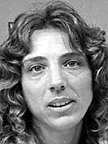 With the recent resignation of Dr. Kim Thorburn as the "Prison Doc," and the associated concerns raised regarding medical ethics and medical autonomy in correction facilities, the Hawaii Medical Association believes it is important that our state reflect on the necessity to maintain a system of adequate medical care for inmates.
While the Bill of Rights may be of little interest to most of us on a daily basis, those who have been convicted of a crime are very much aware of the guarantee of the Eighth Amendment in the U.S. Constitution, which provides that "cruel and unusual punishment shall not be inflicted."
Although modern penal systems no longer use medieval tortures, the proper health care of prisoners has become the subject of numerous prisoner-initiated lawsuits.
About 20 years ago, in an effort to establish a universal system which would define adequate health care in prisons, the American Medical Association, with Law Enforcement Assistance Administration funding, initiated a pilot program for the Accreditation of Medical Care and Health Services in Jails.
The Hawaii Medical Association physicians and staff worked with 28 other state medical associations to formulate a national accreditation process.
The primary benefit of accreditation to a jail is the professional and public recognition of good performance, i.e., a jail's health-care delivery system is found to be "adequate" in terms of the medical care and services it offers. In addition, implementation of the recognized standards can result in (1) more effective health-care delivery, (2) greater cost efficiency and (3) better overall health protection for inmates, jail staff and the public at large.
In the 1980s, Dr. Kim Thorburn, an expert in correctional health who had previous experience at prisons such as San Quentin and other California facilities, came to the islands to serve as Hawaii's first designated health authority responsible for the health-care services in all correctional facilities in the state.
Under her direction, national standards were implemented in Hawaii, and the federal consent decrees imposed on state facilities began to be lifted, resulting in some relief from legal struggles and penalties.
The HMA believes these national standards must be maintained. The concerns raised by Thorburn, a world expert in prison health care, cannot be ignored. Charges regarding inhumane treatment of prisoners, violations of physician-patient privacy and the medical autonomy of the health-care administrator must be investigated.
HMA believes the public has a right to know what is going on in the correctional system. HMA's Committee on Health Care in Correctional Facilities is willing to participate in professional reviews. Reports from the national correctional accreditation teams which have visited Hawaii's facilities must be examined. A public advisory committee can be formed to provide a collective conscience regarding the concerns raised.
We thank Thorburn for a job well done. She has guided the development of a health-care system in our correctional facilities that has met national standards. Unless the concerns raised by Thorburn are addressed, we foresee more bad publicity and demoralization of those doing an effective job, as well as increased federal consent decrees accompanied by increased legal expense. Solutions can be found; more problems are not needed.
Carl W. Lehman, M.D., is president of the Hawaii Medical Association. Frederick C. Holschuh, M.D., is chairman of the HMA Committee on Health Care in Correctional Facilities. The opinions in View Point columns are those of the authors and are not necessarily shared by the Star-Bulletin.