If Hawaii could pool its resources and expertise in this field to address the ever-worsening global fisheries crisis, we could turn bad news into an opportunity for Hawaii on the domestic and global stage.
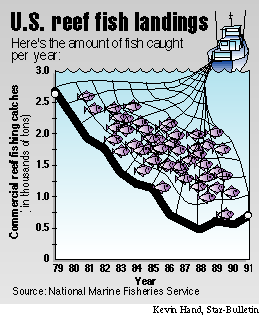 The U.S. Congress has finally recognized what Garrett Hardin was telling us more than 25 years ago. Hardin's "Tragedy of the Commons" (published in the journal Science in 1968) predicted that U.S. fisheries would be squandered if their regulation was left in the hands of the fishing industry. Nevertheless, in 1976, Congress mandated fishing industry-dominated regional organizations to regulate U.S. fisheries.
Today, U.S. fisheries are in such bad shape that new laws are being written by the current Congress to protect fish over fishermen's pocketbooks.
Annual yields in U.S. ocean fisheries have declined so dramatically that even a Congress bent on eradicating federal regulations realizes that this is one case where the government must step in immediately.
The depletion of U.S. fisheries is part of a worldwide trend. The United Nations Food and Agriculture Organization forecast a collapse in the growth of world fishery landings by the turn of the century. FAO statistics now show that this collapse has already happened - a decade earlier than predicted.
We also have seen the environmental consequences of population growth and rapid urban development. Increasingly we wonder if our children and future generations will be able to enjoy Hawaii's marine resources as we once did - fishing for prized Hawaiian fish; exploring pristine reefs and unspoiled beaches; enjoying Hawaii's beauty and its diverse natural resources, which are increasingly being threatened by environmental problems.
It has been estimated, for example, that landings of coastal fisheries in Hawaii have declined by 80 percent since the turn of the century, primarily because of over-fishing and development-related habitat degradation problems.
Hawaii's expertise and resources in the areas of marine fisheries, ocean technologies and the environment should be pooled and applied toward developing a cooperative, integrated fisheries/natural resource management strategy. With the public sector acting as a catalyst, public and private organizations in Hawaii could join forces to initiate such a cooperative program. Among these organizations could be the UH Institute of Marine Biology, the East-West Center, state Department of Business, Economic Development and Tourism, state Department of Land and Natural Resources, National Marine Fisheries Service, the Oceanic Institute and the National Energy Laboratory of Hawaii Authority.
These organizations - a "Hawaii, Inc." combining diverse talents in fisheries and the environment - could be a powerful force working to ensure long-term sustainability of our marine resources. "Hawaii, Inc." could serve as a model for solving worldwide fisheries/natural resource and environmental management problems, setting a trend in the global market.
For example, the Oceanic Institute (OI) at Makapuu Point on Oahu, the world's largest applied aquaculture research facility, has developed advanced aquaculture technologies for producing marine fish and shrimp, to supplement natural food production from the sea.
OI is also leading the nation in developing and demonstrating a responsible stock enhancement technology, which involves releasing hatchery-raised marine fish into the ocean to restore wild stocks and positively impact fishery landings.
In addition, the National Energy Laboratory of Hawaii Authority (NELHA) at Keahole Point offers technologies for alternative energy sources, e.g., ocean thermal energy conversion (OTEC) and marine aquaculture technologies. The University of Hawaii, National Marine Fisheries Service, OI and other organizations in the state also offer expertise in fisheries monitoring, resource assessment, habitat restoration and environmental mitigation technologies.
Next, we should define and establish the markets for these pooled resources. It is clear that there are domestic, national and international customers with both the resources and interest to support Hawaii's participation in addressing the global marine fisheries/environmental crisis. Potential clients, such as the regional development banks, World Bank and environmentally oriented foundations, need to understand the depth and breadth of expertise "Hawaii, Inc." can bring to their concerns.
Finally, a coordinated marketing strategy must be developed and implemented to bring to fruition the tremendous potential and comparative advantage Hawaii has in fisheries, ocean technologies and the environment. A concentrated effort can fuel the development of Hawaii's ocean-related institutions to a new level of economic importance to the state.
The grim state of the global fisheries crisis should inspire us to turn this crisis into an opportunity by making "Hawaii, Inc." a reality.