Friday Record Reviews

By John Berger,
Special to the Star-Bulletin
Friday, April 26, 1996
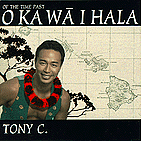 TONY Conjugacion returns to his roots as singer and recording artist with this 14-song tribute to the late Vicki Ii Rodrigues.
Fans who remember his early albums for Ken Kahanu Post and who thought his beautiful nationalist anthem, "Great Hawaiian Hope," was "too haole" will love "O Ka Wa I Hala."
With a single exception, all the songs are sung in Hawaiian, and his falsetto is absolutely beautiful. A duet with Nina Keali'iwahamana is a dramatic and sentimental highlight.
Unlike a number of recent Mountain Apple albums, this one is properly annotated. It includes complete lyrics in Hawaiian and line-by-line translations that share the basic meaning with the English-speaking majority. The kaona, or hidden meanings, are kept for those who can deduce them; that's proper too.
It doesn't require a crystal ball to see Conjugacion as a finalist in every possible category at the Hoku Awards next year.
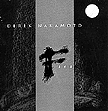 GO back far enough in local pop music history and you'll find Derek Nakamoto. He departed the local lounge scene more than 20 years ago for a career doing studio work in California. His name occasionally appears as producer, arranger, writer or musician when local artists opt to record pop material in Los Angeles. This is his first known project as an album headliner.
The general theme is about winter as the final season of life. Nakamoto and eight colleagues explore the concept from an imaginative variety of musical perspectives. The musical palette includes solo acoustic piano, a potential pop chart hit titled "The River Rises," instrumental jazz, and Native American chant.
Utilizing the latter is a gamble considering the number of Native American recording artists with a more direct claim to the material. Nakamoto explains his choices and diffuses any suspicions of cultural plagiarism in a beautifully illustrated 14-page booklet of lyrics, essays, poems and photographs.
Sophisticates appreciative of music that can be enjoyed both as Muzak and serious mind fodder will find Nakamoto's 70-minute multicultural odyssey of interest. His music wears well through repeat play.
 SEVERAL years ago the Mountain Apple Company distributed an album that Pauline Wilson had recorded in Japan for a Japanese record label. Sloppy research by the HARA Selection Committee resulted in the album appearing on the Hoku Awards ballot in 1994 even though it was in no way a product of the local recording industry. (Wilson was a California resident at the time.)
However, the album was of local interest because Wilson was originally from here, and because it was apparently her first album since her days with Seawind. "Gravity" is another such album with a tenuous local link.
The band is a vehicle for Harold Payne, known locally as the composer of songs recorded by Kalapana. The small print indicates the album was apparently recorded in 1989 by the same label that recorded Wilson. (Pony Canyon has also released Japanese albums by Kalapana and Cecilio & Kapono.) It's a shame it can't be claimed as a local product beyond Payne's link to Kalapana.
Lead vocalist Clydene Jackson Edwards is a powerhouse singer who also writes. "Don't Mention My Heartache" and "California Blues" are sweet and soulful showcases; the former is a Hot 100 hit waiting to be discovered. "I Wish He Didn't Trust Me So Much" features Payne on a song he co-wrote about a clandestine romantic triangle. He is also the co-writer of "Music Speaks Louder Than Words" - a feel-good anthem that sounds familiar on first listen.