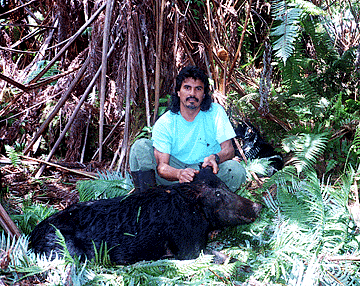
A hunter's reward: Danny Munoz with the payback for a long day's work. Photo by Steve Lichter, Kurtistown, Hawaii
A hunter's reward: Danny Munoz with the payback for a long day's work. Photo by Steve Lichter, Kurtistown, Hawaii
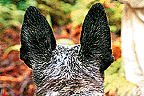
A dog listens for clues to a pig's presence.
 The dogs are out and you're sitting on a fallen log with the old man atop "Hamburger Hill" while others survey the mountain. Like the GIs in the film by the same name, you've fought and scrapped and clawed your way to the top and the breathtaking vantage and the delicious opportunity to rest. There's nothing like the smell of victory in the morning.
Except the dogs haven't barked and your legs are on fire and the old man's saying the pig hunting just isn't what it used to be.
Al Jardine looks for signs of pigs in the forest outside Hilo
where he has hunted for more than 60 years.
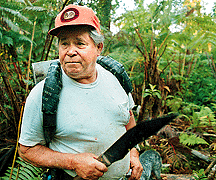 Al Jardine's been hunting pigs here since his father taught him to take aim and fire in the early '30s. He knows "the mountain" like Uncle Jack knows his favorite golf holes; he can tell you exactly where he bagged a boar seven years ago and how big the sow was that left the tracks in the mud the night before.
But even the elder statesman of the Big Island hunting fraternity can't guarantee you'll "catch one pig."
"You get coffee in your car?" asks Jardine, poker faced. "The dogs must be back there taking one coffee break."
Laughter all around.
The imagery sticks as you rise stiffly and resume the trail.
Where are those hounds?
Jardine and other longtime Big Island pig hunters took the Star-Bulletin on a hunt on the outskirts of Hilo to provide a glimpse into a tradition they say is endangered, as controversy swirls statewide over the threat to native species by imported pigs. The hunters say their prey is dwindling and their hunting areas shrinking as environmentalists push to control pigs to prevent further damage. Meanwhile, the uneasy co-existence between environmentalists and hunters continues, as does the hunt.
A hunter's dogs are as essential as his weapon. Healers, beagles, terriers and poi dogs, they're a ragtag crew sharing a heart for the hunt. They'll snort and sniff and run underfoot until they come across fresh scent. One whiff and they're gone.
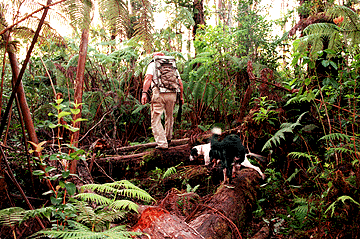
Jardine cuts his way through brush along the slopes of
Mauna Loa outside Hilo as dogs trail behind him,
sniffing the forest floor for a fresh pig scent.
With the dogs chasing shadows, the hunters pick their way through the forest. Jardine's in the lead, hacking at the hapuu and poka and ohia to clear the way. He carries the bullets; son Ranford follows with the unloaded .30-caliber World War II vintage carbine, a pack frame on his back. Every few minutes, they stop to listen for barking in the muffled stillness.
Steve Lichter and Danny Munoz hang back. Patient. Listening.
A helicopter drones overhead and a breeze rattles the trees. Rubber boots scuff the dirt. Someone stifles a belch.
Then a faint yip, miles away. And another.
The hunters move toward the sound, energized.
A mile further, Maile, a bull terrier cross, and Barney, a beagle, appear, their rumps spattered with blood.
"Small ones," says Munoz.
While the dogs often chase young pigs and kill them, they usually can only corner the bigger ones, keeping them at bay until handlers arrive with rifle or bow or knife. This time, the gun remains silent, slung over Ranford's back.
Lichter sees the forest as a haven from work and worries and the telephone. A Kurtistown flower grower and founder of Pig Hunters of Hawaii, Lichter worries that more people, fewer hunting grounds and the push to eradicate feral pigs to preserve native Hawaiian bird species will end hunting as he knows it.
Hunters point to a landmark court decision in the 1970s that prompted eradication of sheep and goats from Mauna Kea to save habitat for the endangered palila bird.
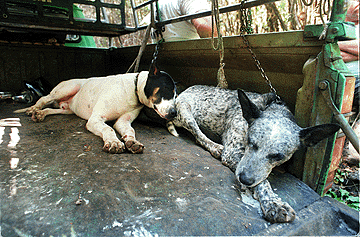
Weary dogs nap in the back of the pickup after the hunt.
Meanwhile, the palila is making a comeback.
"We're getting to the place that one day our kids won't have any place to hunt because there will be nothing to hunt," Lichter says. "It's hunting that's on the verge of extinction. ... This is what saved me in high school. You come out here and it's just you and the mountain and your dogs."
The forest here is full of pig sign: Cloven-hooved tracks in the mud, expanses of rototilled soil and fallen hapuu ferns bored into for the pithy core. But in the dank closeness of the Olaa rain forest, the real thing is elusive.
So, too, is common ground between hunters and environmentalists.
Scientists and conservationists liken the pigs to mobile, snouted garbage disposals, well-equipped to lay waste to prime forest by uprooting shrubs, spreading alien seeds through their feces and promoting avian malaria by creating rainwater reservoirs in fern stalk and soil. Hunters see them as part of the natural scheme, an essential resource with traditional significance. Pigs roasted in an imu have long been associated with the milestones of life in Hawaii: The birth of a child, first-year luau, celebrations. The hunt, stalk and kill are part of that tradition.
Jardine and Lichter discount the pigs' rooting and browsing as benign. Where environmentalists see endangered birds and habitat degradation, Lichter and Jardine see what their fathers and the fathers before them saw -- pigs.
"Hunting pigs, it builds up in your genes," says Munoz.
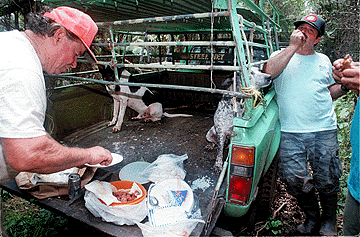
Al Jardine serves up some sausage while Steve Lichter
munches on chicken.
Then they bust out the beverages and the pork sausage and the stories of other hunts and other mountains. The prized dog slashed to death by a cornered boar. The lost dogs that finally found their way home. The tusks and the trophies and the meat on the table.
"It's not a matter of what you caught and how big it was," says Munoz.
"It's the enjoyment of going out, catching your animal and sharing your story, smoking the meat together. That's the love you share with people."