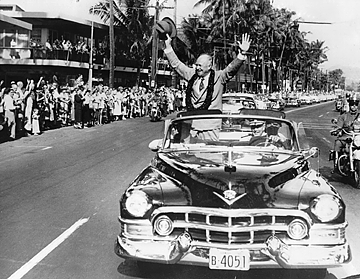
The real Ike Eisenhower gets a warm aloha from a Hawaii crowd in 1952. Star-Bulletin file photo
The real Ike Eisenhower gets a warm aloha from a Hawaii crowd in 1952. Star-Bulletin file photo
That simple sentence recalled for me the greatest thrill of my entire life. For it wasn't President Eisenhower who received the cheers and adulation from the crowds, it was me! And how was that so? Let me explain.
Several months prior to Ike's visit, Korean students had launched the "April Revolution." The South Korean government had become excessively repressive and was generally hated by the majority of Koreans. This was particularly true of the students who had been exposed to American ideals of freedom and democracy during their academic instruction.
The focus of the students' hatred was the speaker of the National Assembly, Lee Ki Poong, and only secondarily focused on the president, Syngman Rhee. Rhee was called "oboji" or "father" by the general populace who loved him for his role as national leader in exile during World War II and his founding of the Korean republic after the Japanese surrender.
But the people also believed he was responsible for the excesses of Lee Ki Poong and felt that father of the country or not, he had to go as well. Rhee had adopted Lee's son (called "Young Rhee") because Rhee and his wife were childless. This act had made Lee and Rhee inextricably connected by family as well as by politics.
The student revolution grew and grew in violence and intensity. Thousands of young Koreans were slain in the streets of Seoul during those horrible days and nights. Those of us living in the Yongsan United Nations Command compound could hear gunfire throughout the night.
As the chaos and slaughter intensified, the American Embassy finally decided to act. The American ambassador was out of the country but the charge d' affaires, Marshall Green, announced to the riot-torn nation: "The American people recognize that the Korean people have certain justifiable grievances." The exact meaning of the message was debatable, but the Korean people immediately assumed that this simple declarative sentence meant that the American government was firmly on the side of the Korean students in this bloody political struggle.
The revolution ended soon afterward. President Rhee had called in the Army which, after rolling into Seoul, refused to shoot any more students. Young Rhee (whom I had gotten to know at Yongsan) went to the home of his true family and promptly killed his father, Lee Ki Poong, mother, and all the other members of his family. Then he turned his .45 calibre pistol on himself. The student revolution was over and "democracy and freedom" was the rallying cry of the day. Everywhere Americans went in Seoul after that, they received the cheers and adulation.
It was into this euphoric milieu that President Eisenhower arrived several months later. However, the ever-cautious Secret Service wasn't taking any unnecessary chances. They arranged for a presidential motorcade to proceed from Kempo Air Base to the embassy compound merely as a diversionary tactic. The president was actually going to travel by helicopter. All they needed to complete the charade was a volunteer to play the role of President Eisenhower. That was me.
At that time, I was employed as a Department of the Army civilian in the 8th Army Information Office. I knew, in my heart of hearts, that neither Eisenhower nor his impersonator had anything to fear from the Korean people. They were truly united in their love for America and American ideals. President Eisenhower was the embodiment of those ideals.
Of course, I was slightly younger than Ike - by about 40 years - but no matter. I wore a dark suit and a black homburg and sat alone in the rear seat of the presidential limousine. When we reached the main streets of Seoul, Koreans were everywhere - on rooftops, hanging out windows, clinging to utility poles, on top of cars, jamming every inch of sidewalk space. Lines of people and soldiers tried to keep the masses from surging into the streets.
With complete abandon, I waved enthusiastically to everyone. Occasionally the masses broke through police barriers risking a truncheon blow across the head just to touch the presidential car and to scream out their affection for the leader of the free world. Sometimes the vehicle was actually rocked by the surging throngs but I never felt in danger. (My only fear was that someone might catch on to the fact that I wasn't the president after all.)
Later, at the embassy, I was introduced to President Eisenhower but no mention was made of the role I had played. Meeting the president of the United States should have been the greatest thrill of my young life but nothing could ever compare with receiving the wild embrace of an adoring nation. Eisenhower probably had that experience dozens of times in his life time, but for me, even though a rank imposter, it was incomparable.
Reading Neilan's column brought it all back to me. Yes, Eisenhower, according to the official history books, visited South Korea, "where more than one million turned out in the Seoul streets to welcome the U.S. leader." But I know, and now you know, that was not exactly what really happened. But who cares? Those cheers I basked in were for Eisenhower and the American people. No Secret Service ploy could ever take away from that reality. I just felt good about being an American at that special moment. That feeling has never diminished in the 36 years since.
P.S. Ike did ride back to the airport - at about 50 mph through the streets of Seoul, which were now flanked shoulder-to-shoulder by ROK soldiers. Not much presidential waving then.
The opinions in View Point columns are the authors and are not necessarily shared by the Star-Bulletin.