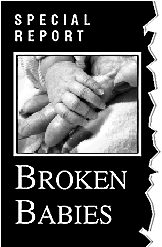
 Hundreds of children are in limbo in foster care - unable to go home or to an adoptive family because of snags in the system.
State Human Services officials are working with the Family Court in a special effort to get kids into permanent homes.
Lynn Mirikidani, an assistant program administrator in child welfare services, said adoptions are pending for about 200 of the 900 kids in foster care. Only 38 adoptions were completed on Oahu last year, she said.
The department is moving kids faster from foster to permanent custody, but adoptions are delayed for several reasons, she said.
Among them: No adoption unit supervisor for a long time. Only one worker to study adoptive families. A tedious court process with myriad forms and procedures. Difficulty finding parents to terminate rights.
With all the requirements, workers aren't able to get children to court as fast as Family Court Senior Judge Michael Town would like, Mirikidani said.
In a recent review of children waiting for adoptions, Mirikidani said, only 22 needed adoptive families. For the others - already with foster parents, relatives or homes wanting to
keep them - it was a matter of completing adoption procedures. It usually takes over six months from termination of parental rights to finalize an adoption, Mirikidani said.
It may take much longer if a youth is 18, because of a new law concerning access to birth information, she added.
Town said the court is working to reduce requirements, such as eliminating unnecessary court trips for social workers and simplifying family service plans.
"I'm letting them (Human Services officials) tell me what they want," he said.
National groups criticize Hawaii for having more kids in foster care than any other state. Officials here call the figures skewed because some states don't count foster kids who are with relatives; Hawaii does.
Still, state Human Services Director Susan Chandler agrees too many kids are in temporary homes - something the department is striving to cut with steps such as enlisting private agencies to help with home studies. "We're more likely to succeed if we're moving children out of foster care into adoption," she said.
Even with a better process, children have gotten more difficult to place because Child and Protective Services is taking only the most serious, problematic cases, Mirikidani said. Children and adoptive parents need help which the staff-short adoption unit has trouble providing, she said.
Also, while the goal is to try to reunite families, that frequently isn't possible because of serious drug problems in the home, Mirikidani said.
Providing some relief is a three-year federal grant of $125,000 per year to focus on adoptions or long-term homes for children 13 and older. Often, these youths don't want to be adopted so the child and adoptive parents must undergo intensive counseling, she said.
From last June to December, a team reviewed 80 children heading for permanent out-of-home placements, with decisions to come in 18 months, Mirikidani said. "That's the length of time families have to work toward reunification. If things are not moving, for the child's best interest, we want to place a child in a permanent home."
The Related Story:
Broken Babies
Foster Parents
Text Site Directory:
[News] [Business]
[Features] [Sports] [Editorial] [Community] [Info] [Stylebook]
[Feedback]