Friday Record Reviews
By John Berger,
Special to the Star-Bulletin
Friday, April 12, 1996
 EVERY year an album or two gets lost in the shuffle as far as getting reviewed, yet come Hoku time is shown to have struck a chord with the Hawaii Academy of Recording Artists membership. This is one of them. Rookie recording artist Darren Benitez drew on an array of talent that includes Sean Na'auao, Michael Grande and Bully Soares to craft a beautifully traditionalist album.
Benitez will appeal to the same constituency as Dennis Pavao. He sings in a similar falsetto, avoids synthetic instrumentation, and favors the same range of material. The title song - a requiem for several friends and relatives - is a Pavao-style tear-jerker; it's one of two originals.
Benitez' other original, "Kea-kea'alani," is a more impressive piece of writing but lacks the sentimental hook popular in local music. Selections by other composers include a Christian hymn, Latin rhythms, and six untranslated Hawaiian songs.
It's to the credit of Na'auao as producer and Benitez as artist that no musical concessions were made to Jawaiian diehards and no limp pop-chart remakes were larded on as bait for "island music" radio programmers.
Traditionalists will applaud his treatment of the Hawaiian language standards; it's unfortunate that Na'auao and Benitez opted to omit English translations.
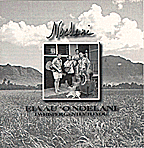 NOELANI Mahoe's 15-song collection slipped through the cracks last summer. It was not only her return to local charts but a preview of 'Elua Kane (Tau Grieg and Damien Farden); the duo released its debut album later last summer.
Listening to it now - with Mahoe up for Female Vocalist and 'Elua Kane up for Most Promising Artist(s) Hokus- it's hard to see how the album was overlooked.
The selections cover the gamut of what is considered traditionalist Hawaiian music - chant, Hawaiian classics, hapa-haole, and modern Hawaiian-language compositions. There is also a single puzzling remake, and a well-visualized translation of an American pop chart hit into Hawaiian.
The album is divided into segments featuring different combinations of vocalists with Mahoe's beautiful voice the common denominator.
At a time when some major local producers are cutting costs by omitting song lyrics, translations and background material, Mahoe and annotator Ka'upena Wong include it all with six full pages of information. The result is an album that shares the history and significance of the music with English-speaking listeners.
About half the songs on "My Life . . . My Destiny . . ." are originals. Others are karaoke bar standards, like "My Way," that Hank (McKeague) evidently enjoys singing. His singing is much more substantial than the low-budget local pop tracks. Hank and his producer, Ken Matsumiya, stretched the album from 10 songs to 12 by including two "karaoke version" arrangements.
The liner notes reveal that the album is Hank's heartfelt response to the problem of child and spouse abuse; an unspecified amount of any proceeds will go to an unidentified nonprofit organization.An original, "Little Man," addresses the human cost of the problem. "My Heart Cries Out Hawaii" and "Kuulei" have nothing to do with abuse but display his talents as singer/songwriter.
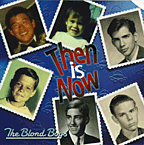 THE Blond Boys are not all blonds and not all "boys." Francyne "Miss Franny" Harper adds a feminine voice to the mix as the sextet serves up a cross-section of 1950s and '60s chart hits . The band sounds like the best local-based oldies group since Robbie & The Rockets and the Rock & Roll All-Stars of '70s.
Harper stars early, singing "Mama Said" with appropriate old-style sincerity. Male vocalists aren't identified individually, but the lead on "Surfin' Safari" comes reasonably close to the nasal tones of the early Beach Boys. "Pipeline/Walk Don't Run," honors the Ventures and Chantay's; it's one of the best cuts.
The group fails the impossible mission of matching Phil Spector's arrangement in "Da Doo Ron Ron," but does relatively well otherwise. They treat the music with respect rather than "Grease"-like condescension.
The album contains no information on the band or why it recorded an album of well-known mainstream oldies. More importantly, do the "boys" have the talent to write original old-fashioned rock?