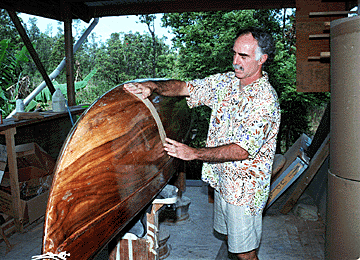
Gary Young holds a piece of bamboo fiber against a koa canoe at his shop in Kapoho on the Big Island yesterday. The canoe hull is made of bamboo fiber laminate with a veneer of koa. Photo by Rod Thompson, Star-Bulletin
Gary Young holds a piece of bamboo fiber against a koa canoe at his shop in Kapoho on the Big Island yesterday. The canoe hull is made of bamboo fiber laminate with a veneer of koa. Photo by Rod Thompson, Star-Bulletin
It could be used for car bodies, boats, and all types of construction, he says. Young, who operates his business in Kapoho, on the coast south of Hilo, already has made a reputation using bamboo for surfboards and sailboards. Champion windsurfer Robbie Naish has one of his boards.
Bamboo is also gaining national attention for many other products, and next month Hilo will be the center of the world's bamboo brainstorming at the Big Island Bamboo Conference and Trade Show.
Young is one of the pioneers in bamboo experimentation, including the use of shredded palm fronds to create laminates which are light and strong.
"They use less resin and are less energy-intensive to manufacture than synthetic fibers or steel," Young said. "They look the same when painted and (have) no rust or rot."
While Young is doing research and development in high-tech uses of bamboo, the Chinese and Japanese have been using bamboo commercially for centuries.
"Cultures like China have managed bamboo groves for more than 900 years," he said.
In Hawaii, the bamboo-growing industry is still in its infancy.
"We've spent the last six and a half years importing elite species from Asia and South America," said Peter Berg, co-owner with Susan Ruskin of Quindembo Bamboo Nursery on the Big Island. But getting these bamboo species through quarantine and under cultivation on the six-acre nursery is only the beginning.
He has sold many of these plants to Jeffree Trudeau on Maui, who has the biggest acreage under bamboo cultivation in Hawaii, Berg said.
Asians and Polynesians brought some species of bamboo to Hawaii but it has only been the last 20 years that international information on the best species for construction has been spread around the world, Berg said.
China has more species of bamboo than any other country, but the most organized commercial farming operations and record-keeping are probably done in India, Berg said.
In China, multi-ply laminates of bamboo have been used for concrete forms and ply-bamboo is made into panels for the beds of flatbed trucks - lighter and stronger than the wood and steel they replaced, he said. China also is experimenting in using bamboo laminate for truck bodies.
The economics of commercial bamboo farming is very complex, Berg said. While Asian countries do have some figures on production levels, he said it is difficult to apply that to Hawaii.
However, there is no doubt that bamboo can grow well on many of the former sugar lands, he said.
"Bamboo is a fantastically adaptable plant," Berg said. "The soil quality is not critical, bamboo mulches itself, and 50-60 inches of rainfall a year is enough for most species."
The Kahua O'malio Farm at Huelo, Maui, has 15 bamboo acres under cultivation. First plantings were done a year and a half ago, and they are already 8- to 10-feet high. "Next year, they will be 30- to 40-feet high," said farm manager Trudeau. Harvesting may begin in four or five years, he said.
Huelo gets 100 inches of rain a year, and the farm adds compost but uses no pesticides. In about two months, Trudeau will be selling the first solid, treated bamboo poles brought into Hawaii. The container load from Vietnam is expected to be used by homeowners who want to put up gazebos or backyard sheds.
To get approval for bamboo in homes, Trudeau is talking to the building departments of Maui, Kaui and Hawaii counties. "We hope to have that in a year."
Jim Green, owner of Island Bamboo at Paia, Maui, has been using bamboo for construction for 20 years.
"I learned construction while in a Japanese monastery for four years," he said.
His biggest bamboo job is the ceiling of the Humuhumunukunukuapua'a restaurant at the Grand Wailea Hotel.
Sarah Hollingsworth of the Bamboo Plywood Co. at Haiku, Maui, sells bamboo flooring and plywood. "I've brought in two container loads of bamboo veneer in the last eight years," Hollingsworth said. "They use it to cover walls."
She sells to homeowners, hotels, builders and decorators and even sells out of state.
Organizers hope next month's bamboo conference will lead to an increase in bamboo construction. Hollingsworth said that Oscar Hidalgo, an author of books on bamboo construction, will show slides of two-story homes in Colombia made of bamboo covered with stucco that were constructed for $7,000.
The first Big Island Bamboo Conference and Trade Show will be May 24-26 at the University of Hawaii at Hilo. Topics will include bamboo cultural ecology, farming practices, architecture and buildings, landscape design, history, and economics and versatility. World experts on bamboo will be featured speakers. The Thai example of bamboo farming and its potential for former Hawaii sugar lands, will be explained by Charupant Thongtham, director of the Royal Institute for Agricultural Development in Thailand. For more conference information contact Judith Fox-Goldstein at 1-808-933-3555.