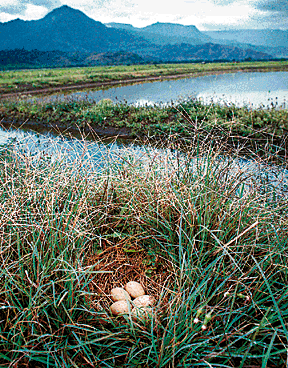
A nest of endangered moorhen lies near taro ponds
at the Hanalei National Wildlife Refuge.
Photos by Ken Sakamoto, Star-Bulletin
A nest of endangered moorhen lies near taro ponds
at the Hanalei National Wildlife Refuge.
Photos by Ken Sakamoto, Star-Bulletin
Endangered moorhens and coots are grinding taro in a big way, prompting farmers to question whether their livelihood is as threatened as the native water birds that share their fields.
"We don't want to be an obnoxious group," said Rodney Haraguchi, who farms 40 acres in the refuge. "We understand we need to co-exist with the birds. But we can only co-exist if both sides are happy."
And now, many of the farmers who lease land in the federal refuge aren't happy. They're currently tallying their losses, and Haraguchi predicts "it's going to be a lot."
Hanalei farmers produce 60 percent of Hawaii's wetland taro crop, so smaller harvests in the refuge contribute to poi shortages that will be felt statewide.
Still, it isn't just the crop damage that has farmers annoyed.
Some are also frustrated by what they consider a slow response from the U.S. Fish and Wildlife Service, which manages the 917-acre refuge. "They aren't doing anything to take the pressure off the farmers," said Mel Quick, whose seven-acre farm has been hard hit. "We're all pretty despondent."
Bird damage is nothing new to refuge farmers. But this year the birds are eating both the tender young huli and the more mature taro, and they've been feeding on it for months. No one knows why.
"With this problem, it's pretty much uncharted territory," said refuge wildlife biologist Cris Dippel.
Nowhere else in the nation are endangered birds suddenly feeding on a crop with which they've successfully co-existed for some 1,200 years, said refuge wetlands manager James Glynn.
"We want to know if the mum is teaching this to the chicks, because if so, it's going to get worse," Quick said. Haraguchi said it's the most severe loss his family has seen in 35 years of growing taro, although Glynn said records show 1976 "was another very devastating year. We're just hoping this is a glitch."
In case it isn't, the Fish and Wildlife Service and various state agencies are working on short- and long-term solutions. Rye grass, winter wheat and lotus root may be planted on the dikes to give the birds another food source, and introduced fish that compete with birds for insects and plants in the refuge ponds will be eradicated.
Farmers have also been allowed to erect fences and scarecrows to discourage the birds. But Glynn said he must walk a fine line between helping the farmers and fulfilling his responsibility to prevent harassment of the rare birds.
"Their protected status prevents us from accommodating the farmers 100 percent," Glynn said, and that rules out letting dogs run loose and hazing the birds out of the fields.
"We have to remember the refuge was created for the birds."
Dippel said the birds may be eating the taro to fatten up before nesting, so they are now being offered scratch corn as supplemental food. But they haven't shown much interest, and feeding has risks of its own. The birds could contract a disease from moldy grain, and the handouts could attract even more birds to the refuge.
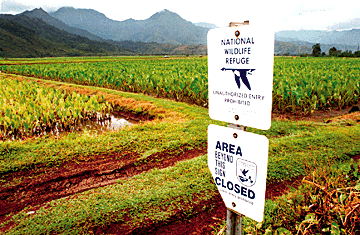
Farmers do gain certain advantages from leasing in the refuge. The fields are free of apple snails, which also eat taro; rent is just $25 per acre; the Fish and Wildlife Service maintains the water delivery system and six farmers receive free housing.
"But when you start plowing under your crop, like one guy did, some of those benefits probably don't start adding up," Dippel said.
Quick doesn't want to leave the refuge, but he's worried about the future. "I don't think we'd be grumbling so much if we could see a way out of this," he said.
Haraguchi is trying to organize the farmers in an effort to seek state or federal compensation for their losses. But that won't change the fact that taro production is way down this year. And bird damage is keeping some fields from being replanted, meaning yields may be low next year also.
"There's definitely going to be a poi shortage," Koga said.
"And it's going to be even worse than last year and right after the hurricane."
Facts about the Hanalei National Wildlife Refuge: Hanalei Refuge facts
Created: 1972
Acres: 917
Acres for taro: 120
Acres for cattle grazing: 80
Taro farmers: Nine
Acres in bird ponds and impoundments: 80-90
Endangered water birds: Coot ('alae ke'oke'o), moorhen ('alae 'ula), stilt (ae'o), Hawaiian duck (koloa)
Wildlife: 49 species of birds, including the four endangered species and 18 introduced species.
Predators: Dogs, cats, rats and bullfrogs
And more . . .
- It has the biggest concentration of native water birds in the state
- Refuge farmers produce about 60 percent of the state's wetland taro crop
- It has been used for wetland agriculture for more than 1,200 years.